

Archive position — measured, not model output
0 likes on Devpost
2,263 of the 7,850 archived projects have more likes, and 5,587 share exactly 0 — so this project's #6,184 place in the like-ranked listing is a tie-break inside that group, not a ranking.
Projects (log scale)
Likes on Devpost. ▲ marks this project's group.
Show the figures
| Likes | Projects | Share of archive |
|---|---|---|
| 0 | 5,587 | 71.2% |
| 1 | 1,758 | 22.4% |
| 2 | 284 | 3.6% |
| 3–4 | 132 | 1.7% |
| 5–9 | 75 | 1.0% |
| 10+ | 14 | 0.2% |
 User Stories BotA demo video on every pull request
Get a demo video on every new feature
GitHub App that watches your pull requests and records a narrated, captioned demo.
Save time on demo prep and make informed decisions faster with a video walkthrough of every new feature.
Executive Summary
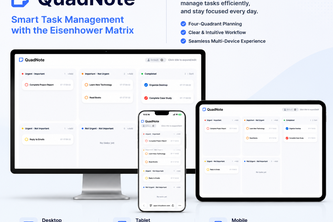
QuadNote is a self-reported browser-based task management tool built around the Eisenhower Matrix. The author states it helps users sort tasks into four quadrants—Urgent & Important, Important but Not Urgent, Urgent but Not Important, and Neither—to prioritize work. It is described as a single-page application with no backend or cloud storage, relying entirely on browser-local data persistence (LocalStorage/IndexedDB). The tool supports keyboard shortcuts, drag-and-drop, and responsive design.
The project was submitted to the OpenAI 2026 hackathon by one developer, Zhizhi Miao. No revenue, customers, or traction are evidenced. The description states that QuadNote is a privacy-first, zero-backend solution with no sign-up required. It is not clear whether it has been released publicly or used beyond its creator.
The single most important open question
Is there any evidence of user adoption or market demand beyond the author’s personal use case?
What The Product Actually Is
- The description states that QuadNote is a browser-based task management tool.
- It is built using modern web technologies, including HTML5, CSS3, JavaScript, and local storage.
- It is described as a single-page application (SPA) with no backend or cloud database.
- It uses the Eisenhower Matrix to categorize tasks into four quadrants.
- The tool supports keyboard shortcuts and drag-and-drop functionality for task management.
- Data is stored locally in the browser using LocalStorage/IndexedDB, without any server-side infrastructure.
Note: This is a self-reported description. No independent verification or demonstration of the product exists beyond the author's account.
Positioning & Claim Evolution
- The author states that QuadNote was built to solve a personal problem: managing tasks across multiple work types (UI design, backend, frontend) with varying urgency levels.
- It is positioned as a lightweight, intuitive, and privacy-focused productivity tool.
- The product claims to offer a clean interface, intuitive task organization, and no sign-up or data privacy concerns.
- The author notes that the tool was inspired by the need for an existing app that could both distinguish urgency levels and function as a to-do list—something they say does not currently exist in the market.
Inference: The positioning appears to be rooted in personal experience rather than market research or user feedback. The lack of evidence for external validation suggests this is a self-asserted claim, not a validated product-market fit.
Target Customer & ICP
- The author states that QuadNote was built for someone who collaborates with multiple colleagues and handles various types of tasks—UI design, backend, frontend—with different urgency levels.
- It is implied to be aimed at individuals or small teams managing personal or project-based workflows.
- No specific customer segments or personas are defined.
Not evidenced: There is no evidence of a defined ICP beyond the author’s own use case. No segmentation or targeting data is provided.
Business Model & Pricing Evidence
- The description states that QuadNote is a privacy-first, zero-backend tool.
- It does not mention any pricing model or monetization strategy.
- The tool is described as free to use, with no sign-up required.
- No evidence of paid features, subscriptions, or commercial partnerships.
Not evidenced: There is no indication of how the product would generate revenue or whether it has a business model beyond personal use.
Technical & Delivery Signals
- QuadNote is built as a purely frontend application using modern web technologies.
- It uses LocalStorage/IndexedDB for data persistence, without any backend or cloud infrastructure.
- The UI is described as responsive, intuitive, and lightweight.
- It supports keyboard shortcuts and drag-and-drop functionality.
- The tool is built with native JavaScript or lightweight libraries.
- Challenges included optimizing state persistence and drag-and-drop responsiveness.
Inference: The technical approach suggests a minimal viable product (MVP) with no scalability or enterprise features. The lack of backend implies limited data sharing or collaboration beyond local use.
Traction & Maturity Signals
- The project was submitted to the OpenAI 2026 hackathon, indicating it is an early-stage prototype.
- It is described as a fully functional MVP that solves a real daily struggle.
- No evidence of user adoption, customer base, or usage metrics is provided.
- The author mentions future plans for cloud sync, task reminders, and team sharing, suggesting the product is still in development.
Not evidenced: There is no evidence of traction, revenue, or user engagement beyond the author’s personal use.
Competitive Context
- The description states that the author searched for an existing app that could both distinguish urgency levels and function as a to-do list but found nothing suitable.
- It is implied that QuadNote is positioned to address a gap in the market for Eisenhower Matrix-based task management tools.
- No mention of direct competitors or competitive analysis.
Not evidenced: There is no evidence of existing products or market landscape. The claim about lack of alternatives is self-reported and unverified.
Open Questions & Risks
- The tool relies entirely on browser-local storage, which limits multi-device access and data backup.
- It has no backend or cloud sync, which may restrict scalability and usability for teams or remote workers.
- The product is described as a single-developer hackathon project, with no evidence of ongoing development or team support.
- The lack of pricing, monetization, or customer data raises questions about its viability as a commercial product.
- No evidence of user feedback, testing, or iteration beyond the author’s own experience.
Inference: The risk of limited adoption is high due to lack of backend, scalability, and market validation. The project appears to be in early development with no clear path to commercialization.
Questions the description leaves open
- What specific user problems does QuadNote solve that existing tools do not?
- Has the tool been tested or used by others beyond the creator?
- Are there any plans for monetization, and how would it scale beyond a single-user model?
- What are the technical limitations of local storage in terms of data persistence and recovery?
- How does the team plan to address the lack of cloud sync and multi-device support?
Overall Assessment
- The project is described as an early-stage MVP built by a single developer.
- It has no evidence of traction, revenue, or customer adoption.
- It is positioned as a privacy-first, zero-backend tool, which may limit its appeal to teams or enterprise users.
- No clear business model or monetization strategy is evident.
Assessment: Not ready for investment or partnership. The project appears to be a personal solution with no demonstrated market demand or commercial viability. Further development and validation are required before any strategic interest can be considered.
User Stories BotA demo video on every pull request
Get a demo video on every new feature
GitHub App that watches your pull requests and records a narrated, captioned demo.
Save time on demo prep and make informed decisions faster with a video walkthrough of every new feature.
Source
Submitted to the OpenAI 2026 hackathon on Devpost. Project home on Devpost. Back to the full gallery on Devpost.
This competitive analysis was produced by top-founders.com (opens in a new tab)
Generated by a language model from this project's public Devpost page — its tagline, the author's own write-up and any built-with tags listed there — as captured in August 2026. Short quotations are the author's words. It is an opinion on the idea as a business, not on the people behind it, and it reflects the description as published then. If the project has moved on, request a correction below. The analysis is not independent research and contains no verified traction, revenue or customer data.
An independent guide by KFG International LLC — not affiliated with, endorsed by, or connected to Devpost or OpenAI.