

Archive position — measured, not model output
1 like on Devpost
505 of the 7,850 archived projects have more likes, and 1,758 share exactly 1 — so this project's #2,260 place in the like-ranked listing is a tie-break inside that group, not a ranking.
Projects (log scale)
Likes on Devpost. ▲ marks this project's group.
Show the figures
| Likes | Projects | Share of archive |
|---|---|---|
| 0 | 5,587 | 71.2% |
| 1 | 1,758 | 22.4% |
| 2 | 284 | 3.6% |
| 3–4 | 132 | 1.7% |
| 5–9 | 75 | 1.0% |
| 10+ | 14 | 0.2% |
 User Stories BotA demo video on every pull request
Get a demo video on every new feature
GitHub App that watches your pull requests and records a narrated, captioned demo.
Save time on demo prep and make informed decisions faster with a video walkthrough of every new feature.
Executive Summary
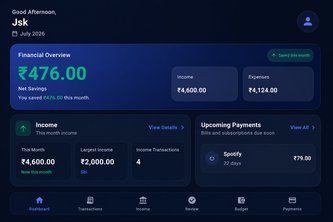
The company appears to be a solo developer project named Zors, an Android personal finance app that automatically tracks expenses and income from payment notifications. The author states the app uses modern Android development practices, including Kotlin, Jetpack Compose, and Room database, with a focus on offline-first architecture. It claims to parse payment notifications, extract transaction details, and provide financial analytics.
What changed: The project was submitted as part of an OpenAI 2026 hackathon, indicating it is in early development or prototype stage. No commercial traction, revenue, or customer data are evidenced.
The single most important open question: Is there any evidence that Zors has moved beyond a proof-of-concept or hackathon prototype to actual user adoption or monetization?
What The Product Actually Is
- The description states: "ZORS was built to automate this process by intelligently detecting payment notifications, extracting transaction details, and organizing them into a clean, offline-first personal finance experience."
- It is described as an Android app that tracks expenses and income from payment notifications.
- Key features include automatic expense detection, income detection, budget management, subscription tracking, financial dashboard, analytics, transaction history, export to PDF/CSV, and local backup/restore.
- The app uses a local database (Room) and follows an offline-first architecture.
- It is built using Kotlin, Jetpack Compose, MVVM architecture, and Android Notification Listener APIs.
Inference: Based on the author's own write-up, Zors is a personal finance application designed to automate transaction logging for Android users. It does not appear to be a commercial product with revenue or customers at this stage.
Positioning & Claim Evolution
- The description states: "An Android personal finance app that automatically tracks expenses and income from payment notifications, manages budgets, monitors subscriptions, and provides insightful financial analytics."
- The author claims the app automates manual expense recording by parsing payment notifications.
- It positions itself as a privacy-focused tool with local data storage.
- It also mentions AI-assisted development but asserts that the app itself is not AI-powered.
Inference: Zors positions itself as a privacy-conscious, offline-first personal finance automation tool. The claim of automation is self-reported and unverified; no evidence of actual user adoption or performance metrics are provided.
Target Customer & ICP
- The description states: "Managing personal finances manually is time-consuming, and many people forget to record everyday expenses."
- It targets users who want to automate their expense tracking.
- The app is built for Android users, specifically those using payment methods that generate notifications (e.g., banks, UPI apps).
- No specific demographic or user segment is identified.
Inference: The target customer appears to be Android users who manually track expenses and seek automation. However, no evidence of actual users or market segmentation exists.
Business Model & Pricing Evidence
- The description states: "All user data is stored locally on the device to prioritize privacy."
- No pricing information, monetization strategy, or business model is mentioned.
- There is no indication of paid features, subscriptions, or in-app purchases.
- The app is described as a standalone personal finance tool with no mention of enterprise or B2B use.
Inference: No evidence of a business model or pricing structure. The app seems to be a free, offline-first tool without any commercial revenue streams.
Technical & Delivery Signals
- Built using Kotlin, Jetpack Compose, MVVM architecture, Room database, and Android Notification Listener APIs.
- Uses modern Android development practices including Material Design 3.
- The app is described as fully offline-first with local data storage.
- AI tools (GPT-5.6, OpenAI Codex) were used during development but not in the final product.
Inference: The technical stack and architecture suggest a well-structured, modern Android application. However, no evidence of production deployment or scalability beyond a prototype is provided.
Traction & Maturity Signals
- The project was submitted to an OpenAI 2026 hackathon.
- No evidence of user adoption, downloads, revenue, or customer base.
- No mention of app store presence, beta testing, or user feedback.
- The author states the app is a prototype built in a hackathon.
Inference: There is no evidence of traction or maturity beyond a hackathon submission. No commercial metrics or user engagement data are available.
Competitive Context
- The description does not mention any competitors.
- No market analysis, competitive positioning, or differentiation strategy is provided.
- It is unclear whether similar apps already exist in the personal finance space for Android.
Inference: No evidence of competitive landscape or market positioning. The app's place in the broader market is unknown.
Open Questions & Risks
- The app is described as a solo developer project with no team or funding.
- It is built for Android only, limiting its reach.
- Reliance on parsing payment notifications from various banks and UPI apps may be technically challenging and inconsistent.
- No evidence of monetization, user base, or long-term sustainability.
- AI tools were used in development but not integrated into the app itself.
Inference: Risks include technical limitations, lack of scalability, no commercial viability, and limited market reach. The project is unproven beyond a prototype.
Questions the description leaves open
- What is the actual user adoption rate or feedback for Zors?
- Has the app been tested with real users or only in development?
- Are there plans to monetize the app, and if so, how?
- How does it handle edge cases like notifications from different banks or UPI apps?
- What is the long-term roadmap beyond the hackathon prototype?
- Is there any plan for cloud synchronization or multi-device support?
Overall Assessment
- The project is described as a solo developer hackathon submission.
- No evidence of revenue, customers, or traction exists.
- It is not evident that Zors has moved beyond a prototype or proof-of-concept stage.
- The app is not monetized and lacks commercial viability indicators.
Inference: Based on the self-reported description alone, there is no evidence to support investment or partnership interest. The project appears to be in early development with no demonstrated commercial traction or scalability.
User Stories BotA demo video on every pull request
Get a demo video on every new feature
GitHub App that watches your pull requests and records a narrated, captioned demo.
Save time on demo prep and make informed decisions faster with a video walkthrough of every new feature.
Source
Submitted to the OpenAI 2026 hackathon on Devpost. Project home on Devpost. Back to the full gallery on Devpost.
This competitive analysis was produced by top-founders.com (opens in a new tab)
Generated by a language model from this project's public Devpost page — its tagline, the author's own write-up and any built-with tags listed there — as captured in August 2026. Short quotations are the author's words. It is an opinion on the idea as a business, not on the people behind it, and it reflects the description as published then. If the project has moved on, request a correction below. The analysis is not independent research and contains no verified traction, revenue or customer data.
An independent guide by KFG International LLC — not affiliated with, endorsed by, or connected to Devpost or OpenAI.