

Archive position — measured, not model output
1 like on Devpost
505 of the 7,850 archived projects have more likes, and 1,758 share exactly 1 — so this project's #2,262 place in the like-ranked listing is a tie-break inside that group, not a ranking.
Projects (log scale)
Likes on Devpost. ▲ marks this project's group.
Show the figures
| Likes | Projects | Share of archive |
|---|---|---|
| 0 | 5,587 | 71.2% |
| 1 | 1,758 | 22.4% |
| 2 | 284 | 3.6% |
| 3–4 | 132 | 1.7% |
| 5–9 | 75 | 1.0% |
| 10+ | 14 | 0.2% |
 User Stories BotA demo video on every pull request
Get a demo video on every new feature
GitHub App that watches your pull requests and records a narrated, captioned demo.
Save time on demo prep and make informed decisions faster with a video walkthrough of every new feature.
Executive Summary
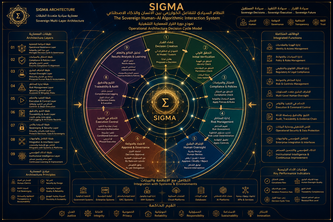
The company appears to be a single-inventor project submitted to the OpenAI 2026 hackathon. The author describes an engineering architecture called SIGMA (Sovereign Algorithmic Human–AI Interaction System) that governs AI decision-making through a pre-execution workflow integrating governance, compliance, verification, risk management, documentation, and human oversight.
The innovation is presented as a sovereign operational framework for AI governance, designed to be model-agnostic and integrable with existing AI systems without replacement of infrastructure. The author states the system was internationally filed under the Patent Cooperation Treaty (PCT) and published under WO2026/071935.
The single most important open question is: What is the actual technical implementation of SIGMA, and how does it differ from existing AI governance or compliance frameworks?
What The Product Actually Is
The description states that SIGMA is an "engineering innovation" that provides a sovereign operational architecture for governing the execution of artificial intelligence systems. It integrates governance, compliance, verification, risk management, documentation, evidence preservation, traceability, and human oversight within a pre-execution operational workflow.
The system is described as:
- A "sovereign governance layer positioned between AI systems and execution environments"
- An independent architecture that operates above existing AI models
- Model-agnostic, allowing integration with different AI engines without dependency on specific vendors or technologies
- Designed to enhance reliability, accountability, transparency, and trustworthiness of AI operations
It is not evidenced whether SIGMA is a software product, a protocol, an architecture specification, or a conceptual framework. The description does not specify implementation details, technical stack, or deployment mechanisms.
Positioning & Claim Evolution
The author positions SIGMA as:
- A sovereign operational governance infrastructure for AI prior to execution
- An engineering solution that embeds governance directly into the operational lifecycle of AI systems
- A system that "transforms artificial intelligence from a system that produces directly executable decisions into a sovereign human-governed operational decision system"
Claims include:
- SIGMA enables responsible and structured deployment of AI systems
- It supports auditable and traceable management of entire operational decision lifecycles
- It is designed to be compatible with current and future technological ecosystems
- It addresses global challenges in AI governance, such as lack of transparency, weak traceability, insufficient human oversight, and compliance with evolving regulations
The positioning evolves from a technical architecture to a governance framework that aligns with international regulatory trends like the EU AI Act and UNESCO Recommendation on the Ethics of Artificial Intelligence.
Target Customer & ICP
The description states SIGMA is intended for:
- Government entities
- Sovereign institutions
- Regulatory authorities
- Defense and security organizations
- Financial institutions
- Healthcare organizations
- Industrial and manufacturing enterprises
- Energy and utilities providers
- Transportation and logistics organizations
- Smart cities
- Critical infrastructure operators
- AI technology providers
- Large enterprises
The target customer profile appears to be organizations operating AI in mission-critical environments, with a focus on those requiring high levels of governance, compliance, and auditability.
There is no evidence of specific use cases, customer segments, or market prioritization beyond the broad categories listed.
Business Model & Pricing Evidence
Not evidenced. The description does not mention any pricing model, licensing terms, monetization strategy, or commercialization approach.
Technical & Delivery Signals
The description states:
- SIGMA is designed as a fully model-agnostic architecture
- It operates as an independent governance layer positioned above existing AI systems
- It supports non-invasive deployment, requiring no redesign of enterprise systems or replacement of operational infrastructure
- It enables phased deployment strategies for gradual adoption
- It integrates cybersecurity, documentation, auditability, and lifecycle recording capabilities
There is no evidence regarding:
- Implementation details (e.g., code, APIs, protocols)
- Technical architecture diagrams
- Deployment mechanisms
- Performance metrics or scalability claims
- Integration with existing AI platforms or tools
Traction & Maturity Signals
Not evidenced. The description does not mention any:
- Revenue or ARR
- Customers or pilot programs
- Product usage or adoption data
- Market traction or user feedback
- Funding rounds or investor involvement
- Product development milestones or release history
The only maturity signal is that the invention was internationally filed under PCT and published under WO2026/071935, but this does not indicate product development or commercialization.
Competitive Context
The description states that SIGMA responds to:
- Global regulatory frameworks such as the EU AI Act and UNESCO Recommendation on the Ethics of Artificial Intelligence
- A global transition toward trustworthy and governed AI
It is implied that SIGMA addresses a gap in current AI governance, where:
- AI outputs are executed directly without sufficient oversight
- Governance is fragmented or applied post-execution
- Compliance and auditability are lacking
No specific competitors or competitive positioning are mentioned.
Open Questions & Risks
- Lack of commercial evidence: No revenue, customers, or traction data.
- Unproven implementation: The description does not provide technical details or a working prototype.
- Unclear differentiation: It is unclear how SIGMA differs from existing AI governance tools or frameworks.
- Single-inventor project: With only one team member, there may be limited capacity for execution or scaling.
- High-level claims without proof: Many assertions about reliability, accountability, and trustworthiness are not substantiated with evidence.
- No pricing or monetization strategy: The business model remains undefined.
Questions the description leaves open
- What is the actual technical architecture of SIGMA? Can you provide a diagram or specification?
- How does SIGMA differ from existing AI governance tools or frameworks in the market?
- Have you built a prototype or proof-of-concept for SIGMA?
- What are the specific integration mechanisms with existing AI systems or platforms?
- What is the timeline and roadmap for commercialization?
- Are there any pilot users or early adopters of SIGMA?
- How does SIGMA handle performance overhead in real-time decision-making?
- What are the key assumptions underlying the PCT filing, and how do they align with current regulatory trends?
Overall Assessment
Not evidenced. The description provides no information on:
- Financials or valuation
- Funding history or investor interest
- Strategic partnerships or alliances
- Go-to-market strategy
- Commercial viability or scalability
The project is presented as a conceptual engineering innovation, not a product or business. It has not demonstrated traction, revenue, or customer adoption beyond the author's own description.
This is a pre-commercial, pre-product initiative submitted to a hackathon, with no evidence of operational readiness or market validation. Any investment or partnership decision would require further due diligence into technical feasibility, commercialization strategy, and competitive positioning.
User Stories BotA demo video on every pull request
Get a demo video on every new feature
GitHub App that watches your pull requests and records a narrated, captioned demo.
Save time on demo prep and make informed decisions faster with a video walkthrough of every new feature.
Source
Submitted to the OpenAI 2026 hackathon on Devpost. Project home on Devpost. Back to the full gallery on Devpost.
This competitive analysis was produced by top-founders.com (opens in a new tab)
Generated by a language model from this project's public Devpost page — its tagline, the author's own write-up and any built-with tags listed there — as captured in August 2026. Short quotations are the author's words. It is an opinion on the idea as a business, not on the people behind it, and it reflects the description as published then. If the project has moved on, request a correction below. The analysis is not independent research and contains no verified traction, revenue or customer data.
An independent guide by KFG International LLC — not affiliated with, endorsed by, or connected to Devpost or OpenAI.