

Archive position — measured, not model output
0 likes on Devpost
2,263 of the 7,850 archived projects have more likes, and 5,587 share exactly 0 — so this project's #6,188 place in the like-ranked listing is a tie-break inside that group, not a ranking.
Projects (log scale)
Likes on Devpost. ▲ marks this project's group.
Show the figures
| Likes | Projects | Share of archive |
|---|---|---|
| 0 | 5,587 | 71.2% |
| 1 | 1,758 | 22.4% |
| 2 | 284 | 3.6% |
| 3–4 | 132 | 1.7% |
| 5–9 | 75 | 1.0% |
| 10+ | 14 | 0.2% |
 User Stories BotA demo video on every pull request
Get a demo video on every new feature
GitHub App that watches your pull requests and records a narrated, captioned demo.
Save time on demo prep and make informed decisions faster with a video walkthrough of every new feature.
Executive Summary
What the company appears to be
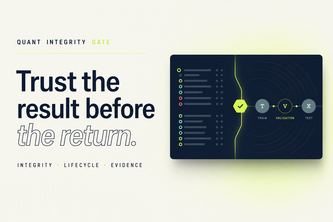
Quant Integrity Gate is a self-reported tool for quant research governance, designed to detect flaws in backtesting workflows before flawed results advance. It operates as a local application with two connected modules: "Integrity Gate" and "Setup Lifecycle Gate". The author states it uses Python, vanilla HTML/CSS/JS, and OpenAI models (Codex, GPT-5.6) for development.
What changed
The project was built during the OpenAI Build Week hackathon in July 2026. It is a self-contained local tool with no external dependencies or runtime packages, using synthetic data only.
Single most important open question
Is there any evidence of real-world usage, adoption or integration into actual quant research pipelines beyond this prototype?
What The Product Actually Is
The description states that Quant Integrity Gate consists of two modules:
- Integrity Gate: Inspects trade CSVs for:
- Exact duplicate rows;
- Economically equivalent trades;
- Repeated source events;
- Leakage across train/validation/test splits;
- Distortion in performance metrics.
It generates row-level evidence, portable HTML reports, JSON evidence, and cleaned canonical CSVs.
- Setup Lifecycle Gate: Evaluates synthetic candidate summaries across:
- Exploration;
- Out-of-sample review;
- Forward-paper confirmation.
Nine deterministic controls assess sample sufficiency, fold stability, regime concentration, performance retention, drawdown expansion, profit-factor stability, and cost drift.
Candidates receive one of three statuses: READY_FOR_PAPER_REVIEW, REVIEW, or REJECT. Progression is sequential — if a phase fails, later phases are marked BLOCKED but diagnostic evidence remains visible.
The tool exports artifacts in HTML, JSON, and CSV formats with consistent metadata (analysis_id, analyzed_at, policy identifier).
Evidence strength Self-reported only. No revenue, customers, or traction data provided.
Positioning & Claim Evolution
The author claims the tool addresses a core issue in quant research: that backtests can appear profitable yet be untrustworthy due to:
- Duplicate trades;
- Repeated events;
- Leakage across splits;
- Unstable setup progression.
It positions itself as an audit-ready governance tool, not a trading system or signal generator. The author emphasizes reproducibility and transparency of decision-making.
The claim evolution shows a shift from general problem identification (backtests can be flawed) to specific solution design (a two-gate framework with evidence export).
Evidence strength Self-reported. No external validation or market positioning data.
Target Customer & ICP
Not evidenced.
The description does not name target customers, nor does it describe any segmentation strategy or ideal customer profile (ICP). It only describes the tool's functionality and use case within a research context.
Business Model & Pricing Evidence
Not evidenced.
There is no mention of pricing models, monetization strategies, or business structure. The tool is described as a local application with no external integrations or commercial features.
Technical & Delivery Signals
The tool is built using:
- Python standard library;
- Vanilla HTML/CSS/JS for UI;
- Codex and GPT-5.6 for architecture and implementation support;
- No third-party runtime dependencies;
- Unit and integration tests (37 total);
- Fully synthetic demonstrations with no sensitive data.
It supports:
- Row-level evidence generation;
- Portable audit artifacts (HTML, JSON, CSV);
- Deterministic decision-making;
- Provenance tracking across exports.
Evidence strength Self-reported. No independent verification of technical claims or delivery quality.
Traction & Maturity Signals
Not evidenced.
There is no evidence of revenue, customers, user base, or product adoption beyond the author’s own prototype. The project is described as a hackathon submission with synthetic data and zero external dependencies.
Competitive Context
Not evidenced.
No mention of competitors, market landscape, or how this tool compares to existing solutions in quant research governance or backtesting quality control.
Open Questions & Risks
- Prototype-only: The tool is described as a hackathon prototype with no real-world usage.
- No external dependencies: While this may be a strength for security, it also implies limited scalability or integration capability.
- Self-reported only: All claims are unverified; there is no third-party validation of functionality or effectiveness.
- No commercialization path: No indication of how the tool would transition from prototype to product or service.
- Single-person team: The entire project was built by one person, raising questions about long-term maintenance and development capacity.
Questions the description leaves open
- What specific quant research workflows does this tool aim to integrate into?
- Has it been tested in real-world scenarios beyond the synthetic examples?
- Are there plans to support external data sources or APIs for integration?
- How would you scale this from a single-person prototype to a product with multiple users?
- What is your roadmap for monetization or commercial viability?
Overall Assessment
Not evidenced.
There is no evidence of traction, revenue, or customer interest beyond the author’s own description. The tool is presented as a hackathon prototype with no indication of market readiness or commercial potential. Any investment or partnership decision would require further validation of real-world utility and adoption.
User Stories BotA demo video on every pull request
Get a demo video on every new feature
GitHub App that watches your pull requests and records a narrated, captioned demo.
Save time on demo prep and make informed decisions faster with a video walkthrough of every new feature.
Source
Submitted to the OpenAI 2026 hackathon on Devpost. Project home on Devpost. Back to the full gallery on Devpost.
This competitive analysis was produced by top-founders.com (opens in a new tab)
Generated by a language model from this project's public Devpost page — its tagline, the author's own write-up and any built-with tags listed there — as captured in August 2026. Short quotations are the author's words. It is an opinion on the idea as a business, not on the people behind it, and it reflects the description as published then. If the project has moved on, request a correction below. The analysis is not independent research and contains no verified traction, revenue or customer data.
An independent guide by KFG International LLC — not affiliated with, endorsed by, or connected to Devpost or OpenAI.