

Archive position — measured, not model output
0 likes on Devpost
2,263 of the 7,850 archived projects have more likes, and 5,587 share exactly 0 — so this project's #6,182 place in the like-ranked listing is a tie-break inside that group, not a ranking.
Projects (log scale)
Likes on Devpost. ▲ marks this project's group.
Show the figures
| Likes | Projects | Share of archive |
|---|---|---|
| 0 | 5,587 | 71.2% |
| 1 | 1,758 | 22.4% |
| 2 | 284 | 3.6% |
| 3–4 | 132 | 1.7% |
| 5–9 | 75 | 1.0% |
| 10+ | 14 | 0.2% |
 User Stories BotA demo video on every pull request
Get a demo video on every new feature
GitHub App that watches your pull requests and records a narrated, captioned demo.
Save time on demo prep and make informed decisions faster with a video walkthrough of every new feature.
Executive Summary
What the company appears to be
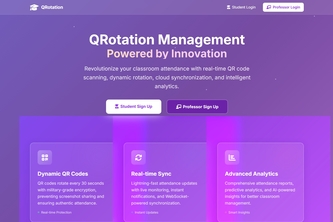
QRotation is a self-reported privacy-first attendance platform for colleges, built as a hackathon project. The author describes it as a system that uses rotating QR codes with cryptographic signing to prevent proxy and screenshot fraud, with real-time sync, explainable presence scoring, and offline syncing capabilities.
What changed
This is a single-person hackathon project submitted to the OpenAI 2026 hackathon. No commercial traction or product development beyond this prototype is evidenced.
The single most important open question
Is there any evidence of actual deployment, usage, or revenue generation from QRotation? The description states no such evidence exists.
What The Product Actually Is
The description states that QRotation is a privacy-first attendance platform for colleges. It uses rotating QR codes that expire every few seconds and are server-signed with HMAC. Students scan these codes via a Progressive Web App (PWA), and the backend verifies tokens, device binding, IP behavior, and geofencing before marking attendance. Attendance records include explainable presence scores, and suspicious scans are routed to a fraud review queue.
The system includes offline syncing capabilities, where scan payloads are encrypted and queued locally, then synced once network connectivity is restored. The backend is built with Flask and SQLAlchemy, and the frontend uses Jinja2 and Tailwind CSS.
Evidence Self-reported by author; no independent verification or product screenshots provided.
Positioning & Claim Evolution
The description states that QRotation was built to address proxy attendance fraud on college campuses, where static QR codes are easily shared. The platform positions itself as a solution that "kills proxy & screenshot fraud" through real-time sync, explainable presence scoring, and offline syncing.
It claims to be privacy-first and designed to prevent the same broken paper process from being digitized, instead closing loopholes in attendance tracking.
Evidence Self-reported claims about positioning and intent. No evidence of market validation or customer feedback.
Target Customer & ICP
The description states that QRotation is intended for colleges and academic institutions. It targets professors, students, and administrators who manage attendance data.
Evidence Self-reported; no evidence of actual customers or institutional partnerships.
Business Model & Pricing Evidence
The description does not provide any information about pricing, monetization, or business model. The author mentions future plans to integrate with campus ERPs and build a Docker Compose setup for production-grade deployments, but no commercial details are shared.
Evidence Not evidenced.
Technical & Delivery Signals
The system is built using Flask, SQLAlchemy, PostgreSQL, Redis, and JavaScript technologies. It uses HMAC-sha512 for token signing, service workers for offline support, and Flask-SocketIO for real-time updates. The frontend is server-rendered with Jinja2 and Tailwind CSS, and the scanner page is a PWA.
The author notes challenges in balancing token rotation window, making fraud signals explainable, and building reliable offline support.
Evidence Self-reported technical stack and implementation details; no evidence of production deployment or performance data.
Traction & Maturity Signals
There is no evidence of traction, revenue, customers, or adoption beyond the single-person hackathon project. The description states that this was submitted to a hackathon and does not mention any live usage or institutional rollouts.
Evidence Not evidenced.
Competitive Context
The description does not provide information about competitors or market positioning relative to existing attendance systems. No mention of similar tools or platforms in the market is made.
Evidence Not evidenced.
Open Questions & Risks
- Single-person development: The project was built by one individual, raising questions about scalability and long-term maintenance.
- No commercial traction: There is no evidence of product-market fit, customer adoption, or revenue generation.
- Unverified claims: All claims are self-reported without independent verification.
- Hackathon prototype: The system is described as a hackathon submission, not a production-ready product.
Evidence Inferred from lack of evidence and description alone.
Questions the description leaves open
- Has QRotation been tested or deployed in any real-world college setting?
- What is the current status of the project beyond the hackathon prototype?
- Are there any existing partnerships with colleges or educational institutions?
- How does the system handle edge cases like time synchronization across devices?
- What are the plans for monetization and scaling beyond a PWA?
Inference Based on lack of evidence, these questions aim to uncover commercial viability and real-world usage.
Overall Assessment
There is no evidence of revenue, customers, or product-market fit. The project is described as a hackathon submission with no indication of commercial traction or development beyond prototype stage.
Confidence Low. This is a single-person, self-reported project with no verified data on adoption, usage, or financials.
Assessment Not ready for investment or partnership consideration without further evidence of product-market fit, traction, or commercial viability.
User Stories BotA demo video on every pull request
Get a demo video on every new feature
GitHub App that watches your pull requests and records a narrated, captioned demo.
Save time on demo prep and make informed decisions faster with a video walkthrough of every new feature.
Source
Submitted to the OpenAI 2026 hackathon on Devpost. Project home on Devpost. Back to the full gallery on Devpost.
This competitive analysis was produced by top-founders.com (opens in a new tab)
Generated by a language model from this project's public Devpost page — its tagline, the author's own write-up and any built-with tags listed there — as captured in August 2026. Short quotations are the author's words. It is an opinion on the idea as a business, not on the people behind it, and it reflects the description as published then. If the project has moved on, request a correction below. The analysis is not independent research and contains no verified traction, revenue or customer data.
An independent guide by KFG International LLC — not affiliated with, endorsed by, or connected to Devpost or OpenAI.