

Archive position — measured, not model output
0 likes on Devpost
2,263 of the 7,850 archived projects have more likes, and 5,587 share exactly 0 — so this project's #6,172 place in the like-ranked listing is a tie-break inside that group, not a ranking.
Projects (log scale)
Likes on Devpost. ▲ marks this project's group.
Show the figures
| Likes | Projects | Share of archive |
|---|---|---|
| 0 | 5,587 | 71.2% |
| 1 | 1,758 | 22.4% |
| 2 | 284 | 3.6% |
| 3–4 | 132 | 1.7% |
| 5–9 | 75 | 1.0% |
| 10+ | 14 | 0.2% |
 User Stories BotA demo video on every pull request
Get a demo video on every new feature
GitHub App that watches your pull requests and records a narrated, captioned demo.
Save time on demo prep and make informed decisions faster with a video walkthrough of every new feature.
Executive Summary
What the company appears to be
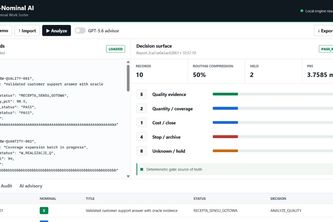
Q-Nominal AI is a self-reported project that describes itself as a deterministic triage system for AI work queues. It sorts workflow records into five nominal lanes (1–5, 4, 8) based on evidence and quality-first ordering. It uses GPT-5.6 only for advisory explanations of unknown records, never to make operational decisions.
What changed
The project was extracted from a larger experimental system called Matrix 12, with refactored components into a standalone Python package. It supports local dashboard, CLI, API, Windows Edge app, and Docker container deployment. The core logic is deterministic and offline-capable, with optional GPT-5.6 integration for ambiguity analysis.
Single most important open question
Is there any evidence of real-world usage or adoption beyond the author’s own demo and development environment?
Note: This analysis is based solely on the self-reported project description provided by the caller. No external verification, revenue data, customer names, or traction metrics are available. All claims are treated as stated by the author, not proven.
What The Product Actually Is
The description states that Q-Nominal AI is a system for sorting workflow records into five nominal lanes (1–5, 4, 8) using deterministic logic based on identity, duplicates, provenance, and evidence. It includes:
- A deterministic engine that checks these criteria.
- A multilevel audit process producing reproducible JSON reports.
- Optional GPT-5.6 integration for held records (unknown status), which provides explanations but never overrides or executes decisions.
- Deployment options: local dashboard, CLI, API, Windows Edge app, Docker container.
- The deterministic core works offline with no third-party dependencies.
The system was built from a larger experimental framework called Matrix 12 and refactored into a standalone Python package using standard library tools and optional adapters.
Inference: The product is described as a triage engine for AI workloads, not a general-purpose AI assistant or LLM interface. It emphasizes control over generative outputs.
Positioning & Claim Evolution
The author positions Q-Nominal AI as a system that:
- Keeps semantic help from language models while making the control boundary explicit.
- Prioritizes deterministic evidence over model-generated decisions.
- Avoids silent deletion and ensures auditability through reproducible reports.
- Uses GPT-5.6 only for advisory purposes, never to make operational choices.
It is described as a “fail-closed” triage system — meaning it does not allow AI models to override or pass unknown statuses automatically.
Claim: The product aims to reduce audit gaps in AI workflows by separating decision-making from generative interpretation.
Inference: This reflects an evolution from general-purpose AI tools toward more controlled, explainable systems with clear operational boundaries.
Target Customer & ICP
The description does not name specific customers or target industries. However, it implies use cases in environments where:
- AI workflows involve verified outputs, unfinished tasks, cost observations, failures, and new statuses.
- There is a need for auditability and control over how decisions are made.
- Users may be developers, data engineers, or operations teams managing complex AI pipelines.
The system supports local deployment and offline use, suggesting it might appeal to organizations with strict compliance or security requirements.
Claim: The product targets users who want deterministic control in AI workflows while still leveraging generative models for explanation.
Not evidenced: No explicit customer segments, personas, or use cases beyond the author’s own development context.
Business Model & Pricing Evidence
There is no evidence of pricing, monetization strategy, or business model in the description. The project is presented as a standalone tool built during a hackathon and made available via GitHub.
Claim: No commercial model or pricing structure is described.
Not evidenced: No indication of revenue streams, subscriptions, licensing, or paid features.
Technical & Delivery Signals
The system is built with:
- Python (standard library)
- HTML/CSS/JS for UI
- OpenAI API integration (GPT-5.6) used only for advisory explanations
- Local HTTP server and CLI support
- Docker containerization
- Optional adapters for runtime-specific imports
- Reproducible JSON reports
It runs offline with no third-party dependencies, and GPT-5.6 is explicitly restricted from creating PASS decisions.
Claim: The system supports multiple deployment modes (local, CLI, API, Edge, Docker).
Inference: The architecture suggests modularity and portability, but no evidence of scalability or production-grade infrastructure.
Traction & Maturity Signals
The project is described as a hackathon submission (OpenAI 2026) and includes:
- A demo script
- Reproducible benchmarks
- Documentation for judge testing and AI impact analysis
- A GitHub repository with source code and instructions
However, there is no evidence of real-world usage, customer feedback, or adoption beyond the author’s own environment.
Claim: The system has been tested in a demo and benchmarked against prior versions.
Not evidenced: No user base, production metrics, or external validation.
Competitive Context
The description does not mention competitors or direct market positioning. It is implied that Q-Nominal AI addresses a gap in AI workflow management where control and auditability are prioritized over automation.
Inference: The product may compete with general-purpose AI triage tools or workflow orchestration platforms, but no explicit comparison is made.
Not evidenced: No competitive landscape, pricing, or differentiation from other systems.
Open Questions & Risks
- No real-world usage: The system appears to exist only in a demo or development context.
- Unproven impact claims: While benchmarks show reduced GPT input and payload size, no live API usage or production savings are measured.
- Limited scope: The project is described as a single-person effort with no team or external support.
- No commercial viability: No pricing, monetization, or business model is evident.
Inference: The product may be an experimental prototype rather than a scalable solution.
Questions the description leaves open
- What specific AI workflow problems does this system solve in practice?
- Has it been tested with real data from actual users or teams?
- Are there any plans to integrate with existing enterprise systems (e.g., Jira, Slack)?
- How is the deterministic logic validated and maintained over time?
- What are the long-term goals for scalability and production use?
- Is there a roadmap for expanding beyond the current five nominal lanes?
Overall Assessment
This project is described as an experimental hackathon submission with no evidence of traction, revenue, or customer adoption. It presents a technical solution to a niche problem — deterministic triage in AI workflows — but lacks commercial viability indicators.
Assessment: Not ready for investment or partnership at this stage. The product shows potential for further development but requires real-world testing and clear business alignment before it can be considered a viable commercial offering.
User Stories BotA demo video on every pull request
Get a demo video on every new feature
GitHub App that watches your pull requests and records a narrated, captioned demo.
Save time on demo prep and make informed decisions faster with a video walkthrough of every new feature.
Source
Submitted to the OpenAI 2026 hackathon on Devpost. Project home on Devpost. Back to the full gallery on Devpost.
This competitive analysis was produced by top-founders.com (opens in a new tab)
Generated by a language model from this project's public Devpost page — its tagline, the author's own write-up and any built-with tags listed there — as captured in August 2026. Short quotations are the author's words. It is an opinion on the idea as a business, not on the people behind it, and it reflects the description as published then. If the project has moved on, request a correction below. The analysis is not independent research and contains no verified traction, revenue or customer data.
An independent guide by KFG International LLC — not affiliated with, endorsed by, or connected to Devpost or OpenAI.