

Archive position — measured, not model output
1 like on Devpost
505 of the 7,850 archived projects have more likes, and 1,758 share exactly 1 — so this project's #2,248 place in the like-ranked listing is a tie-break inside that group, not a ranking.
Projects (log scale)
Likes on Devpost. ▲ marks this project's group.
Show the figures
| Likes | Projects | Share of archive |
|---|---|---|
| 0 | 5,587 | 71.2% |
| 1 | 1,758 | 22.4% |
| 2 | 284 | 3.6% |
| 3–4 | 132 | 1.7% |
| 5–9 | 75 | 1.0% |
| 10+ | 14 | 0.2% |
 User Stories BotA demo video on every pull request
Get a demo video on every new feature
GitHub App that watches your pull requests and records a narrated, captioned demo.
Save time on demo prep and make informed decisions faster with a video walkthrough of every new feature.
Executive Summary
What the company appears to be
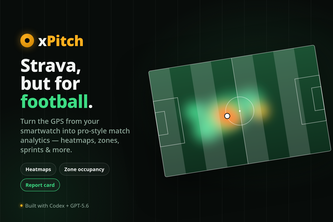
xPitch is a self-reported tool that processes .fit files from smartwatches worn during football (soccer) matches to generate player analytics including heatmaps, positional zones, movement trails, and performance metrics. It claims to offer a Strava-like experience for football players, but tailored to the sport’s unique dynamics.
What changed
The project was built as a hackathon submission by one developer (Ismail Sunni), using AI-assisted development tools like Codex. The author states it evolved from a prototype into a complete product with local-first analysis, cloud storage, and social sharing features — all deployed on GitHub Pages without paid infrastructure.
Single most important open question
Is there any evidence of user adoption or traction beyond the founder’s personal use and friends’ feedback? The description does not provide data on users, revenue, or market validation.
What The Product Actually Is
The description states that xPitch:
- Processes .fit files from smartwatches worn during football matches.
- Generates insights such as positional heatmaps, zone occupancy, movement trails, distance covered, sprints, HR zones, and role estimates.
- Uses a browser-based .fit decoder with no upload required for initial analysis.
- Allows users to save matches to the cloud (via Supabase), share via public link, or export images for social media.
- Includes semi-automatic session splitting based on heart rate data.
- Estimates pitch orientation using either user input or PCA-based methods.
It is described as a tool that turns raw GPS and HR data into football-specific visualizations and reports — with an emphasis on privacy (local processing) and ease of use (no upload needed for core analysis).
Inference The product appears to be a lightweight, single-user analytics platform built around the idea of making personal football performance data accessible in a way similar to how Strava presents running data.
Positioning & Claim Evolution
The description states that xPitch is:
- “Strava for football player”
- Designed to analyze football matches like professional breakdowns on TV — heatmaps, positional zones, sprint counts, heart-rate load.
- Built around how football actually works (stop-start, multi-directional, played in halves).
- Aims to provide a “football-specific” experience that Strava lacks.
The author also notes:
- The tool was built with AI assistance (Codex), which accelerated development.
- It started as a prototype and evolved into a full product loop.
- It works for personal use and has been tested by friends, who requested accounts.
Inference Positioning is centered on offering a niche, privacy-focused analytics solution for amateur football players. The claim of being “Strava for football” suggests an intent to capture a segment of the market that lacks dedicated tools — but no evidence exists of actual adoption or competitive positioning beyond self-reporting.
Target Customer & ICP
The description states:
- xPitch is aimed at football players who want to analyze their own performance using smartwatch data.
- It targets those who play regularly and care about metrics like distance, sprints, HR zones, and role estimation.
- Friends have asked for accounts, suggesting early interest from a small group of users.
Inference The ICP appears to be amateur or semi-professional football players with access to smartwatches and .fit files. No evidence exists of segmentation beyond this, nor any indication of whether the tool targets coaches, teams, or clubs.
Business Model & Pricing Evidence
The description states:
- Matches can be saved to the cloud using Supabase.
- Users can share matches via public links or export images for social media.
- The author mentions a future goal to open it up to everyone — implying a potential freemium or open-access model.
- No pricing information, monetization strategy, or revenue streams are mentioned.
Inference There is no clear business model evidenced. The tool seems to be free to use for personal purposes, with possible future monetization through cloud features or expanded integrations. The lack of any pricing or commercial structure makes it difficult to assess scalability or sustainability.
Technical & Delivery Signals
The description states:
- Built using canvas, GitHub, OpenLayers, PostgreSQL, Supabase, TypeScript, Vite, Vue.
- Uses a local-first .fit parser that decodes binary data entirely in the browser.
- Implements custom logic for pitch geometry and orientation estimation (PCA).
- Includes semi-automatic session splitting based on HR signal.
- Deployed on GitHub Pages with no paid infrastructure.
- Developed using AI tools like Codex to accelerate development.
Inference The technical stack is lightweight, modern, and focused on client-side processing. The use of AI for rapid prototyping and refactoring suggests a lean engineering approach. However, there is no evidence of scalability, performance testing, or production-grade infrastructure beyond GitHub Pages.
Traction & Maturity Signals
The description states:
- The founder has been using the tool to track his own matches.
- Friends have asked for accounts.
- A small amount of historical data exists (from two matches).
- The author notes that he doesn’t yet have enough data for meaningful analysis — “unfortunately, I only play twice since I build this project.”
Inference There is minimal traction or user adoption evidenced. The tool appears to be in early stages of development and personal use only. No metrics on active users, retention, or engagement are provided.
Competitive Context
The description states:
- xPitch aims to fill a gap left by Strava, which treats football like a jog.
- It is positioned as a more accurate analytics tool for football players.
- No mention of direct competitors or market analysis.
Inference There is no evidence of competitive landscape analysis. The author does not name other tools or platforms in the space, nor does he describe how xPitch differentiates from them. This leaves open whether such a niche exists or if there are existing solutions already addressing this need.
Open Questions & Risks
- No user data or adoption metrics: The tool is described as personal use only with no evidence of broader traction.
- Single-person development: Only one developer (the founder) is involved, raising questions about scalability and long-term maintenance.
- Limited data sources: Relies solely on .fit files from smartwatches; lacks camera or ball tracking data.
- Unproven commercial viability: No pricing model, monetization strategy, or revenue path described.
- No third-party validation: The tool is self-reported with no external verification of performance or accuracy.
Inference The project is in a very early stage and lacks any signs of market traction or business maturity. It may be a proof-of-concept rather than a scalable product.
Questions the description leaves open
- What percentage of your time was spent on AI-assisted development versus traditional coding?
- How many users have you personally tested the tool with, and what feedback did they give?
- Are there any plans to integrate with specific smartwatch brands or platforms (e.g., Garmin)?
- Has the tool been tested under various match conditions (e.g., different pitches, weather, formats)?
- What is your long-term vision for monetization or product expansion?
- How do you plan to scale beyond a single developer?
Overall Assessment
The description states that xPitch is:
- A personal project built in a hackathon.
- Designed for amateur football players.
- Currently used by the founder and his friends.
- Not yet open to the public or monetized.
Inference At this stage, xPitch is not ready for investment or partnership. It lacks commercial traction, user validation, and a clear business model. While technically impressive for a single-person hackathon project, it does not yet demonstrate viability as a scalable product or service. The tool may be a promising idea in need of further development and market testing before any serious consideration for funding or collaboration.
User Stories BotA demo video on every pull request
Get a demo video on every new feature
GitHub App that watches your pull requests and records a narrated, captioned demo.
Save time on demo prep and make informed decisions faster with a video walkthrough of every new feature.
Source
Submitted to the OpenAI 2026 hackathon on Devpost. Project home on Devpost. Back to the full gallery on Devpost.
This competitive analysis was produced by top-founders.com (opens in a new tab)
Generated by a language model from this project's public Devpost page — its tagline, the author's own write-up and any built-with tags listed there — as captured in August 2026. Short quotations are the author's words. It is an opinion on the idea as a business, not on the people behind it, and it reflects the description as published then. If the project has moved on, request a correction below. The analysis is not independent research and contains no verified traction, revenue or customer data.
An independent guide by KFG International LLC — not affiliated with, endorsed by, or connected to Devpost or OpenAI.