

Archive position — measured, not model output
0 likes on Devpost
2,263 of the 7,850 archived projects have more likes, and 5,587 share exactly 0 — so this project's #6,174 place in the like-ranked listing is a tie-break inside that group, not a ranking.
Projects (log scale)
Likes on Devpost. ▲ marks this project's group.
Show the figures
| Likes | Projects | Share of archive |
|---|---|---|
| 0 | 5,587 | 71.2% |
| 1 | 1,758 | 22.4% |
| 2 | 284 | 3.6% |
| 3–4 | 132 | 1.7% |
| 5–9 | 75 | 1.0% |
| 10+ | 14 | 0.2% |
 User Stories BotA demo video on every pull request
Get a demo video on every new feature
GitHub App that watches your pull requests and records a narrated, captioned demo.
Save time on demo prep and make informed decisions faster with a video walkthrough of every new feature.
Executive Summary
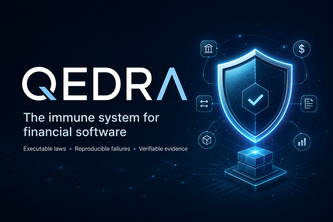
The description states that QEDRA is a system designed to act as an "immune system for financial software". It claims to support executable laws, reproducible failures, isolated repairs, exact replay, and verifiable evidence. The project was built using Codex and GPT-5.6 during OpenAI Build Week, with human decisions around scope, safety boundaries, and repair policies retained. The author describes a demonstration that uses deterministic record/replay for judges to reproduce results without credentials. No revenue, customers, or traction data are provided beyond the self-reported account.
Key open question
What is the actual commercial viability of QEDRA as a financial software immune system, given that it appears to be a proof-of-concept built in a hackathon environment with no evidence of production use or adoption?
What The Product Actually Is
The description states that QEDRA is a system for financial software with features including:
- Executable laws
- Reproducible failures
- Isolated repairs
- Exact replay
- Verifiable evidence
It was built using Codex and GPT-5.6 during OpenAI Build Week, and includes components such as:
- Constitution design
- Scenario engine
- Verification engine
- Git worktree boundary
- CLI
- Evidence passport
- Dashboard
- Flutter presentation client
The system implements a "TRANSFER_IDEMPOTENCY invariant" and supports wallet fixture and deterministic timeout-after-commit retry scenario.
Inference Based on the self-reported description, QEDRA appears to be a framework or toolset for building and managing financial software with strong emphasis on auditability, reproducibility, and repair capabilities. It is not described as a finished product but rather an experimental system built in a hackathon context.
Positioning & Claim Evolution
The description states that QEDRA positions itself as "the immune system for financial software". This is presented as a core positioning claim, with the tagline listing specific capabilities: executable laws, reproducible failures, isolated repairs, exact replay, and verifiable evidence.
The author notes that GPT-5.6 was used through Codex to build and refine the product, but emphasizes that human decisions were made regarding financial law, product scope, safety boundaries, deterministic judge path, mandatory approval policy, and the decision not to claim successful live model repair without authenticated runtime evidence.
Inference The positioning appears to be evolving from a technical demonstration to a conceptual framework for financial software integrity. The claims are framed around building systems that can self-diagnose and repair failures while maintaining verifiable audit trails.
Target Customer & ICP
The description does not state specific target customers or ideal customer profiles (ICP). It describes QEDRA as being for "financial software" but provides no details about:
- Which types of financial institutions or organizations would use it
- What size organizations are targeted
- Specific use cases within financial software
- Whether it's aimed at developers, compliance teams, or operations
Inference Based on the description, the target appears to be financial software developers or organizations seeking robust, auditable systems. However, no specific customer segments or personas are identified.
Business Model & Pricing Evidence
The description does not provide evidence of any business model or pricing structure. It states that QEDRA was built during a hackathon and includes a demonstration path but makes no claims about:
- Revenue generation
- Licensing models
- Subscription structures
- Commercial partnerships
- Pricing tiers or costs
Inference No commercial business model is evident from the self-reported description. The project appears to be experimental in nature, with no indication of monetization strategy.
Technical & Delivery Signals
The description states that QEDRA was built using:
- Codex and GPT-5.6
- Dart, Fastify, Flutter, Node.js, TypeScript
- Git, GitHub Actions, Vitest, Zod
- SQLite database
- OpenAI Codex SDK
It includes components such as:
- Scenario engine
- Verification engine
- CLI
- Evidence passport
- Dashboard
- Flutter presentation client
The demonstration path uses deterministic record/replay and does not require external credentials or services for judges to reproduce results.
Inference The technical stack suggests a modern, developer-focused approach using cloud-native tools and AI-assisted development. The delivery appears to be focused on reproducible testing and verification rather than production deployment.
Traction & Maturity Signals
The description states that this project was submitted to the OpenAI 2026 hackathon on Devpost. It includes a demonstration path with:
- pnpm install --frozen-lockfile
- pnpm demo
- pnpm evidence:verify
The author notes that no OpenAI API key, external database, cloud account, test credentials, or proprietary service is required for the judge path.
However, there is no evidence of:
- Revenue generation
- Customer adoption
- Production usage
- Market traction
- Growth metrics
- User feedback
- Product maturity beyond the hackathon demonstration
Inference The project shows minimal traction beyond a hackathon submission. No evidence of real-world adoption or commercial success is provided.
Competitive Context
The description does not provide information about competitive landscape or direct competitors. It makes no mention of:
- Existing solutions in financial software integrity
- Similar tools or platforms
- Market positioning relative to other players
- Competitive advantages claimed
- Industry standards or benchmarks
Inference No competitive context is evident from the self-reported description. The project appears to be positioned as a novel approach but without reference to existing market players.
Open Questions & Risks
The description states:
- QEDRA was built during a hackathon (no commercial validation)
- It uses GPT-5.6 through Codex for development
- The demonstration path does not require external services or credentials
- Human decisions were made regarding scope, safety boundaries, and repair policies
- The decision not to claim successful live model repair without authenticated runtime evidence
Key risks include:
- Lack of production use or real-world testing
- Dependency on AI tools (Codex, GPT-5.6) for development
- No commercial traction or revenue generation
- Limited evidence of market demand or customer validation
- Experimental nature of the project
Inference The primary risk is that this remains an experimental proof-of-concept with no demonstrated commercial viability or production use.
Questions the description leaves open
- What specific financial software problems does QEDRA solve that existing solutions don't?
- How does the system handle real-world complexity beyond the demo scenario?
- What are the actual limitations of the current implementation?
- Are there any plans for production deployment or commercialization?
- What is the roadmap for moving from a hackathon prototype to a viable product?
- How do you plan to validate that the system works in actual financial environments?
- What would be required to scale this beyond the current demonstration?
- Have you identified specific use cases where this approach would add value?
Overall Assessment
The description states that QEDRA was built during OpenAI Build Week and submitted to Devpost as a hackathon project. No evidence of revenue, customers, or traction is provided beyond the self-reported account.
Confidence level Very low - this appears to be an experimental prototype with no demonstrated commercial viability or market validation.
Assessment Not evidenced as a viable investment or partnership opportunity at this stage. The project shows technical capability in a controlled environment but lacks evidence of real-world application, customer demand, or commercial traction. Any potential value would require significant additional development and validation beyond what is described.
User Stories BotA demo video on every pull request
Get a demo video on every new feature
GitHub App that watches your pull requests and records a narrated, captioned demo.
Save time on demo prep and make informed decisions faster with a video walkthrough of every new feature.
Source
Submitted to the OpenAI 2026 hackathon on Devpost. Project home on Devpost. Back to the full gallery on Devpost.
This competitive analysis was produced by top-founders.com (opens in a new tab)
Generated by a language model from this project's public Devpost page — its tagline, the author's own write-up and any built-with tags listed there — as captured in August 2026. Short quotations are the author's words. It is an opinion on the idea as a business, not on the people behind it, and it reflects the description as published then. If the project has moved on, request a correction below. The analysis is not independent research and contains no verified traction, revenue or customer data.
An independent guide by KFG International LLC — not affiliated with, endorsed by, or connected to Devpost or OpenAI.