

Archive position — measured, not model output
0 likes on Devpost
2,263 of the 7,850 archived projects have more likes, and 5,587 share exactly 0 — so this project's #6,175 place in the like-ranked listing is a tie-break inside that group, not a ranking.
Projects (log scale)
Likes on Devpost. ▲ marks this project's group.
Show the figures
| Likes | Projects | Share of archive |
|---|---|---|
| 0 | 5,587 | 71.2% |
| 1 | 1,758 | 22.4% |
| 2 | 284 | 3.6% |
| 3–4 | 132 | 1.7% |
| 5–9 | 75 | 1.0% |
| 10+ | 14 | 0.2% |
 User Stories BotA demo video on every pull request
Get a demo video on every new feature
GitHub App that watches your pull requests and records a narrated, captioned demo.
Save time on demo prep and make informed decisions faster with a video walkthrough of every new feature.
Executive Summary
What the company appears to be
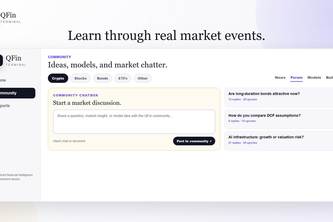
QFin Terminal is an AI-powered finance command center, as described by the author. It claims to transform financial data (annual reports, spreadsheets, charts) into beginner-friendly insights using Qwen Cloud-compatible AI.
What changed
The project was submitted to the OpenAI 2026 hackathon on Devpost. No evidence of prior development or commercial activity is provided.
The single most important open question
Is there any evidence of product-market fit, customer traction, or revenue generation? The description provides no information about these critical commercial signals.
What The Product Actually Is
The description states that QFin Terminal is an AI finance command center. It claims to turn annual reports, spreadsheets, charts, and market questions into clear beginner-friendly insights using Qwen Cloud-compatible AI.
Evidence
- The author describes it as an "AI finance command center"
- It processes "annual reports, spreadsheets, charts, and market questions"
- It uses "Qwen Cloud-compatible AI"
Inference
- The product likely involves parsing financial documents and presenting insights via an interface (possibly web-based, given the tech stack).
- It may be aimed at individuals or small teams seeking to understand financial data without deep expertise.
Not evidenced
- No details on how the AI processes data or what output format is produced.
- No mention of specific financial APIs or tools used beyond general tech tags.
Positioning & Claim Evolution
The author positions QFin Terminal as a tool that makes financial data accessible to beginners, using AI to simplify complex information.
Evidence
- Tagline: “QFin Terminal is an AI finance command center that turns annual reports, spreadsheets, charts, and market questions into clear beginner-friendly insights using Qwen Cloud-compatible AI.”
Inference
- The positioning implies a democratization of financial analysis for non-experts.
- It suggests a shift from traditional financial tools (e.g., Excel, Bloomberg) to an AI-driven interface.
Not evidenced
- No indication of prior positioning or evolution in messaging.
- No evidence of how this differs from existing tools like Yahoo Finance, Bloomberg Terminal, or financial dashboards.
Target Customer & ICP
The description implies that QFin Terminal targets individuals or small teams who want beginner-friendly financial insights.
Evidence
- The tagline mentions “beginner-friendly insights”
- It processes data from annual reports and spreadsheets, suggesting a user base interested in financial analysis but not necessarily finance experts
Inference
- Likely ICP includes retail investors, students, or small business owners who want to analyze financial data without deep domain knowledge.
Not evidenced
- No explicit customer personas or use cases provided.
- No evidence of target segment validation or user research.
Business Model & Pricing Evidence
There is no evidence in the description of a business model or pricing structure.
Evidence
- The author does not mention monetization, subscriptions, or fees.
Inference
- If this is a hackathon project, it may be non-commercial or early-stage.
- It could evolve into a freemium or SaaS model in the future.
Not evidenced
- No pricing tiers, revenue streams, or monetization strategy described.
Technical & Delivery Signals
The project uses a range of technologies including Python, FastAPI, React, Qwen-VL, Dashscope, Supabase, and PostgreSQL.
Evidence
- Built with: ai-chatbot, cloud, community-forum, csv-analysis, dashscope, excel-analysis, fastapi, finance, financial-data-apis, github, glm, image-analysis, pdf-analysis, postgresql, python, qwen-vl, react, render, rest-api, stock-research, supabase, tailwind-css, typescript, vite
Inference
- The tech stack suggests a full-stack web application with AI integration and data processing capabilities.
- It likely supports document parsing (PDF/Excel), image analysis, and API-based financial data ingestion.
Not evidenced
- No evidence of delivery mechanism or product architecture beyond tech tags.
- No mention of scalability, performance, or deployment strategy.
Traction & Maturity Signals
There is no evidence of traction or maturity in the description.
Evidence
- Submitted to a hackathon (OpenAI 2026)
- Team size: 3 members
- No mention of users, revenue, or product adoption
Inference
- The project appears early-stage and likely not yet in production.
- It may be a prototype or proof-of-concept.
Not evidenced
- No data on user engagement, retention, or monetization.
- No evidence of product-market fit or customer feedback.
Competitive Context
The author does not provide any competitive analysis or positioning relative to existing tools.
Evidence
- No mention of competitors or market landscape
Inference
- The project likely competes with financial data platforms like Bloomberg Terminal, Yahoo Finance, or Excel-based tools.
- It may also compete with AI-powered financial assistants or chatbots.
Not evidenced
- No evidence of competitive differentiation or market validation.
Open Questions & Risks
Several risks and open questions are evident from the description:
Evidence
- Submitted to a hackathon — suggests early-stage development
- No revenue, traction, or customer data
Inference
- High risk of product-market misalignment if no user feedback exists.
- Lack of commercial viability or scalability in current form.
Not evidenced
- No evidence of IP protection, team experience, or funding history.
Questions the description leaves open
- What is the intended user journey from uploading a document to receiving insights?
- How does the AI determine which insights are “beginner-friendly”?
- Are there any specific financial data sources or APIs integrated?
- What is the current stage of development? Is this a prototype or a working product?
- Have you validated the product with potential users?
- How do you plan to monetize this tool, if at all?
Overall Assessment
Not evidenced.
The description provides no evidence of commercial traction, revenue, or customer validation. It is unclear whether QFin Terminal has moved beyond a hackathon prototype. The lack of any financial or user data makes it impossible to assess its viability for investment or partnership.
Confidence Low
Reasoning
The project is described as a hackathon submission with no evidence of prior development, adoption, or monetization. Any commercial potential remains speculative.
User Stories BotA demo video on every pull request
Get a demo video on every new feature
GitHub App that watches your pull requests and records a narrated, captioned demo.
Save time on demo prep and make informed decisions faster with a video walkthrough of every new feature.
Source
Submitted to the OpenAI 2026 hackathon on Devpost. Project home on Devpost. Back to the full gallery on Devpost.
This competitive analysis was produced by top-founders.com (opens in a new tab)
Generated by a language model from this project's public Devpost page — its tagline and any built-with tags listed there, since the author published no write-up — as captured in August 2026. Short quotations are the author's words. It is an opinion on the idea as a business, not on the people behind it, and it reflects the description as published then. If the project has moved on, request a correction below. The analysis is not independent research and contains no verified traction, revenue or customer data.
An independent guide by KFG International LLC — not affiliated with, endorsed by, or connected to Devpost or OpenAI.