

Archive position — measured, not model output
0 likes on Devpost
2,263 of the 7,850 archived projects have more likes, and 5,587 share exactly 0 — so this project's #6,173 place in the like-ranked listing is a tie-break inside that group, not a ranking.
Projects (log scale)
Likes on Devpost. ▲ marks this project's group.
Show the figures
| Likes | Projects | Share of archive |
|---|---|---|
| 0 | 5,587 | 71.2% |
| 1 | 1,758 | 22.4% |
| 2 | 284 | 3.6% |
| 3–4 | 132 | 1.7% |
| 5–9 | 75 | 1.0% |
| 10+ | 14 | 0.2% |
 User Stories BotA demo video on every pull request
Get a demo video on every new feature
GitHub App that watches your pull requests and records a narrated, captioned demo.
Save time on demo prep and make informed decisions faster with a video walkthrough of every new feature.
Executive Summary
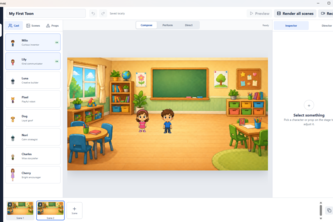
Qanvaz is a self-reported local-first animation studio for kids, built by a single founder (Ely Ayertey), that allows children to create animated stories using AI-powered tools. The product is described as an AI-assisted creative playground where kids can build scenes with characters, backgrounds, props, and dialogue, and record their own voices into the animations.
The author states that Qanvaz was built using Codex as a development partner and emphasizes its local-first design to reduce reliance on expensive cloud-based AI services. It includes features such as scene creation, animation, audio controls, local storage, and video rendering.
There is no evidence of revenue, customers, or traction beyond the single developer’s account. The project appears to be an early-stage prototype submitted to a hackathon, with no indication of commercial adoption or product-market fit.
The single most important open question
Is there any evidence that Qanvaz has been tested with children or families in real-world use, and what is the actual utility of its AI features for creative storytelling?
What The Product Actually Is
The description states that Qanvaz is an AI-powered creative playground for kids. It allows children to:
- Build scenes using animated characters, backgrounds, and props
- Write dialogue
- Perform using their own voices
- Explore interactive lessons about AI
- Turn complete stories into shareable videos
It is described as a desktop application that includes:
- A complete animation studio
- Reusable projects
- Interactive AI lessons
- Character performances
- Audio controls
- Local storage
- Full-project video rendering
The author notes that Qanvaz was built with Codex, an AI development tool, and that it is designed to be local-first — meaning core features work without a subscription or cloud dependency.
Inference The product is described as a creative application for children, but the exact nature of its AI integration (e.g., whether it uses generative models for story generation, voice synthesis, or animation) is not specified beyond the use of Codex and local-first design.
Positioning & Claim Evolution
The author positions Qanvaz as:
- A safe, creative, and approachable introduction to AI for children
- An application that helps kids understand AI as a creative tool, not just a technical concept
- A platform that encourages critical thinking, experimentation, and control over what is created
The project evolved from the founder’s personal motivation:
- To give their own children a hands-on experience with AI through play and storytelling
- To demonstrate how AI can be used in creative and educational contexts without overwhelming or exposing children to complex technical concepts
Inference The positioning reflects an intent to merge education, creativity, and child-safe AI use — but there is no evidence of prior user testing or feedback that would validate this approach.
Target Customer & ICP
The author states that Qanvaz is designed for kids, specifically:
- Children who enjoy characters, stories, imagination, and play
- Families seeking safe, creative tools for children
There is no mention of specific age ranges, parental involvement, or segmentation beyond “kids.”
Inference The ICP appears to be children aged 3–12 (based on typical toy/creative tool usage), with a secondary audience being parents or caregivers. However, this is not explicitly stated.
Business Model & Pricing Evidence
The description does not include any information about:
- Revenue streams
- Pricing models
- Monetization strategy
- Subscription plans or in-app purchases
It does state that Qanvaz is local-first, with core features working without a subscription, and that cloud-based AI remains optional for dynamic responses.
Inference The business model appears to be based on local-first functionality with optional cloud services. However, no commercial structure is described beyond the founder’s own development process.
Technical & Delivery Signals
The author states:
- Qanvaz was built using Codex
- It includes a desktop application with features like:
- Scene creation
- Animation system
- Audio recording and controls
- Video rendering
- Local storage
- The app is designed to be local-first to reduce reliance on cloud services due to cost concerns
There is no mention of:
- Technical architecture
- Platform support (e.g., Windows, macOS, Linux)
- AI model types or capabilities used
- Scalability or performance metrics
Inference The technical approach seems to prioritize local execution and minimal cloud dependency. However, the actual implementation details are not described.
Traction & Maturity Signals
The description states:
- Qanvaz was built by a single developer
- It is a prototype submitted to a hackathon
- The author has completed the product from idea to working application
There is no evidence of:
- User testing
- Customer feedback
- Adoption metrics
- Revenue or monetization
- Product-market fit
Inference This is an early-stage prototype, likely not yet in production or available for public use. There is no indication of traction or user engagement.
Competitive Context
The description does not mention:
- Competitors
- Market positioning relative to existing tools
- Similar products in the children’s creative or AI education space
It is described as a local-first animation studio, but there is no comparison to other platforms such as Scratch, Tinkercad, or AI storytelling apps for kids.
Inference The competitive context is unknown. There is no evidence of market analysis or differentiation from existing tools.
Open Questions & Risks
- Single-founder development: No team, no external validation, no product-market fit evidence
- Unproven user adoption: No real-world testing with children or families
- Unclear AI utility: The role of AI in the product is not clearly defined beyond its use in development
- Local-first design limitations: The author notes that local AI models are not yet mature for child-friendly applications, which may limit future scalability
- No commercial viability evidence: No revenue, pricing, or monetization strategy
Inference The project is highly speculative and lacks any evidence of real-world traction or commercial potential.
Questions the description leaves open
- Has Qanvaz been tested with children or families? What feedback was received?
- How does the AI functionality actually work in practice — what models are used, and how is it integrated into the creative process?
- What are the actual costs of running the cloud-based features, and why were they made optional?
- Is there a plan to expand beyond the current prototype, or to monetize the product?
- How does Qanvaz compare to existing tools for children’s creativity or AI education?
Overall Assessment
Not evidenced.
The description provides no information on:
- Revenue or financials
- Customer base or adoption
- Product-market fit
- Commercial strategy or scalability
This is a self-reported prototype submitted to a hackathon, with no evidence of traction, monetization, or real-world use.
Inference At this stage, Qanvaz is not a viable investment or partnership opportunity. It is an early-stage idea with no demonstrated commercial potential or user validation.
User Stories BotA demo video on every pull request
Get a demo video on every new feature
GitHub App that watches your pull requests and records a narrated, captioned demo.
Save time on demo prep and make informed decisions faster with a video walkthrough of every new feature.
Source
Submitted to the OpenAI 2026 hackathon on Devpost. Project home on Devpost. Back to the full gallery on Devpost.
This competitive analysis was produced by top-founders.com (opens in a new tab)
Generated by a language model from this project's public Devpost page — its tagline, the author's own write-up and any built-with tags listed there — as captured in August 2026. Short quotations are the author's words. It is an opinion on the idea as a business, not on the people behind it, and it reflects the description as published then. If the project has moved on, request a correction below. The analysis is not independent research and contains no verified traction, revenue or customer data.
An independent guide by KFG International LLC — not affiliated with, endorsed by, or connected to Devpost or OpenAI.