

Archive position — measured, not model output
0 likes on Devpost
2,263 of the 7,850 archived projects have more likes, and 5,587 share exactly 0 — so this project's #6,171 place in the like-ranked listing is a tie-break inside that group, not a ranking.
Projects (log scale)
Likes on Devpost. ▲ marks this project's group.
Show the figures
| Likes | Projects | Share of archive |
|---|---|---|
| 0 | 5,587 | 71.2% |
| 1 | 1,758 | 22.4% |
| 2 | 284 | 3.6% |
| 3–4 | 132 | 1.7% |
| 5–9 | 75 | 1.0% |
| 10+ | 14 | 0.2% |
 User Stories BotA demo video on every pull request
Get a demo video on every new feature
GitHub App that watches your pull requests and records a narrated, captioned demo.
Save time on demo prep and make informed decisions faster with a video walkthrough of every new feature.
Executive Summary
What the company appears to be
Q-HTML is a self-described declarative programming language for building web pages and components, positioned as a replacement for HTML, CSS, and JavaScript. It is described as a "language of the future" that compiles into standard web technologies (HTML, CSS, JS) and aims to simplify web development by abstracting away complexity.
What changed
The project description states that Q-HTML was built from scratch, inspired by Qt's QML language, with the goal of addressing limitations in traditional web languages. It evolved through iterative development of a complex system (a page builder), adding features incrementally until it matched or exceeded capabilities of ReactJS.
Single most important open question
Is there any evidence of real-world usage, adoption, or traction beyond the author's own development efforts?
Note: This analysis is based entirely on self-reported information from the project description. No external verification, revenue data, customer names, or independent sources are available. All claims in this report are attributed to the author’s own submission.
What The Product Actually Is
The description states that Q-HTML is a declarative language for building web content. It compiles into standard HTML, CSS, and JavaScript, and supports features such as:
- Reusable components (
q-component) - Scoped theming capabilities
- Named reference pointer assignments
- Integration with existing JS libraries, CSS frameworks, and PHP
- Support for dynamic object creation, serialization, and bound properties
It also claims to be compatible with modern web development practices while aiming to replace traditional HTML/CSS/JS.
Inference: The product appears to be a domain-specific language (DSL) or meta-language that translates into standard web technologies. It is not a runtime environment but rather a compilation layer.
Positioning & Claim Evolution
The author positions Q-HTML as:
- A replacement for HTML, CSS, and JavaScript
- A "language of the future" for web content
- A declarative alternative to ReactJS and similar frameworks
- Compatible with existing tools and ecosystems
It evolved from an idea inspired by Qt's QML language, aiming to address what the author sees as outdated design decisions in traditional web languages.
Claim: The product is positioned as a modern, simplified, and more powerful replacement for current web development stacks.
Inference: This positioning suggests a desire to disrupt or streamline an established ecosystem, though no evidence of market disruption exists.
Target Customer & ICP
Not evidenced. The description does not specify:
- Who uses Q-HTML
- What type of developers or organizations might adopt it
- Whether it targets beginners, experienced developers, or enterprise users
Absence of evidence: No indication of target customer segments or ideal customer profiles.
Business Model & Pricing Evidence
Not evidenced. The description does not mention:
- How Q-HTML will be monetized
- Whether it is open-source or proprietary
- Any pricing strategy or licensing model
- Revenue streams or business plans
Absence of evidence: No commercial or financial structure described.
Technical & Delivery Signals
The project is built using:
- C++
- Codex (AI code generation tool)
- Emscripten
- ES6
- HTML5
- JavaScript
- Qt
- WebAssembly
It has two versions:
- QHTML6: JavaScript-only version
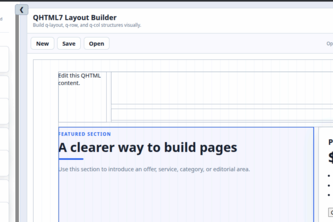
- QHTML7: WebAssembly-powered version
The author notes that QHTML7 was developed to overcome limitations in JavaScript, particularly around parsing and determinism.
Claim: Q-HTML is a cross-platform tool built with modern development practices.
Inference: The use of WebAssembly suggests an attempt to improve performance and reliability over traditional JS-based solutions.
Traction & Maturity Signals
Not evidenced. The description does not provide:
- Any user base or adoption metrics
- Customer testimonials or case studies
- Product usage statistics
- Release history or versioning information beyond two versions (QHTML6 and QHTML7)
- Feedback from early adopters or users
Absence of evidence: No signs of traction, market validation, or real-world deployment.
Competitive Context
The author claims Q-HTML is a replacement for:
- HTML
- CSS
- JavaScript
- ReactJS
It draws inspiration from Qt's QML language and aims to simplify web development by abstracting complexity.
Claim: Q-HTML competes with traditional web technologies and modern frameworks like React.
Inference: If true, it would be competing in a highly saturated market with strong incumbents. However, no evidence of competitive positioning or differentiation is provided beyond self-description.
Open Questions & Risks
- No real-world usage or adoption – The project appears to exist only as an author-built prototype.
- Unverified claims – All features and capabilities are stated by the author without external validation.
- Lack of commercial viability – No mention of monetization, pricing, or business model.
- Technical challenges noted – The author explicitly states ongoing issues with parsing, runtime errors, and AI integration.
- Single-person team – Only one developer is listed, which may limit scalability or long-term maintenance.
Inference: Without external validation or user feedback, the risk of failure due to unmet expectations or lack of demand is high.
Questions the description leaves open
- What specific problems in current web development does Q-HTML solve that existing tools don’t?
- Have you tested Q-HTML with real-world applications beyond the page builder example?
- How do you plan to attract and retain users in a crowded market dominated by React, Vue, etc.?
- Is there any feedback from developers who have tried using Q-HTML?
- What is your roadmap for monetization or commercial viability?
- Can you demonstrate measurable performance improvements over existing technologies?
Overall Assessment
Not evidenced.
Absence of evidence: No financials, traction data, or clear path to profitability are provided. The project remains in a pre-product or prototype phase with no indication of market readiness or commercial potential.
User Stories BotA demo video on every pull request
Get a demo video on every new feature
GitHub App that watches your pull requests and records a narrated, captioned demo.
Save time on demo prep and make informed decisions faster with a video walkthrough of every new feature.
Source
Submitted to the OpenAI 2026 hackathon on Devpost. Project home on Devpost. Back to the full gallery on Devpost.
This competitive analysis was produced by top-founders.com (opens in a new tab)
Generated by a language model from this project's public Devpost page — its tagline, the author's own write-up and any built-with tags listed there — as captured in August 2026. Short quotations are the author's words. It is an opinion on the idea as a business, not on the people behind it, and it reflects the description as published then. If the project has moved on, request a correction below. The analysis is not independent research and contains no verified traction, revenue or customer data.
An independent guide by KFG International LLC — not affiliated with, endorsed by, or connected to Devpost or OpenAI.