

Archive position — measured, not model output
2 likes on Devpost
221 of the 7,850 archived projects have more likes, and 284 share exactly 2 — so this project's #284 place in the like-ranked listing is a tie-break inside that group, not a ranking.
Projects (log scale)
Likes on Devpost. ▲ marks this project's group.
Show the figures
| Likes | Projects | Share of archive |
|---|---|---|
| 0 | 5,587 | 71.2% |
| 1 | 1,758 | 22.4% |
| 2 | 284 | 3.6% |
| 3–4 | 132 | 1.7% |
| 5–9 | 75 | 1.0% |
| 10+ | 14 | 0.2% |
 User Stories BotA demo video on every pull request
Get a demo video on every new feature
GitHub App that watches your pull requests and records a narrated, captioned demo.
Save time on demo prep and make informed decisions faster with a video walkthrough of every new feature.
Executive Summary
What the company appears to be
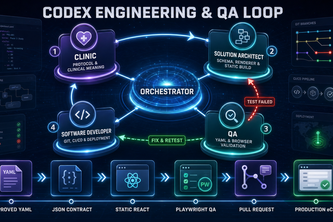
Codex Clinical Form Studio is an AI-assisted platform for building, reviewing, testing, and releasing CDISC-aligned electronic Case Report Forms (eCRFs) in clinical trials. It uses structured YAML specifications as the source of truth, integrates AI agents (specifically Codex and GPT-5.6) to assist with form configuration, CDISC mapping, QA, and change proposals, and follows a human-in-the-loop model where clinical users approve all changes before deployment.
What changed
The project was submitted as a hackathon prototype by a team of four (Ryan Lee, Yuting Ko, 永昌 馬, Zozo Meng) to the OpenAI 2026 hackathon. It represents an early-stage exploration of how AI can be used in regulated clinical environments to automate parts of the eCRF development lifecycle while maintaining human oversight and traceability.
Single most important open question
Is there evidence that this platform has moved beyond a proof-of-concept into actual clinical trial use or adoption by healthcare teams? The description states it is a prototype built for a hackathon, with no mention of real-world deployment or customer feedback.
What The Product Actually Is
The description states that Codex Clinical Form Studio is an AI-assisted platform for building, reviewing, testing, and releasing CDISC-aligned eCRFs. It uses structured YAML as the source of truth for form fields, data types, validation rules, options, units, CDISC mappings, approval status, and version information.
It supports:
- Natural-language instructions to propose form changes
- AI-ranked CDISC/CDASH concept mapping with explanations
- Browser-based QA testing using Playwright
- Version comparison highlighting field-level differences
- GitHub CI/CD integration for deployment
The system treats HTML as a generated artifact rather than the source of truth, and uses ASP.NET Core, Blazor, YamlDotNet, OpenAI GPT-5.6, Codex, and Microsoft Playwright for .NET.
Inference The platform is designed to support clinical workflows in regulated environments like clinical trials, with an emphasis on traceability, human control, and automation of repetitive tasks.
Positioning & Claim Evolution
The description states that the platform was inspired by the idea that clinical professionals should be able to collaborate with AI without directly editing application code. It aims to translate clinical change requests into technical implementation while keeping clinical users responsible for reviewing and approving decisions.
It positions itself as a tool that enables structured, version-controlled, AI-assisted development of eCRFs in alignment with CDISC standards. The platform emphasizes:
- Human-in-the-loop model
- AI-powered search, mapping, testing, and explanation
- Traceability through YAML-based specifications
- Integration with GitHub for deployment
Inference The positioning reflects a shift from manual, fragmented processes to an automated yet controlled workflow that leverages AI without replacing domain expertise.
Target Customer & ICP
The description states that the platform targets clinical teams involved in building electronic Case Report Forms (eCRFs) from clinical trial protocols. These users are described as needing to interpret protocol requirements, define data fields, configure validation rules, identify CDISC/CDASH concepts, and coordinate with engineering and QA teams.
It is implied that these users are likely:
- Clinical research coordinators
- Data managers
- Regulatory affairs specialists
- Biostatisticians or clinical data analysts
The platform is designed to help them collaborate more efficiently with AI while maintaining control over decisions.
Inference The ICP appears to be clinical professionals working in regulated environments, particularly those involved in eCRF development and clinical trial data management.
Business Model & Pricing Evidence
Not evidenced. The description does not contain any information about pricing models, monetization strategies, or business model assumptions.
Technical & Delivery Signals
The platform is built using:
- ASP.NET Core and C# for backend
- Blazor for frontend UI
- YamlDotNet for YAML parsing and generation
- OpenAI GPT-5.6 for AI analysis, mapping, QA root cause, and change proposals
- Codex for implementing features, generating UI components, building tests, diagnosing failures
- Microsoft Playwright for .NET for browser-based QA
- GitHub and GitHub Actions for CI/CD
It uses structured YAML as the source of truth, treats HTML as a generated artifact, and separates specification issues from renderer issues during QA.
Inference The architecture is designed around traceability, version control, and separation of concerns between AI assistance and human decision-making. It shows early signs of a mature engineering approach to regulated software development.
Traction & Maturity Signals
Not evidenced. There is no mention of revenue, customers, user adoption, or product traction beyond the hackathon submission.
The description explicitly states that this was a prototype built for a hackathon and does not include any data on usage, performance, or impact in real-world settings.
Competitive Context
Not evidenced. The description does not reference existing tools or platforms in the clinical form engineering space, nor does it compare Codex Clinical Form Studio to competitors.
Open Questions & Risks
- Prototype nature: Built for a hackathon; no evidence of production use or real-world validation.
- AI dependency without clarity on autonomy: While it claims to be human-in-the-loop, the extent of AI involvement and whether it can scale beyond prototype remains unclear.
- No commercial viability signals: No pricing, monetization, or customer data provided.
- Limited scope: The project focused on demonstrating one complete workflow rather than full platform functionality.
- Unverified AI capabilities: GPT-5.6 and Codex are used but not validated in terms of accuracy or reliability for clinical use cases.
Questions the description leaves open
- Has this prototype been tested with actual clinical teams or trial sponsors?
- What is the current level of automation vs. manual intervention required for key steps like CDISC mapping and form approval?
- Are there any known limitations in how well AI handles complex protocol amendments or edge cases?
- How does the platform plan to integrate with existing EDC, CTMS, or clinical data management systems?
- What are the plans for expanding beyond the current CDISC domains and controlled terminologies?
- Is there a roadmap for compliance with regulatory standards such as 21 CFR Part 11 or ISO 13485?
Overall Assessment
Not evidenced. There is no indication of funding, valuation, or investment interest in the project beyond its submission to a hackathon.
The description indicates that this is an early-stage prototype with no demonstrated traction, revenue, or customer base. While it shows promise in terms of technical architecture and alignment with clinical needs, there is insufficient evidence to assess commercial viability or strategic fit for investment or partnership at this time.
Confidence Level Low — based entirely on self-reported information from a hackathon submission with no external validation or data points.
User Stories BotA demo video on every pull request
Get a demo video on every new feature
GitHub App that watches your pull requests and records a narrated, captioned demo.
Save time on demo prep and make informed decisions faster with a video walkthrough of every new feature.
Source
Submitted to the OpenAI 2026 hackathon on Devpost. Project home on Devpost. Back to the full gallery on Devpost.
This competitive analysis was produced by top-founders.com (opens in a new tab)
Generated by a language model from this project's public Devpost page — its tagline, the author's own write-up and any built-with tags listed there — as captured in August 2026. Short quotations are the author's words. It is an opinion on the idea as a business, not on the people behind it, and it reflects the description as published then. If the project has moved on, request a correction below. The analysis is not independent research and contains no verified traction, revenue or customer data.
An independent guide by KFG International LLC — not affiliated with, endorsed by, or connected to Devpost or OpenAI.