

Archive position — measured, not model output
0 likes on Devpost
2,263 of the 7,850 archived projects have more likes, and 5,587 share exactly 0 — so this project's #4,210 place in the like-ranked listing is a tie-break inside that group, not a ranking.
Projects (log scale)
Likes on Devpost. ▲ marks this project's group.
Show the figures
| Likes | Projects | Share of archive |
|---|---|---|
| 0 | 5,587 | 71.2% |
| 1 | 1,758 | 22.4% |
| 2 | 284 | 3.6% |
| 3–4 | 132 | 1.7% |
| 5–9 | 75 | 1.0% |
| 10+ | 14 | 0.2% |
 User Stories BotA demo video on every pull request
Get a demo video on every new feature
GitHub App that watches your pull requests and records a narrated, captioned demo.
Save time on demo prep and make informed decisions faster with a video walkthrough of every new feature.
Executive Summary
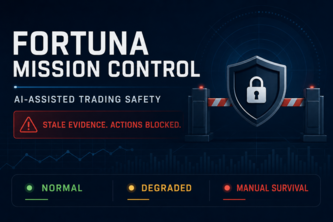
What the company appears to be: Fortuna Mission Control is a self-reported safety control layer for AI-assisted trading workflows. It does not execute trades or recommend actions; instead, it evaluates whether required operating evidence can be trusted before allowing consequential actions to proceed.
What changed: The author states that the underlying operational concept existed prior to Build Week but was formalized and demonstrated during the OpenAI 2026 hackathon using Codex with GPT-5.6. A public demo was built using Next.js, React, TypeScript, Tailwind CSS, and a deterministic JavaScript evaluator.
Single most important open question: Does Fortuna Mission Control have any real-world application beyond a hackathon demo? The description provides no evidence of traction, customers, revenue or adoption.
What The Product Actually Is
The description states that Fortuna Mission Control is "a safety control layer for AI-assisted trading operations." It evaluates four mandatory pieces of evidence before allowing consequential actions to proceed. It demonstrates three operating states: Normal (fresh and consistent evidence), Degraded (stale or incomplete evidence blocks actions), and Manual Survival (conflicting or unknown authoritative evidence results in automation being disabled). The system is described as fail-closed, meaning it does not guess when evidence is unreliable—it classifies the situation, blocks affected actions, and leaves final decisions to humans.
It is explicitly stated that Fortuna "does not recommend trades, connect to a broker or place orders." It also does not call an AI model, connect to a broker, prepare orders, or make financial decisions in its runtime. The system was built with deterministic logic and uses Codex and GPT-5.6 primarily for design, testing, verification, and documentation.
Positioning & Claim Evolution
The author claims that Fortuna Mission Control addresses the question: "How does an AI-assisted trading system know when it must stop?" This represents a shift from typical financial AI products that focus on finding opportunities or automating workflows. Instead, this product positions itself as a control layer where stopping is treated as correct behavior—not failure.
The claim evolution appears to be:
- Start with a conceptual idea of safety in AI-assisted trading.
- Formalize it into a public demonstration during Build Week.
- Frame the solution as a "fail-closed safety layer" that prioritizes human authority over automation.
- Extend the concept beyond trading to other consequential workflows like compliance reviews, incident response, and approvals.
This positioning is described as being motivated by the idea that acting on unreliable evidence can be worse than no action at all.
Target Customer & ICP
Not evidenced.
The description does not identify specific target customers or personas. It mentions potential applications in "compliance reviews, incident response, approvals and back-office operations," but these are speculative uses rather than confirmed customer segments.
There is no mention of existing users, buyer roles, or decision-makers within organizations that might adopt this product.
Business Model & Pricing Evidence
Not evidenced.
The description does not contain any information about pricing models, monetization strategies, revenue streams, or business model assumptions. It focuses entirely on the technical and conceptual aspects of the system.
Technical & Delivery Signals
The project was built using:
- Frameworks: Next.js, React
- Languages: JavaScript, TypeScript
- UI Library: Tailwind CSS
- AI Tools: Codex, GPT-5.6
- Runtime Environment: Deterministic JavaScript evaluator
Key technical signals include:
- The system is described as deterministic.
- It does not call an AI model at runtime.
- It separates design/implementation from execution using Codex and GPT-5.6.
- It includes a judge-facing interface.
- It supports three operating states (Normal, Degraded, Manual Survival).
- It enforces fail-closed behavior with explicit recovery rules.
The author notes that the hardest part was making “nothing happened” feel like a successful result, indicating attention to user experience and clarity in communication of system status.
Traction & Maturity Signals
Not evidenced.
There is no evidence of revenue, customers, usage metrics, or adoption. The project is described as a hackathon demo submitted to the OpenAI 2026 hackathon. No mention of product-market fit, user feedback, or post-demo development.
Competitive Context
Not evidenced.
The description does not reference existing competitors or similar products in the market. It does not discuss how Fortuna Mission Control compares to other safety layers, risk management tools, or AI governance systems.
Open Questions & Risks
- Lack of real-world application: The system is described as a hackathon demo with no evidence of deployment or use outside of fictional scenarios.
- No traction or revenue: No customers, users, or monetization strategy are mentioned.
- Unproven scalability: The author states that the same pattern could support other workflows but provides no indication of progress toward that goal.
- Self-reported maturity: The product is presented as a demonstration with no evidence of production readiness or long-term viability.
- Limited scope: The system only evaluates four pieces of evidence and does not appear to be configurable beyond its current implementation.
Questions the description leaves open
- What specific financial AI workflows are you targeting, and how do they differ from the fictional scenarios in the demo?
- How would you implement configurability of evidence contracts without compromising the fail-closed guarantees?
- Have you tested or validated the interface's ability to explain system behavior clearly to non-technical users?
- What is your plan for transitioning from a hackathon prototype to a production-ready product?
- Are there any real-world use cases or partners interested in piloting this solution?
Overall Assessment
Not evidenced.
There is no evidence of financial performance, customer traction, or strategic alignment that would support an investment or partnership decision. The project is described as a hackathon submission with no indication of commercial viability, market demand, or path to monetization. The author’s stated next steps involve configurability and broader application, but these are unproven concepts without supporting data.
The description is entirely self-reported and unverified. No third-party validation, customer feedback, or operational history exists beyond the project's own claims.
User Stories BotA demo video on every pull request
Get a demo video on every new feature
GitHub App that watches your pull requests and records a narrated, captioned demo.
Save time on demo prep and make informed decisions faster with a video walkthrough of every new feature.
Source
Submitted to the OpenAI 2026 hackathon on Devpost. Project home on Devpost. Back to the full gallery on Devpost.
This competitive analysis was produced by top-founders.com (opens in a new tab)
Generated by a language model from this project's public Devpost page — its tagline, the author's own write-up and any built-with tags listed there — as captured in August 2026. Short quotations are the author's words. It is an opinion on the idea as a business, not on the people behind it, and it reflects the description as published then. If the project has moved on, request a correction below. The analysis is not independent research and contains no verified traction, revenue or customer data.
An independent guide by KFG International LLC — not affiliated with, endorsed by, or connected to Devpost or OpenAI.