

Archive position — measured, not model output
0 likes on Devpost
2,263 of the 7,850 archived projects have more likes, and 5,587 share exactly 0 — so this project's #4,212 place in the like-ranked listing is a tie-break inside that group, not a ranking.
Projects (log scale)
Likes on Devpost. ▲ marks this project's group.
Show the figures
| Likes | Projects | Share of archive |
|---|---|---|
| 0 | 5,587 | 71.2% |
| 1 | 1,758 | 22.4% |
| 2 | 284 | 3.6% |
| 3–4 | 132 | 1.7% |
| 5–9 | 75 | 1.0% |
| 10+ | 14 | 0.2% |
 User Stories BotA demo video on every pull request
Get a demo video on every new feature
GitHub App that watches your pull requests and records a narrated, captioned demo.
Save time on demo prep and make informed decisions faster with a video walkthrough of every new feature.
Executive Summary
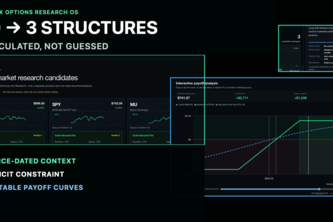
What the company appears to be: Forvix Options Research OS is a self-reported research tool for options traders that allows users to build, compare and audit options strategies using deterministic financial calculations. It presents three main surfaces: Portal (for viewing candidates), Research Funnel (guided questionnaire for strategy building), and Position Lifecycle Research (for managing existing holdings). The system is built with Azure technologies, Vue.js, and uses GPT-5.6 in a constrained way to help design and review decisions.
What changed: This appears to be a greenfield build week project (OpenAI Build Week 2026), independent from any legacy codebase. It was developed over the course of one week with a single team member, Chi Chen, using AI assistance for architecture and decision-making but not for core financial calculations.
The single most important open question: Is there evidence of commercial traction or adoption beyond this self-reported prototype? The description states no revenue, customers, or usage data exist outside of the author's own account.
Note: This analysis is based entirely on the self-reported project description provided by the caller. No independent verification or historical data exists for this project.
What The Product Actually Is
The description states that Forvix Options Research OS connects three production surfaces:
- Portal — displays source-dated candidates (QQQ, SPY, MU) with Cash-Secured Put and Covered Call context, visible data provenance, compact payoff previews, and non-real-time disclosures.
- Research Funnel — a guided questionnaire capturing position state, outlook, objective, and risk constraints. It includes quality checks and hard exclusions before grouping compatible strategies.
- Position Lifecycle Research — starts from an investor's actual holding, confirms structure, and compares governed paths (Hold, Close, Add, Roll, Restructure, Protection). Hold and Close remain visible baselines.
The system uses a deterministic Core for all financial calculations. The UI cannot redefine payoff, probability, eligibility decisions, or rankings. Results include complete position after adjustment, support state, payoff fields, movement/exclusion reasons, data snapshot, rule version, and audit metadata.
Inference: The product is described as a research tool that enables users to explore options strategies in a structured way, with an emphasis on auditability and determinism. It does not appear to be a trading platform or execution system.
Positioning & Claim Evolution
The author states the following positioning:
- "Turn an options thesis or existing position into auditable, source-dated research"
- "Guided workflows compare strategies while a deterministic Core owns every calculation"
It also claims that the product is built for options researchers, not traders or brokers. The system is described as:
- Not a broker, adviser, execution system, order router, wallet, or autonomous trading agent.
- Providing research comparisons, not buy/sell/hold recommendations.
- Displayed values are source-dated and not executable real-time quotes.
Inference: The positioning has evolved from a general options research tool to one focused on structured, auditable strategy comparison and lifecycle management. It is positioned as a research assistant rather than a trading platform.
Target Customer & ICP
The description does not explicitly state the target customer or ideal customer profile (ICP). However, it implies that Forvix is aimed at:
- Options traders or researchers who want to build, compare, and audit options strategies.
- Users who value source-dated data, deterministic calculations, and audit trails.
Inference: The ICP likely includes individual or institutional investors focused on options research, particularly those who need structured workflows for evaluating risk and payoff scenarios. No evidence of specific customer segments or personas is provided.
Business Model & Pricing Evidence
There is no evidence in the description of a business model or pricing structure. The author does not mention:
- Revenue streams
- Subscription tiers
- Licensing models
- Commercial use cases beyond the prototype
Inference: No commercial business model or pricing information is evident from the self-reported description.
Technical & Delivery Signals
The system is built using:
- Frontend: Vue 3, TypeScript, Vite, Azure Static Web Apps
- Backend: Azure Functions, Python, Redis (cache/lock/rate-limit), MongoDB (persistent truth)
- Data Providers: Moomoo market context and WhaleQuant option-chain proof of concept are isolated from financial engines.
- AI Tools Used: GPT-5.6 via Codex for architecture review and decision validation; not used in runtime financial calculations.
- Testing & CI/CD: GitHub Actions, 144 unit tests, 80 golden tests, 13 mocked collector tests, 6 automation tests.
- Deployment: Production deployment to Azure with smoke testing passing all documented routes.
Inference: The system is built with modern, scalable tech stack and includes automated testing and CI/CD. It is not a prototype in the traditional sense but a functional, tested product.
Traction & Maturity Signals
The description states:
- This is a greenfield Build Week implementation.
- Built by one person (Chi Chen).
- No revenue or customer data is reported.
- The system has passed 144 unit tests, 80 golden tests, and other verification steps.
- It includes responsive UI testing in multiple languages and screen sizes.
- Accessibility features are implemented.
Inference: There is no evidence of traction, adoption, or usage beyond the author’s own development and testing. The system is mature in terms of engineering but lacks commercial validation.
Competitive Context
The description does not provide any information about competitive landscape or direct competitors. It does not mention:
- Who else builds options research tools
- How Forvix compares to existing platforms
- Whether there are similar products in the market
Inference: No competitive context is provided, so it's unclear how Forvix fits into the broader options research ecosystem.
Open Questions & Risks
Key risks and open questions based on the self-reported description:
- No commercial traction or revenue: The system is a prototype with no evidence of adoption.
- Single-person team: Limited capacity for scaling, marketing, or product development.
- AI dependency in design but not execution: GPT-5.6 was used to help design and review decisions, but not for core financial calculations.
- No commercial authorization or data provider agreements: The system uses third-party data providers (Moomoo, WhaleQuant) but does not clarify if they are authorized for commercial use.
- No pricing or monetization model: No indication of how the product would be monetized.
Inference: The lack of commercial traction and a single-person team raise concerns about scalability and viability as a business. The absence of a monetization strategy is a major risk.
Questions the description leaves open
- What is your plan for monetizing this product?
- Have you validated the need for this tool with potential users or customers?
- How do you intend to scale beyond a single developer?
- Are there any commercial agreements or licensing issues with Moomoo or WhaleQuant?
- What are the key assumptions in your financial models, and how were they tested?
- Do you have any plans for integrating real-time data feeds or execution capabilities?
- How do you intend to market this tool to options researchers or traders?
Overall Assessment
This is a self-reported prototype built during a hackathon (OpenAI Build Week 2026). It includes:
- A functional UI with three connected surfaces
- Deterministic financial calculations
- Automated testing and CI/CD
- Use of AI for architecture review, not core operations
However, there is no evidence of:
- Revenue or customers
- Commercial traction
- Pricing or monetization model
- Market validation
- Team expansion plans
Assessment: The project shows strong engineering execution but lacks commercial viability or traction. It is a functional prototype with no clear path to market adoption or revenue generation. Not evidenced as a viable investment or partnership opportunity at this stage.
User Stories BotA demo video on every pull request
Get a demo video on every new feature
GitHub App that watches your pull requests and records a narrated, captioned demo.
Save time on demo prep and make informed decisions faster with a video walkthrough of every new feature.
Source
Submitted to the OpenAI 2026 hackathon on Devpost. Project home on Devpost. Back to the full gallery on Devpost.
This competitive analysis was produced by top-founders.com (opens in a new tab)
Generated by a language model from this project's public Devpost page — its tagline, the author's own write-up and any built-with tags listed there — as captured in August 2026. Short quotations are the author's words. It is an opinion on the idea as a business, not on the people behind it, and it reflects the description as published then. If the project has moved on, request a correction below. The analysis is not independent research and contains no verified traction, revenue or customer data.
An independent guide by KFG International LLC — not affiliated with, endorsed by, or connected to Devpost or OpenAI.