

Archive position — measured, not model output
0 likes on Devpost
2,263 of the 7,850 archived projects have more likes, and 5,587 share exactly 0 — so this project's #6,170 place in the like-ranked listing is a tie-break inside that group, not a ranking.
Projects (log scale)
Likes on Devpost. ▲ marks this project's group.
Show the figures
| Likes | Projects | Share of archive |
|---|---|---|
| 0 | 5,587 | 71.2% |
| 1 | 1,758 | 22.4% |
| 2 | 284 | 3.6% |
| 3–4 | 132 | 1.7% |
| 5–9 | 75 | 1.0% |
| 10+ | 14 | 0.2% |
 User Stories BotA demo video on every pull request
Get a demo video on every new feature
GitHub App that watches your pull requests and records a narrated, captioned demo.
Save time on demo prep and make informed decisions faster with a video walkthrough of every new feature.
Executive Summary
The description states that python-rust-debugger integration is a VS Code debugging prototype aiming to merge Python and Rust execution in one debugging workflow. The project was built as part of the OpenAI 2026 hackathon, with a team of two (Peter Chan and Felice Au). It focuses on integrating CPython 3.14 and Rust/PyO3 execution within VS Code using tools like CodeLLDB, debugpy, and DAP.
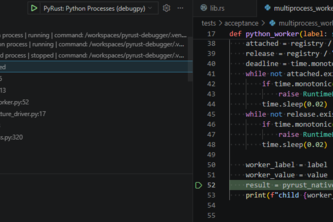
The author claims this is an exploratory effort to address awkwardness in debugging mixed Python-Rust code, particularly around thread handling, child processes, and callback flows. It includes a PyRust Process Tree view and dual-debug-engine coordination logic to manage ownership of stops between CodeLLDB and debugpy.
Key commercial due-diligence read
The project is a prototype with no evidence of revenue, customers, or adoption. It is not yet a product for sale or use in production environments. The single most important open question is whether this prototype can evolve into a stable, installable, and widely usable debugging tool that supports real-world Python-Rust projects beyond the current Linux x86_64 scope.
What The Product Actually Is
The description states:
- PyRust is a VS Code debugging prototype.
- It presents Python and Rust execution in one debugging workflow.
- It launches targets through CodeLLDB.
- It merges native Rust frames with recovered CPython 3.14 frames.
- It shows mixed Python/Rust call stacks via DAP.
- It supports Python -> Rust and Rust -> Python -> Rust callback fixtures.
- It handles Python threads, Rust threads, child processes, and async non-nesting cases.
- It adds a PyRust Process Tree view to show real process/thread ownership.
- It supports opt-in debugpy-backed Python stops for breakpoints and evaluation.
- It keeps Rust stops owned by CodeLLDB with read-only Python snapshots at those stops.
This is a debugging tool prototype, not a commercial product or service. The author describes it as an exploratory effort to integrate debugging workflows between Python and Rust in VS Code, using specific technologies like CodeLLDB, debugpy, DAP, and PyO3.
Positioning & Claim Evolution
The description states:
- The project attempts to explore the first trial of meaningful integration between Python and Rust debugging.
- It addresses a gap where developers must mentally stitch together separate Python and native debugger views.
- The goal is to make mixed CPython 3.14 and Rust/PyO3 execution legible inside VS Code.
The positioning appears to be:
- A developer tool for debugging hybrid Python-Rust applications.
- Positioned as a solution to an awkwardness in current debugging workflows.
- Framed as a prototype exploring integration, not yet a finished product or service.
There is no evidence of prior versions, market positioning beyond the hackathon submission, or claims about broader adoption or commercial viability. The claim evolution shows a focus on solving technical challenges rather than market traction or user feedback.
Target Customer & ICP
The description states:
- The tool targets developers working with mixed Python-Rust code, especially in AI and systems applications.
- It is intended for use inside VS Code.
- It supports CPython 3.14 and Rust/PyO3 execution.
There is no evidence of a defined ICP beyond the general category of developers using Python and Rust together. No specific personas, customer segments, or use cases are detailed. The project is described as a prototype for a developer tool, not a product targeting end-users or enterprises.
Business Model & Pricing Evidence
The description states:
- This is a prototype submitted to a hackathon.
- It includes no mention of pricing models, monetization strategies, or business model details.
- The project is built using open-source tools like CodeLLDB, debugpy, and DAP.
There is no evidence of any business model or pricing structure. The tool is not described as a paid product or service, nor is there indication of how it might be monetized if developed further.
Technical & Delivery Signals
The description states:
- Built with: codelldb, codex, dap, debugpy, docker, pyo3, python-3.14, rust, vs-code.
- Uses CodeLLDB for launching and Rust frame handling.
- Uses debugpy for Python stops and evaluation.
- Implements a dual-debug-engine coordinator to route frame operations.
- Includes a PyRust Process Tree view.
- Supports fixture-bound acceptance tests and Dev Container validation.
- The repo includes ADRs, acceptance scripts, and ./scripts/verify-submission.sh.
These are technical delivery signals indicating:
- A working prototype with testable components.
- Use of established debugging protocols (DAP).
- Modular architecture for handling multiple debuggers.
- Commitment to reproducible builds and validation.
However, the tool is scoped to Linux x86_64, CPython 3.14, and PyO3 fixtures — not a general-purpose solution.
Traction & Maturity Signals
The description states:
- This is a prototype built for a hackathon.
- It includes no evidence of user adoption, customer feedback, or usage metrics.
- The project is described as exploratory and experimental.
- No mention of product releases, versioning, or roadmap beyond the current scope.
There are no traction or maturity signals. The project is not demonstrated in production environments, nor does it show signs of being used by developers outside the hackathon context.
Competitive Context
The description states:
- Python and Rust are increasingly paired in AI and systems applications.
- Developers often have to mentally stitch together separate Python and native debugger views.
- Prior art exists around debugging mixed-language code but not integrated workflows.
There is no evidence of direct competitors or market analysis. The project does not reference existing tools or platforms that solve similar problems, nor does it describe how it compares to alternatives in the marketplace.
Open Questions & Risks
The description states:
- The hardest part was debugger ownership — CodeLLDB and debugpy cannot safely own the same stopped process.
- The prototype avoids misleading concurrency displays by preserving real OS/process relationships.
- The tool is intentionally scoped to Linux x86_64, CPython 3.14, PyO3 fixtures, CodeLLDB, and local VS Code extension.
Key risks and open questions include:
- Limited scope: Only works on Linux x86_64 with specific versions.
- Prototype nature: Not a production-ready tool or product.
- Ownership complexity: Requires complex coordination logic to avoid conflicts between debuggers.
- No scalability: No indication of how it would scale beyond the current test environment.
Questions the description leaves open
- What is the long-term vision for this project beyond the hackathon prototype?
- How does the dual-debugger coordination handle edge cases not covered in the current fixtures?
- Are there plans to support Windows or macOS platforms?
- Has the team considered how this would integrate into existing CI/CD pipelines or enterprise environments?
- What are the technical challenges that remain before this could be a production-ready debugging tool?
- How does the project plan to handle more complex Rust futures, async tasks, or embedded Python in real-world projects?
Overall Assessment
The description states:
- This is a prototype built for a hackathon.
- It has no evidence of revenue, customers, or traction.
- It is not yet a product for sale or use in production environments.
This project is not ready for investment or partnership at this stage. It is an experimental prototype with no commercial viability or market readiness demonstrated. The team should be asked to show how they plan to evolve the prototype into a scalable, cross-platform debugging tool that can be adopted by developers working on real-world Python-Rust projects.
User Stories BotA demo video on every pull request
Get a demo video on every new feature
GitHub App that watches your pull requests and records a narrated, captioned demo.
Save time on demo prep and make informed decisions faster with a video walkthrough of every new feature.
Source
Submitted to the OpenAI 2026 hackathon on Devpost. Project home on Devpost. Back to the full gallery on Devpost.
This competitive analysis was produced by top-founders.com (opens in a new tab)
Generated by a language model from this project's public Devpost page — its tagline, the author's own write-up and any built-with tags listed there — as captured in August 2026. Short quotations are the author's words. It is an opinion on the idea as a business, not on the people behind it, and it reflects the description as published then. If the project has moved on, request a correction below. The analysis is not independent research and contains no verified traction, revenue or customer data.
An independent guide by KFG International LLC — not affiliated with, endorsed by, or connected to Devpost or OpenAI.