

Archive position — measured, not model output
0 likes on Devpost
2,263 of the 7,850 archived projects have more likes, and 5,587 share exactly 0 — so this project's #6,139 place in the like-ranked listing is a tie-break inside that group, not a ranking.
Projects (log scale)
Likes on Devpost. ▲ marks this project's group.
Show the figures
| Likes | Projects | Share of archive |
|---|---|---|
| 0 | 5,587 | 71.2% |
| 1 | 1,758 | 22.4% |
| 2 | 284 | 3.6% |
| 3–4 | 132 | 1.7% |
| 5–9 | 75 | 1.0% |
| 10+ | 14 | 0.2% |
 User Stories BotA demo video on every pull request
Get a demo video on every new feature
GitHub App that watches your pull requests and records a narrated, captioned demo.
Save time on demo prep and make informed decisions faster with a video walkthrough of every new feature.
Executive Summary
What the company appears to be
ProofRank is a technical inspection tool for website migration or cleanup projects. It helps site owners and SEO specialists verify that all relevant pages in a declared scope are present and have usable HTML before proceeding with changes. The product is described as a read-only, offline plugin built using Python and Codex, designed to enforce strict evidence-based gates before allowing a human to approve a migration.
What changed
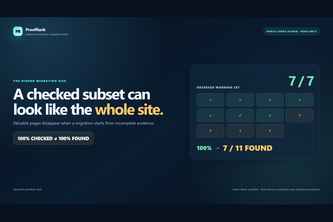
The author, Andrey Zakharov, describes ProofRank as an evolution from earlier private workflows he built using Codex. It emerged from his experience with automation that can appear complete but is not necessarily safe — particularly in the context of website migrations where missing URLs can lead to loss of traffic or business history. The tool formalizes a rule: “no whole-site graph conclusions until the declared starting scope is bound to evidence and every active in-scope page has usable HTML.”
Single most important open question
Is ProofRank intended for use by a single developer or as a product for broader adoption, and if so, what is its path to market?
What The Product Actually Is
The description states that ProofRank is:
- A technical inspection tool for website migrations or cleanups.
- A local, read-only Codex plugin that imports exported data from various sources (GSC, GA4, WordPress, sitemap, crawler, etc.).
- A system that:
- Normalizes URL identities without discarding source provenance;
- Verifies that the declared starting scope matches inventory by SHA-256;
- Checks full HTML for every active page in scope;
- Reports evidence conservatively (broken, noindex, schema, duplicate, reachability, overlap, link-opportunity);
- Emits a machine-readable
decision.jsoncontract with eitherWITHHOLDorREADY_FOR_HUMAN_REVIEW.
It also includes:
- A Guarded Release Contract in
decision.json; - A dashboard that shows owner/release explanation and technical evidence ledger;
- No API keys or third-party packages required for demo.
The tool is described as offline, read-only, and not connected to production systems.
Claim: ProofRank is a local, read-only plugin.
Evidence: The write-up explicitly says it does not perform OAuth, call live APIs, control crawlers, or write to production. It uses offline adapters and deterministic Python tools.
Positioning & Claim Evolution
The author positions ProofRank as a solution to the problem of false completeness in SEO evidence during website migrations:
“Unsafe automation does not remove work; it creates review, risk, and cleanup.”
It is described as turning this issue into an enforceable product rule:
“no whole-site graph conclusions until the declared starting scope is bound to evidence and every active in-scope page has usable HTML.”
The evolution of the claim appears to be from a personal workflow to a reusable plugin, with Codex used to refine design and test automation.
Claim: ProofRank prevents “false green” outcomes.
Evidence: The write-up contrasts an incomplete case (7/11 identities present) that still fails even if all observed pages have HTML, versus a complete case that passes.
Target Customer & ICP
The description states two main user groups:
- Site owners, who want to ask SEO specialists or developers to prove that valuable pages haven’t disappeared.
- Technical teams, who use it as a local, read-only Codex plugin.
It is not clear whether ProofRank targets agencies, internal teams, or individual practitioners. The tool is described as being used in large-scale WordPress migrations, but no specific customer segments are named.
Claim: Site owners and technical teams.
Evidence: The write-up describes the product’s use for both site owners and developers, especially in migration contexts.
Business Model & Pricing Evidence
There is no evidence of a business model or pricing structure. The tool is described as a plugin built with Codex, and it is not presented as a commercial offering.
Claim: Not evidenced.
Evidence: No mention of monetization, subscriptions, licensing, or pricing.
Technical & Delivery Signals
The project is described as:
- Built using Python, Codex, and various tools like Playwright, JSON, CSV, HTML, CSS, XML, GitHub Actions.
- A deterministic system that uses SHA-256 to bind inputs.
- A read-only plugin, not connected to production.
- Includes offline adapters, regression tests, CI, secret scanning, and a dashboard.
Claim: Technical delivery is offline, deterministic, and reproducible.
Evidence: The write-up says it uses standard Python libraries, does not call live APIs, and includes CI, regression tests, and secret checks.
Traction & Maturity Signals
There is no evidence of traction or adoption. The project is described as a personal workflow turned into a plugin, with only synthetic fixtures and sanitized private data used for demonstration.
Claim: Not evidenced.
Evidence: No customers, revenue, usage metrics, or public adoption are mentioned.
Competitive Context
The description does not mention competitors or similar tools. It is unclear whether ProofRank is positioned against existing SEO tools, migration platforms, or workflow automation systems.
Claim: Not evidenced.
Evidence: No competitive landscape or comparison to other tools is provided.
Open Questions & Risks
- The tool is described as a read-only plugin, not a commercial product. This raises questions about its scalability and path to market.
- It is not connected to production systems — this may limit its utility in real-world workflows.
- There is no evidence of monetization, customers, or traction — suggesting it’s still in early development or prototype stage.
Inference: The tool may not be ready for commercial use without further development or integration into larger platforms.
Evidence: The description says it's a plugin, not a service, and lacks any indication of real-world deployment or monetization.
Questions the description leaves open
- What is the intended user base beyond the author’s personal workflows?
- Is there a plan to make this available beyond a local plugin or read-only tool?
- How does ProofRank integrate into existing migration or SEO workflows?
- Are there any plans for authentication, production integration, or API access?
- Has it been tested in real-world scenarios beyond the synthetic and private examples provided?
Overall Assessment
There is no evidence of a commercial product, traction, or monetization strategy. The project appears to be a proof-of-concept or early-stage prototype built by one person (Andrey Zakharov) as part of a hackathon submission.
Inference: ProofRank may have potential as a tool for SEO and migration teams, but it is not yet a product ready for investment or partnership.
Evidence: No revenue, customers, or commercial traction are evident. The project is described as a plugin with no indication of broader market readiness.
User Stories BotA demo video on every pull request
Get a demo video on every new feature
GitHub App that watches your pull requests and records a narrated, captioned demo.
Save time on demo prep and make informed decisions faster with a video walkthrough of every new feature.
Source
Submitted to the OpenAI 2026 hackathon on Devpost. Project home on Devpost. Back to the full gallery on Devpost.
This competitive analysis was produced by top-founders.com (opens in a new tab)
Generated by a language model from this project's public Devpost page — its tagline, the author's own write-up and any built-with tags listed there — as captured in August 2026. Short quotations are the author's words. It is an opinion on the idea as a business, not on the people behind it, and it reflects the description as published then. If the project has moved on, request a correction below. The analysis is not independent research and contains no verified traction, revenue or customer data.
An independent guide by KFG International LLC — not affiliated with, endorsed by, or connected to Devpost or OpenAI.