

Archive position — measured, not model output
1 like on Devpost
505 of the 7,850 archived projects have more likes, and 1,758 share exactly 1 — so this project's #2,215 place in the like-ranked listing is a tie-break inside that group, not a ranking.
Projects (log scale)
Likes on Devpost. ▲ marks this project's group.
Show the figures
| Likes | Projects | Share of archive |
|---|---|---|
| 0 | 5,587 | 71.2% |
| 1 | 1,758 | 22.4% |
| 2 | 284 | 3.6% |
| 3–4 | 132 | 1.7% |
| 5–9 | 75 | 1.0% |
| 10+ | 14 | 0.2% |
 User Stories BotA demo video on every pull request
Get a demo video on every new feature
GitHub App that watches your pull requests and records a narrated, captioned demo.
Save time on demo prep and make informed decisions faster with a video walkthrough of every new feature.
Executive Summary
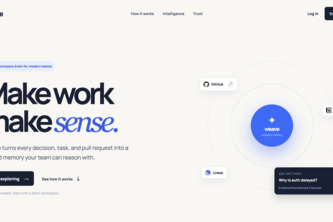
The description states that Weave is an AI operating system for modern companies, aiming to unify scattered organizational knowledge into a single intelligent workspace. The author describes it as a prototype built during a hackathon, with ambitions to integrate tools like GitHub, Notion, Slack, and Linear, and to support features such as Retrieval-Augmented Generation (RAG), persistent company memory, AI agents, and workflow automation.
The project is self-reported and unverified. It is not evidenced that Weave has any revenue, customers, or traction beyond the hackathon prototype. The author claims it is an "AI-native platform" but provides no data on adoption or usage. The team size is stated as two members. There is no evidence of funding rounds, headcount growth, or market validation.
The single most important open question is: What is the actual product capability and how does it differ from existing solutions?
What The Product Actually Is
The description states that Weave is "the foundation of an AI Operating System for modern companies." It is described as a platform that connects knowledge, code, docs, and conversations into one intelligent workspace. The current prototype is said to showcase a fast, responsive landing experience.
Inferred from the write-up: The product is conceptualized as an AI-powered intelligence layer that works with existing tools rather than replacing them. It is described as being built using Next.js, TypeScript, Tailwind CSS, and deployed on Vercel.
Not evidenced: Specific functionality beyond the prototype, or whether it has been tested in real-world environments.
Positioning & Claim Evolution
The description states that Weave positions itself as an AI operating system for modern companies. It claims to connect knowledge, code, docs, and conversations into one intelligent workspace that helps teams search, understand, and act faster.
It also claims that the product is built around "AI-powered retrieval" and is designed to enable context-aware answers across connected tools.
Inferred: The positioning evolved from a general idea of unifying company knowledge to an AI-native platform that works with existing tools rather than replacing them. This evolution was shaped by the hackathon constraints, where the team focused on laying the foundation for an AI operating system.
Not evidenced: Specific claims about competitive differentiation or market traction.
Target Customer & ICP
The description states that Weave is aimed at "modern companies" and targets teams looking to search, understand, and act faster using a unified workspace.
Inferred: The target customer is likely B2B organizations with distributed knowledge and workflows, particularly those using tools like GitHub, Notion, Slack, and Linear.
Not evidenced: Specific customer segments, personas, or use cases beyond the general "modern company" framing.
Business Model & Pricing Evidence
The description does not provide any information on business model or pricing. It only states that Weave is an AI operating system for modern companies.
Not evidenced: No evidence of revenue streams, pricing tiers, or monetization strategy.
Technical & Delivery Signals
The description states that the prototype was built using Next.js, TypeScript, Tailwind CSS, shadcn/ui, and deployed on Vercel. It also mentions a long-term architecture designed around AI-powered retrieval, enabling context-aware answers across connected tools.
Inferred: The technical stack suggests a modern web-based platform with an emphasis on AI integration. The mention of RAG (Retrieval-Augmented Generation) indicates an awareness of current AI trends.
Not evidenced: No evidence of scalability, performance metrics, or production deployment details beyond the prototype.
Traction & Maturity Signals
The description states that Weave was built during a hackathon and is currently in prototype form. It mentions accomplishments such as transforming a bold idea into a working prototype in just a few days.
Inferred: The product is at an early stage, with no evidence of user adoption or market traction beyond the hackathon.
Not evidenced: No evidence of revenue, customers, or usage data.
Competitive Context
The description does not provide any information on competitive landscape or how Weave compares to existing solutions. It only mentions that modern companies rely on dozens of tools like GitHub, Notion, Slack, and Linear but their knowledge remains scattered.
Inferred: The product likely competes with or complements existing productivity and collaboration platforms, but no specific competitors are named.
Not evidenced: No evidence of competitive positioning, market share, or differentiation from other AI or productivity tools.
Open Questions & Risks
- Unproven Product-Market Fit: The project is described as a hackathon prototype with no evidence of traction or customer validation.
- Limited Team Size: Only two team members are mentioned, which may limit execution capability.
- Ambiguous Value Proposition: The description does not clearly articulate how Weave solves specific workflow problems better than existing tools.
- Lack of Monetization Strategy: No information is provided on how the product will generate revenue or sustain itself.
Questions the description leaves open
- What specific workflows or problems does Weave solve that current tools do not?
- How does Weave integrate with existing tools like GitHub, Notion, Slack, and Linear?
- What is the roadmap for development beyond the hackathon prototype?
- Are there any early adopters or pilot users of the product?
- How does Weave plan to monetize its platform?
Overall Assessment
The description states that Weave is an AI operating system for modern companies, built during a hackathon with ambitions to grow into something much bigger. It is not evidenced that Weave has any revenue, customers, or traction beyond the prototype.
Given the lack of evidence for commercial viability, user adoption, or clear monetization strategy, and considering the early-stage nature of the project, there is insufficient basis to recommend investment or partnership at this time.
The author claims it is an "AI-native platform" but provides no data on adoption or usage. The team size is stated as two members, which may limit execution capability. There is no evidence of funding rounds, headcount growth, or market validation.
Assessment: Not evidenced for investment or partnership.
User Stories BotA demo video on every pull request
Get a demo video on every new feature
GitHub App that watches your pull requests and records a narrated, captioned demo.
Save time on demo prep and make informed decisions faster with a video walkthrough of every new feature.
Source
Submitted to the OpenAI 2026 hackathon on Devpost. Project home on Devpost. Back to the full gallery on Devpost.
This competitive analysis was produced by top-founders.com (opens in a new tab)
Generated by a language model from this project's public Devpost page — its tagline, the author's own write-up and any built-with tags listed there — as captured in August 2026. Short quotations are the author's words. It is an opinion on the idea as a business, not on the people behind it, and it reflects the description as published then. If the project has moved on, request a correction below. The analysis is not independent research and contains no verified traction, revenue or customer data.
An independent guide by KFG International LLC — not affiliated with, endorsed by, or connected to Devpost or OpenAI.