

Archive position — measured, not model output
0 likes on Devpost
2,263 of the 7,850 archived projects have more likes, and 5,587 share exactly 0 — so this project's #6,141 place in the like-ranked listing is a tie-break inside that group, not a ranking.
Projects (log scale)
Likes on Devpost. ▲ marks this project's group.
Show the figures
| Likes | Projects | Share of archive |
|---|---|---|
| 0 | 5,587 | 71.2% |
| 1 | 1,758 | 22.4% |
| 2 | 284 | 3.6% |
| 3–4 | 132 | 1.7% |
| 5–9 | 75 | 1.0% |
| 10+ | 14 | 0.2% |
 User Stories BotA demo video on every pull request
Get a demo video on every new feature
GitHub App that watches your pull requests and records a narrated, captioned demo.
Save time on demo prep and make informed decisions faster with a video walkthrough of every new feature.
Executive Summary
What the company appears to be
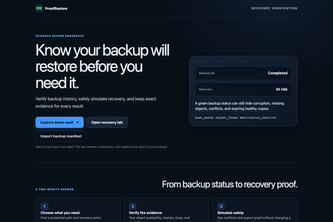
ProofRestore is a self-reported backup verification tool that claims to simulate restores safely, detect hidden failures, and produce evidence-backed proof before disaster strikes. It uses GPT-5.6 for natural-language interpretation and a deterministic TypeScript engine for recovery verification.
What changed
The project was submitted as part of the OpenAI 2026 hackathon. The author describes it as a prototype built using Codex with GPT-5.6, structured outputs, and a strict trust boundary between AI interpretation and deterministic authority.
Single most important open question — the commercial due-diligence read
Is there any evidence of product-market fit or early traction beyond the hackathon submission? The description does not indicate any revenue, customers, or adoption data.
What The Product Actually Is
The description states that ProofRestore:
- Analyzes backup snapshots and verifies whether selected files or folders can be recovered at a chosen point in time.
- Uses GPT-5.6 to interpret natural-language requests such as “Can I recover my thesis from Tuesday evening?”
- Passes structured recovery parameters to a deterministic engine that checks:
- Snapshot eligibility;
- File and folder history;
- Object availability;
- Expected and observed hashes;
- Size consistency;
- Destination conflicts;
- Retention risks.
- Produces a downloadable Proof of Recoverability report with metrics, warnings, methodology, and evidence appendix.
- Includes a browser-only Recovery Lab for simulating controlled failure scenarios without uploading or modifying real files.
Inference The product is described as a verification tool that combines natural language interpretation with deterministic recovery logic. It is not a backup system itself but a tool to validate the recoverability of existing backups.
Positioning & Claim Evolution
The description states:
- The inspiration came from hands-on experience building backup software and seeing how helpful restore tools and verification are.
- The tagline: “ProofRestore verifies whether backups can truly be recovered, simulates restores safely, detects hidden failures, and produces evidence-backed proof before disaster strikes.”
- It claims to answer the question that matters during an emergency: “Can the files actually be restored?”
- The author emphasizes that “backup completion describes the result of a job. It does not prove the future ability to recover.”
Inference The positioning is centered on trust and verification in backup recovery, especially for users who want assurance beyond simple completion badges.
Target Customer & ICP
The description states:
- The user asks questions like: “Can I recover my thesis from Tuesday evening?”
- It supports both natural-language input and deterministic manual controls.
- The Recovery Lab is browser-only and allows users to test selected files without uploading or modifying real data.
Inference The target customer appears to be individuals or teams who rely on backups and want assurance that their data can actually be restored. This could include IT professionals, researchers, or anyone managing critical data where recovery is essential.
Not evidenced No specific ICP, persona, or segmentation details are provided beyond the general use case.
Business Model & Pricing Evidence
The description states:
- The product is a prototype built for a hackathon.
- It includes features like Proof of Recoverability reports and Recovery Lab simulations.
- No pricing model, monetization strategy, or business model is described.
Inference There is no evidence of a commercial business model or pricing structure. The project appears to be in early development and not yet monetized.
Technical & Delivery Signals
The description states:
- Built with Next.js, React, TypeScript, Tailwind CSS, Zod, OpenAI Responses API, Vitest, Playwright.
- Uses GPT-5.6 via the Responses API with structured output.
- The system is designed around a strict trust boundary: natural language for interpretation, deterministic engine for authority.
- Uses Codex with GPT-5.6 Sol as the primary development environment.
- Includes automated tests (66 unit and integration tests), end-to-end Chromium tests, linting, type checking, and build validation.
Inference The technical stack is modern and well-structured, with a focus on deterministic verification and AI-driven interpretation. The use of structured outputs and strict type checking suggests attention to correctness and auditability.
Traction & Maturity Signals
The description states:
- Submitted to the OpenAI 2026 hackathon.
- Includes a realistic eight-snapshot vault with hidden issues like corruption, missing objects, and retention risks.
- Features an adversarial demo vault for testing failure scenarios.
- Has a validation chain including formatting, linting, strict type checking, tests, production build, and end-to-end tests.
Inference The project is at a prototype or early-stage development stage. There is no evidence of revenue, customers, or adoption beyond the hackathon submission.
Competitive Context
The description does not include any information about:
- Competitors in the backup verification space.
- Market size or competitive positioning.
- How ProofRestore differentiates from existing tools.
Inference No competitive context is provided. The author does not reference other tools or markets, nor does it describe how this product fits into a broader ecosystem.
Open Questions & Risks
The description states:
- The project is a hackathon submission.
- No revenue, customers, or traction data are available.
- The system uses GPT-5.6 for interpretation but not for final decisions.
- The deterministic engine handles all consequential verification.
Inference
- Risk of over-reliance on AI interpretation without real-world validation.
- Lack of commercial traction or customer feedback.
- The product is not yet in production or deployed at scale.
- No evidence of market demand or product-market fit beyond the author’s own claims.
Questions the description leaves open
- What is the current stage of development? Is this a prototype, MVP, or early product?
- Have you validated the need for this tool with real users or organizations?
- How do you plan to monetize ProofRestore? Is there a pricing model or business model in mind?
- Are there any existing backup tools or vendors that you’ve considered integrating with?
- What are the technical limitations of the deterministic engine, and how does it scale?
- How do you intend to ensure long-term reliability of GPT-5.6 integration as models evolve?
- Have you tested ProofRestore in real-world backup environments?
Overall Assessment
The description states:
- ProofRestore is a hackathon submission.
- It has no revenue, customers, or traction data.
- The author describes it as a prototype built with Codex and GPT-5.6.
Inference There is no evidence of commercial viability or product-market fit. The project is in early development and lacks any demonstration of traction or monetization. It is not ready for investment or partnership at this stage.
Confidence Level Very low — based entirely on self-reported, unverified information from a hackathon submission with no external validation or evidence of adoption.
User Stories BotA demo video on every pull request
Get a demo video on every new feature
GitHub App that watches your pull requests and records a narrated, captioned demo.
Save time on demo prep and make informed decisions faster with a video walkthrough of every new feature.
Source
Submitted to the OpenAI 2026 hackathon on Devpost. Project home on Devpost. Back to the full gallery on Devpost.
This competitive analysis was produced by top-founders.com (opens in a new tab)
Generated by a language model from this project's public Devpost page — its tagline, the author's own write-up and any built-with tags listed there — as captured in August 2026. Short quotations are the author's words. It is an opinion on the idea as a business, not on the people behind it, and it reflects the description as published then. If the project has moved on, request a correction below. The analysis is not independent research and contains no verified traction, revenue or customer data.
An independent guide by KFG International LLC — not affiliated with, endorsed by, or connected to Devpost or OpenAI.