

Archive position — measured, not model output
0 likes on Devpost
2,263 of the 7,850 archived projects have more likes, and 5,587 share exactly 0 — so this project's #6,142 place in the like-ranked listing is a tie-break inside that group, not a ranking.
Projects (log scale)
Likes on Devpost. ▲ marks this project's group.
Show the figures
| Likes | Projects | Share of archive |
|---|---|---|
| 0 | 5,587 | 71.2% |
| 1 | 1,758 | 22.4% |
| 2 | 284 | 3.6% |
| 3–4 | 132 | 1.7% |
| 5–9 | 75 | 1.0% |
| 10+ | 14 | 0.2% |
 User Stories BotA demo video on every pull request
Get a demo video on every new feature
GitHub App that watches your pull requests and records a narrated, captioned demo.
Save time on demo prep and make informed decisions faster with a video walkthrough of every new feature.
Executive Summary
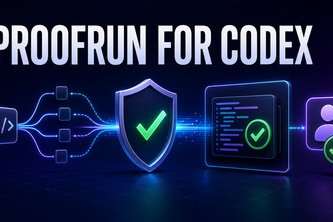
The description states that ProofRun for Codex is a developer tool designed to isolate, validate, and control changes made by coding agents (specifically Codex). The system uses Git detached worktrees and strict package schemas to enforce validation before any change is promoted into the main branch. It appears to be a proof-of-concept or early-stage prototype built as part of an OpenAI hackathon submission.
The author claims that ProofRun enforces repository governance, isolation, evidence generation, rollback capability, and human-controlled commit boundaries. The tool is described as being built with Python, Git, JSON, and other technologies, and includes features like SHA-256 verification, process-tree control, and atomic reports.
Key commercial due-diligence questions include: What is the actual market need? Is there a viable business model beyond a hackathon project? How does this differ from existing CI/CD or Git workflow tools? The most important open question is whether this represents a scalable product or just an experimental prototype.
What The Product Actually Is
The description states that ProofRun for Codex is a developer tool that turns each Codex-assisted change into a "declared transaction". It uses Git detached worktrees and package schemas to validate changes before promoting them to the main branch. Key features include:
- Package-based validation with fixed baseline commits, file allowlists, SHA-256 hashes
- Validation profiles, review requirements, and proposed commit messages
- Detached worktree isolation boundary (not OS sandbox)
- Git identity and integrity validation
- Process-tree control and UTF-8 subprocess behavior checks
- Atomic reports and evidence archives
- Human-controlled final authority over commits
The tool is described as a Python standard-library orchestrator backed by versioned JSON contracts, strict package schemas, and Git detached worktrees.
Positioning & Claim Evolution
The description states that ProofRun was built to address the "confidence breaks down" problem when coding agents produce large changes. It positions itself as a solution for making risks explicit and executable in repository integration workflows.
The author claims that ProofRun makes repository governance, isolation, evidence generation, rollback capability, and commit authority more trustworthy through independent executable constraints. The tool is positioned as addressing the challenge of "a coding agent should not be its own judge" by separating validation from mutation.
Target Customer & ICP
The description states that ProofRun targets developers working with coding agents (specifically Codex) in repository environments where integration confidence breaks down. It appears to be aimed at teams or individuals who want to control and validate changes made by AI-assisted development tools before they are committed to the main branch.
The target customer is described as someone working with "coding agents" and "repository governance", but no specific customer segments, personas, or use cases beyond the hackathon context are detailed.
Business Model & Pricing Evidence
Not evidenced. The description does not contain any information about pricing models, revenue streams, monetization strategies, or business model details.
Technical & Delivery Signals
The description states that ProofRun is built with:
- Python standard library
- Git detached worktrees
- Versioned JSON contracts
- Strict package schema
- Deterministic profile ordering
- Owned process-tree termination
- Atomic reports
- SHA-256 evidence verification
It includes features like:
- Validation of Git identity and integrity
- Repository governance checks
- Schema validation
- Process-tree control
- UTF-8 subprocess behavior checks
- Temporary-worktree capacity checks
- One nonblocking OS lock serializing mutating commands
- Atomic report and byte-bound reservation
- Long-running profile heartbeats and timeouts
- Typed PASS, FAIL, TIMEOUT, or ABORTED results
Traction & Maturity Signals
The description states that the project has gone through several versions:
- v1.7.3: passes 74 of 74 runner tests, demo package passes all eight declared profiles
- v1.8.0: security package passed all eight profiles + 96 of 96 runner tests + 30 of 30 Codex integration tests + 12 of 12 public self-tests; reviewed bytes committed as 95d9322
- v1.9.0: passes 115 of 115 canonical runner tests and 12 of 12 public self-tests; exclusive-lock package passed all seven declared profiles, committed as dfff776
The project is described as a hackathon submission to the OpenAI 2026 hackathon. No information about customers, revenue, or adoption beyond the author's own testing is provided.
Competitive Context
Not evidenced. The description does not contain any information about existing competitive products, market positioning, or competitive landscape in the developer tooling space.
Open Questions & Risks
- The project appears to be a hackathon submission with no evidence of commercial traction or customer adoption
- No revenue, pricing, or business model information provided
- The tool is described as being built for a specific use case (Codex) without indication of broader applicability
- The author states that the current version "passes 115 of 115 canonical runner tests" but this is self-reported validation, not independent verification
- No evidence of market need beyond the author's own stated problem
- The tool appears to be a prototype with no indication of scalability or production readiness
Questions the description leaves open
- What specific market problem are you solving that existing tools don't address?
- How does this differ from current CI/CD or Git workflow solutions?
- What is your go-to-market strategy for reaching potential customers?
- Have you validated the need for this tool with actual users beyond yourself?
- What is your path to monetization and revenue generation?
- How do you plan to scale this beyond a hackathon prototype?
- What are the technical limitations of this approach that might prevent production use?
- How does this integrate with existing development workflows and tools?
Overall Assessment
Not evidenced. The description provides no information about funding rounds, valuations, or investment history. It also lacks evidence of traction, customers, or revenue to support any investment or partnership assessment. The project appears to be a hackathon submission with no commercial evidence beyond the author's own testing.
User Stories BotA demo video on every pull request
Get a demo video on every new feature
GitHub App that watches your pull requests and records a narrated, captioned demo.
Save time on demo prep and make informed decisions faster with a video walkthrough of every new feature.
Source
Submitted to the OpenAI 2026 hackathon on Devpost. Project home on Devpost. Back to the full gallery on Devpost.
This competitive analysis was produced by top-founders.com (opens in a new tab)
Generated by a language model from this project's public Devpost page — its tagline, the author's own write-up and any built-with tags listed there — as captured in August 2026. Short quotations are the author's words. It is an opinion on the idea as a business, not on the people behind it, and it reflects the description as published then. If the project has moved on, request a correction below. The analysis is not independent research and contains no verified traction, revenue or customer data.
An independent guide by KFG International LLC — not affiliated with, endorsed by, or connected to Devpost or OpenAI.