

Archive position — measured, not model output
2 likes on Devpost
221 of the 7,850 archived projects have more likes, and 284 share exactly 2 — so this project's #255 place in the like-ranked listing is a tie-break inside that group, not a ranking.
Projects (log scale)
Likes on Devpost. ▲ marks this project's group.
Show the figures
| Likes | Projects | Share of archive |
|---|---|---|
| 0 | 5,587 | 71.2% |
| 1 | 1,758 | 22.4% |
| 2 | 284 | 3.6% |
| 3–4 | 132 | 1.7% |
| 5–9 | 75 | 1.0% |
| 10+ | 14 | 0.2% |
 User Stories BotA demo video on every pull request
Get a demo video on every new feature
GitHub App that watches your pull requests and records a narrated, captioned demo.
Save time on demo prep and make informed decisions faster with a video walkthrough of every new feature.
Executive Summary
What the company appears to be
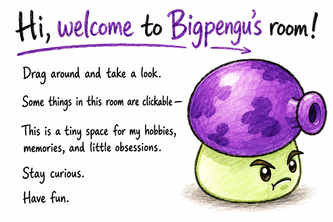
BigPengu's Little World is a self-reported personal 3D interactive website built by one individual (喷菇 big) as a creative experiment in AI-assisted development. The project presents a virtual room where visitors can explore objects that unlock personal archives—such as books, photos, music, and a terminal-based interface. It uses technologies like React, Three.js, GPT-5.6, and Codex.
What changed
The author states this was an experiment in turning visual ideas into a working 3D web experience using AI tools. No prior version or product history is described; it appears to be a one-off creative project submitted for a hackathon.
Single most important open question
Is there any evidence of commercial traction, user adoption, or revenue generation beyond the author’s personal use and hackathon submission?
What The Product Actually Is
The description states that BigPengu's Little World is an interactive 3D personal website presented as a virtual room. Visitors can navigate by dragging to look around, scrolling to zoom, and moving their cursor over objects to trigger interactions.
Each object in the room leads to different parts of the creator’s life:
- Bookshelf opens a reading archive with 18 books.
- Movement corner shows photo collections from cycling, skateboarding, and fitness.
- Record player opens an album library with playback controls.
- Camera displays photographs as a scrollable film roll.
- Computer activates a working terminal with commands like help, about, interests, and socials.
- Whiteboard and signs introduce the room or link to external pages.
The experience is built using:
- React and TypeScript
- Three.js and React Three Fiber for WebGL scene rendering
- React Three Drei for model loading and controls
- GSAP for animations and camera movement
- Blender and baked textures for 3D assets
- Vite for build tooling
Interactive elements are mapped to named meshes in the GLB model, with runtime pivots and hitboxes enabling independent animation without rebuilding the original model.
The terminal is rendered dynamically using a Canvas texture placed directly over the 3D monitor, integrating it into the physical room rather than as a separate HTML window.
Inference The product is an immersive personal website that combines storytelling, interactivity, and multimedia archives in a spatial environment. It is not described as a platform or tool for others to use, but rather as a single creator’s expression.
Positioning & Claim Evolution
The author claims this project explores a more spatial and emotional form of self-introduction than traditional personal websites, which are often reduced to headings, cards, and links.
It positions itself as:
- A personal archive that transforms everyday objects into interactive portals.
- An AI-assisted creation experiment, where GPT-5.6 and Codex were used throughout the development process.
- A creative showcase of what can be achieved with modern 3D web technologies and AI tools.
There is no indication of a broader positioning strategy beyond this single personal project or hackathon submission.
Inference The author sees value in reimagining how people present themselves online through immersive, object-based experiences. However, the claim lacks evidence of market demand or adoption by others.
Target Customer & ICP
The description does not identify a specific target customer or ideal customer profile (ICP). It is framed as a personal website created for one individual — 喷菇 big — and submitted to a hackathon.
There is no mention of:
- Who uses the product
- Who it’s designed for beyond the creator
- Any audience segmentation or user personas
Inference The primary user is the creator themselves. There is no evidence of an external customer base or commercial target market.
Business Model & Pricing Evidence
No business model or pricing information is provided in the description.
The author states:
- This was a personal experiment
- Built for a hackathon submission
- Not intended as a commercial product
There is no indication of monetization, licensing, subscriptions, or any revenue streams.
Inference There is no evidence of a business model or pricing structure beyond the creator’s own use and hackathon participation.
Technical & Delivery Signals
The project was built using:
- Frontend stack: React, TypeScript, Three.js, React Three Fiber, Drei, GSAP
- Development tools: Vite, Blender, GPT-5.6, Codex
- Performance features:
- Demand-based rendering
- Lazy loading for large interfaces
- Texture and GPU prewarming
- Image lazy loading and asset preloading
- Error boundaries for WebGL failures
- Reduced-motion support
- Keyboard navigation and focus management
The author describes iterative development with AI assistance, including:
- Using GPT-5.6 to clarify direction and organize information architecture
- Using Codex to implement code, debug issues, optimize performance, and prepare deployment
Inference The technical implementation is advanced for a solo developer, involving 3D rendering, interactivity, animation, and accessibility features. However, there is no evidence of scalability or reuse beyond this single instance.
Traction & Maturity Signals
The project was submitted to the OpenAI 2026 hackathon, but no further traction or adoption is reported.
There is no evidence of:
- Users or customers
- Revenue or monetization
- Product usage metrics
- Growth or retention data
- Public deployment beyond the Devpost submission
Inference The project has not demonstrated any measurable traction or maturity as a product. It remains a personal experiment with no external validation or commercial success.
Competitive Context
The description does not reference competitors or similar products in the market.
It is described as:
- A personal 3D website
- An interactive experience using AI and modern web technologies
- Not a platform or tool for others to build upon
There is no mention of comparable offerings, such as:
- Other personal 3D websites
- AI-assisted development tools
- Web-based virtual environments or metaverse platforms
Inference No competitive landscape is evident. The project appears unique in its approach but lacks context within existing markets.
Open Questions & Risks
Key risks and open questions include:
- No commercial traction: The product has not been adopted by users or monetized.
- Single creator dependency: Built by one person; no team or organizational structure.
- Unproven scalability: No evidence of reuse, framework potential, or broader applicability.
- Limited market validation: Submitted to a hackathon — not a commercial launch.
- AI reliance: Heavy dependence on GPT-5.6 and Codex raises questions about long-term sustainability if those tools change or become unavailable.
- Technical complexity without external feedback: The author’s own experience may not reflect real-world usability or performance.
Inference The project is experimental, personal, and unproven in a commercial context. It lacks any evidence of viability as a scalable or monetizable product.
Questions the description leaves open
- What is the intended use case for this beyond a personal experiment?
- Are there plans to expand this into a reusable framework or platform?
- Has there been any user testing or feedback from people outside the creator?
- How would you scale this if someone wanted to build their own version?
- What are the long-term maintenance and hosting costs for such an experience?
- Is there any interest in monetizing or licensing this concept?
- What would it take to make this suitable for a wider audience or business use?
Overall Assessment
Not evidenced: There is no evidence of revenue, customers, traction, or commercial viability.
This project is described as a personal experiment, built by one individual using AI tools, submitted to a hackathon. It does not demonstrate any signs of a product-market fit, user adoption, or business model.
Confidence level: Low
The author states this was an experiment in AI-assisted creation and personal storytelling. There is no indication that it has evolved into anything more than a creative showcase or prototype.
Assessment: Not suitable for investment or partnership at this stage. It lacks the commercial signals necessary to assess potential value or risk.
User Stories BotA demo video on every pull request
Get a demo video on every new feature
GitHub App that watches your pull requests and records a narrated, captioned demo.
Save time on demo prep and make informed decisions faster with a video walkthrough of every new feature.
Source
Submitted to the OpenAI 2026 hackathon on Devpost. Project home on Devpost. Back to the full gallery on Devpost.
This competitive analysis was produced by top-founders.com (opens in a new tab)
Generated by a language model from this project's public Devpost page — its tagline, the author's own write-up and any built-with tags listed there — as captured in August 2026. Short quotations are the author's words. It is an opinion on the idea as a business, not on the people behind it, and it reflects the description as published then. If the project has moved on, request a correction below. The analysis is not independent research and contains no verified traction, revenue or customer data.
An independent guide by KFG International LLC — not affiliated with, endorsed by, or connected to Devpost or OpenAI.