

Archive position — measured, not model output
0 likes on Devpost
2,263 of the 7,850 archived projects have more likes, and 5,587 share exactly 0 — so this project's #6,140 place in the like-ranked listing is a tie-break inside that group, not a ranking.
Projects (log scale)
Likes on Devpost. ▲ marks this project's group.
Show the figures
| Likes | Projects | Share of archive |
|---|---|---|
| 0 | 5,587 | 71.2% |
| 1 | 1,758 | 22.4% |
| 2 | 284 | 3.6% |
| 3–4 | 132 | 1.7% |
| 5–9 | 75 | 1.0% |
| 10+ | 14 | 0.2% |
 User Stories BotA demo video on every pull request
Get a demo video on every new feature
GitHub App that watches your pull requests and records a narrated, captioned demo.
Save time on demo prep and make informed decisions faster with a video walkthrough of every new feature.
Executive Summary
What the company appears to be
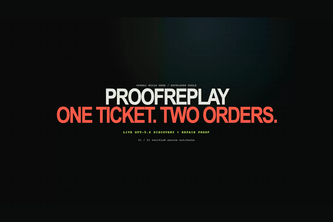
ProofReplay, as described by its author, is a self-reported tool that uses an AI model (GPT-5.6) to generate and validate invariants for software systems, particularly around concurrency issues. It claims to turn a human-approved invariant into a live-generated counterexample, exact replay, test-first repair, and content-addressed proof.
What changed
The project is presented as a hackathon submission (OpenAI 2026) with no prior history or traction. The author describes building a system that bridges AI-driven discovery and deterministic verification using a monorepo in TypeScript/Node.js, leveraging tools like Playwright, SQLite, and OpenAI APIs.
Single most important open question
Is there any evidence of real-world usage, adoption, or revenue generation beyond the author’s own demonstration? The description contains no data on customers, product-market fit, or commercial viability.
Note: This analysis is based solely on the self-reported project description provided by the caller. No external corroboration exists. All claims are treated as stated by the author and not verified.
What The Product Actually Is
The description states that ProofReplay is a system designed to:
- Take a human-approved invariant (e.g., "confirmed orders must never exceed seeded inventory")
- Use GPT-5.6 to generate a counterexample
- Execute that counterexample through HTTP sessions
- Minimize and replay the failure deterministically
- Provide a fresh model context for diagnosis and repair
- Seal each step in a content-addressed evidence bundle
It includes:
- A bounded, read-only view of a toy service
- Execution via Fastify, Playwright, FFmpeg
- Storage using SQLite (via better-sqlite3)
- UI generated from sealed bundles
- Tooling for leak scanning, verification, and canonical manifests
Inference: The product appears to be an experimental framework or prototype aimed at AI-assisted debugging and validation of concurrency-related bugs in software systems.
Positioning & Claim Evolution
The author positions ProofReplay as a tool that:
- Turns human-approved invariants into inspectable chains from discovery to repair
- Uses AI (GPT-5.6) for model-authored counterexamples, exact replays, and test-first repairs
- Provides content-addressed proofs of correctness
It is described as not claiming universal correctness but instead focusing on local correctness verification within defined boundaries.
Claim: The author states that ProofReplay intentionally avoids making broad claims about system-wide correctness.
Inference: This suggests a niche, focused approach rather than a general-purpose solution.
Target Customer & ICP
The description does not identify specific target customers or personas. It refers to a "toy service" and a "user-owned toy service", implying internal or experimental use cases.
Not evidenced: No mention of enterprise clients, developers, or teams using the tool in production environments.
Business Model & Pricing Evidence
There is no evidence of pricing, monetization strategy, or business model in the description. The project is presented as a hackathon submission with no indication of commercial intent or revenue streams.
Not evidenced: No information on how ProofReplay would be sold, licensed, or used commercially.
Technical & Delivery Signals
The author reports:
- Built using TypeScript and Node.js
- Uses Fastify, better-sqlite3, Zod, Vitest, Playwright, FFmpeg
- Implements a monorepo architecture
- Employs content-addressed bundles for evidence sealing
- Includes leak scanning, canonical SHA-256 manifests, and exact replay capabilities
Inference: The technical stack suggests an experimental or proof-of-concept system built with modern developer tools and frameworks.
Traction & Maturity Signals
The description indicates:
- This is a hackathon project (OpenAI 2026)
- It was submitted to Devpost
- No mention of users, customers, or adoption beyond the author’s own testing
- The system has been tested with one seeded ticket and reproduced 20/20 times
Not evidenced: No evidence of traction, usage metrics, or product maturity beyond a single demonstration.
Competitive Context
No competitive landscape is described. The author does not reference existing tools or platforms in this space.
Not evidenced: No information on competitors, market positioning, or differentiation from other debugging or testing tools.
Open Questions & Risks
- Unverified AI model: The project relies on GPT-5.6, which is not publicly available and likely fictional.
- No real-world usage: The system has only been tested in a controlled demo environment.
- Self-reported only: All claims are from the author; no third-party validation or data exists.
- Limited scope: Focuses narrowly on concurrency bugs within defined boundaries.
- Lack of commercialization: No evidence of monetization, product-market fit, or scalability.
Inference: The project lacks any commercial viability indicators and may be purely experimental.
Questions the description leaves open
- Is the GPT-5.6 model real? If not, what is the basis for its use in the system?
- What are the actual constraints or limitations of the current implementation?
- Has this been tested beyond the single demo case?
- Are there any plans to expand beyond the current scope (e.g., payment compensation, crash-consistent transactions)?
- How does ProofReplay integrate with existing CI/CD pipelines or development workflows?
- What are the potential risks of relying on AI-generated patches for critical systems?
Overall Assessment
There is no evidence of a functioning product, revenue, or traction beyond the author’s own demonstration. The project appears to be an experimental prototype submitted as part of a hackathon.
Assessment: Not suitable for investment or partnership at this stage.
Confidence level: Low — based entirely on self-reported claims with no external validation or data.
User Stories BotA demo video on every pull request
Get a demo video on every new feature
GitHub App that watches your pull requests and records a narrated, captioned demo.
Save time on demo prep and make informed decisions faster with a video walkthrough of every new feature.
Source
Submitted to the OpenAI 2026 hackathon on Devpost. Project home on Devpost. Back to the full gallery on Devpost.
This competitive analysis was produced by top-founders.com (opens in a new tab)
Generated by a language model from this project's public Devpost page — its tagline, the author's own write-up and any built-with tags listed there — as captured in August 2026. Short quotations are the author's words. It is an opinion on the idea as a business, not on the people behind it, and it reflects the description as published then. If the project has moved on, request a correction below. The analysis is not independent research and contains no verified traction, revenue or customer data.
An independent guide by KFG International LLC — not affiliated with, endorsed by, or connected to Devpost or OpenAI.