

Archive position — measured, not model output
0 likes on Devpost
2,263 of the 7,850 archived projects have more likes, and 5,587 share exactly 0 — so this project's #6,138 place in the like-ranked listing is a tie-break inside that group, not a ranking.
Projects (log scale)
Likes on Devpost. ▲ marks this project's group.
Show the figures
| Likes | Projects | Share of archive |
|---|---|---|
| 0 | 5,587 | 71.2% |
| 1 | 1,758 | 22.4% |
| 2 | 284 | 3.6% |
| 3–4 | 132 | 1.7% |
| 5–9 | 75 | 1.0% |
| 10+ | 14 | 0.2% |
 User Stories BotA demo video on every pull request
Get a demo video on every new feature
GitHub App that watches your pull requests and records a narrated, captioned demo.
Save time on demo prep and make informed decisions faster with a video walkthrough of every new feature.
Executive Summary
What the company appears to be
ProofRail is a self-reported tool designed to enforce persistent constraints in long-form professional documents through executable revision control. It aims to prevent silent regressions in expert-approved decisions across document revisions.
What changed
The project description indicates an evolution from conceptualizing document governance into a working MVP, built using browser-based technologies and AI assistance (GPT-5.6, Codex). The author describes the tool as a "bounded example" of a general revision-control model intended for real-world workflows.
Single most important open question
Is there evidence that ProofRail has moved beyond a prototype or demonstration into actual usage by professionals in high-stakes drafting environments?
What The Product Actually Is
The description states that ProofRail is not another text generator, but rather an executable revision-control model for long-form professional documents. It is described as:
- A system that turns expert corrections into persistent controls.
- An application that runs entirely in the browser (no backend or API required).
- A static application built with HTML, CSS, and JavaScript.
- Designed to detect regressions in later revisions and block approval until tests pass.
It uses AI tools like GPT-5.6 and Codex for implementation and modeling of corrections as decisions, rules, tests, and bounded patches.
Inference The product is a proof-of-concept demonstration, not a production-ready tool.
Positioning & Claim Evolution
The author claims ProofRail addresses a different problem than most AI drafting tools — it focuses on preventing undoing of accepted decisions, rather than generating new content.
It positions itself as an assurance layer for professional drafting workflows where correctness depends on structure, reasoning, and consistency over time.
The project evolved from a conceptual idea into a bounded demonstration, with the author noting that this MVP is intended to be representative of a broader system applicable across real-world document workflows.
Inference The positioning reflects a niche market need around controlled document governance, but lacks evidence of adoption or traction beyond the demo.
Target Customer & ICP
The description lists several professional roles who would use ProofRail:
- Lawyers and legal teams
- Regulators and regulatory affairs professionals
- Compliance, risk, and audit teams
- Policy authors and public-sector analysts
- Consultants and evidence-based researchers
- Technical writers, architects, and engineering teams
These users are characterized by working with long, high-consequence documents where expert decisions must remain intact across revisions.
Inference The ICP is defined by document complexity and consequence, not by scale or volume of use.
Business Model & Pricing Evidence
There is no mention of pricing, monetization, or business model in the description. The author does not describe any revenue streams, customer acquisition plans, or commercial strategy.
Not evidenced
Technical & Delivery Signals
The MVP is described as:
- A dependency-free static application
- Built with HTML, CSS, JavaScript
- Runs entirely in the browser
- Requires no backend, API keys, credentials, or build process
- Uses AI tools like GPT-5.6 and Codex for development
It implements features such as:
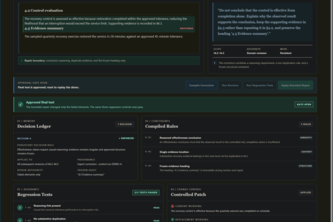
- Decision ledger
- Explicit rules describing what must be preserved
- Executable regression tests
- Controlled patch showing original vs replacement wording
- Approval gate that remains closed until tests pass
Inference The technical approach is lightweight and browser-based, suggesting early-stage prototyping rather than scalable infrastructure.
Traction & Maturity Signals
There is no evidence of traction or maturity beyond the MVP demonstration. No customers, users, or adoption data are provided. The project was submitted to a hackathon (OpenAI 2026), indicating it is in an exploratory phase.
Not evidenced
Competitive Context
The description does not provide information about existing competitors or market positioning relative to other tools for document control, versioning, or AI-assisted drafting.
Not evidenced
Open Questions & Risks
- Prototype-only status: The tool is described as a bounded example and MVP — no indication of production readiness.
- No commercial evidence: No revenue, customers, or business model are mentioned.
- Limited scope: The demonstration only covers one document type and workflow.
- Self-reported claims: All descriptions are self-reported and unverified.
- Single-person team: The project is built by one individual (Dee Lego), raising questions about scalability and long-term maintenance.
Questions the description leaves open
- What specific professional workflows or use cases have you validated beyond the MVP?
- How do you plan to scale this from a browser-based prototype to enterprise-grade document control systems?
- Have you identified any early adopters or pilot users in your target customer segments?
- What is your roadmap for moving from demonstration to production-ready software?
- Are there any partnerships or integrations with existing document management platforms?
Overall Assessment
The description indicates that ProofRail is a conceptual and prototypical tool, built as part of a hackathon submission. It shows potential in addressing a real need for controlled document revision, but lacks evidence of traction, commercial viability, or product-market fit.
Confidence: Low
This is a pre-MVP concept with no demonstrated market validation, revenue, or customer base. Any investment or partnership decision should be contingent on further development and proof of usage in target markets.
User Stories BotA demo video on every pull request
Get a demo video on every new feature
GitHub App that watches your pull requests and records a narrated, captioned demo.
Save time on demo prep and make informed decisions faster with a video walkthrough of every new feature.
Source
Submitted to the OpenAI 2026 hackathon on Devpost. Project home on Devpost. Back to the full gallery on Devpost.
This competitive analysis was produced by top-founders.com (opens in a new tab)
Generated by a language model from this project's public Devpost page — its tagline, the author's own write-up and any built-with tags listed there — as captured in August 2026. Short quotations are the author's words. It is an opinion on the idea as a business, not on the people behind it, and it reflects the description as published then. If the project has moved on, request a correction below. The analysis is not independent research and contains no verified traction, revenue or customer data.
An independent guide by KFG International LLC — not affiliated with, endorsed by, or connected to Devpost or OpenAI.