

Archive position — measured, not model output
2 likes on Devpost
221 of the 7,850 archived projects have more likes, and 284 share exactly 2 — so this project's #251 place in the like-ranked listing is a tie-break inside that group, not a ranking.
Projects (log scale)
Likes on Devpost. ▲ marks this project's group.
Show the figures
| Likes | Projects | Share of archive |
|---|---|---|
| 0 | 5,587 | 71.2% |
| 1 | 1,758 | 22.4% |
| 2 | 284 | 3.6% |
| 3–4 | 132 | 1.7% |
| 5–9 | 75 | 1.0% |
| 10+ | 14 | 0.2% |
 User Stories BotA demo video on every pull request
Get a demo video on every new feature
GitHub App that watches your pull requests and records a narrated, captioned demo.
Save time on demo prep and make informed decisions faster with a video walkthrough of every new feature.
Executive Summary
What the company appears to be
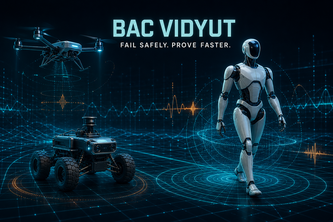
BAC VIDYUT is a browser-based developer tool for testing autonomous machines (e.g., drones, rovers, humanoid robots) in virtual environments before physical trials. It enables teams to validate machine configurations, simulate failure scenarios, and capture reproducible evidence of system behavior.
What changed
The project was developed as part of an OpenAI 2026 hackathon submission. The authors describe it as a prototype tool that integrates with existing engineering ecosystems like Gazebo, PX4, and FMI 3.0 through adapters, while offering its own deterministic execution engine for readiness checks and test planning.
Single most important open question
Is there any evidence of traction or early adoption beyond the hackathon demo? The description does not indicate whether BAC VIDYUT has moved past prototype stage or been used by external customers.
What The Product Actually Is
The description states that BAC VIDYUT is a browser-based developer tool built with JavaScript, Node.js, Three.js, WebGL, and the Web Serial API. It supports:
- Importing machine geometry and engineering data from formats such as URDF, SDF, STEP, glTF/GLB, and KiCad netlists.
- Defining machine components, power rails, communication buses, pin mappings, and assumptions in a versioned manifest.
- Validating readiness for physical testing by detecting issues like incompatible voltage ranges, insufficient current capacity, duplicate I2C addresses, reused pins, invalid interfaces, or incomplete mechanical properties.
- Composing repeatable failure tests using 25 templates covering sensing, navigation, actuation, power, communications, compute, mission, and combined faults.
- Executing tests in either Software-in-the-Loop (SIL) mode or Hardware-in-the-Loop (HIL) via a Web Serial bridge that supports bounded commands, sequence checks, watchdogs, and emergency stops.
- Exporting results as JSON, CSV, HTML reports, or backend adapter packages.
It also includes an automated test suite with 18 passing tests covering core workflows.
Inference The tool appears to be designed for robotics and autonomy engineers working on physical systems who want to validate their designs virtually before costly real-world trials.
Positioning & Claim Evolution
The description states that BAC VIDYUT aims to "follow an autonomous machine through its geometry, electronics, controller interfaces, environment, and failure response so teams can find integration problems before a costly physical trial."
It positions itself as a tool that unifies fragmented workflows across CAD tools, wiring documents, simulators, firmware terminals, and manually assembled reports into one reviewable workflow.
The authors note that smaller robotics and space teams may not have the budget or safe locations to discover integration issues through repeated physical testing.
Inference BAC VIDYUT is positioned as a readiness and validation layer for engineering teams building autonomous machines. It does not claim to replace established tools like Gazebo, PX4, or Isaac Sim but rather sits between them and the physical trial phase.
Target Customer & ICP
The description states that BAC VIDYUT is intended for robotics, physical-AI, autonomy, and space-engineering teams. These users are described as those who need to validate machine configurations and test failure scenarios before entering physical trials.
It also mentions that the tool supports humanoid robots, drones, rovers, and spacecraft, suggesting a broad application across autonomous systems.
Inference The target customer is likely engineering teams in small to mid-sized companies or research groups focused on robotics, autonomy, and space applications. The ICP seems to be engineers working with embedded controllers and simulation environments.
Business Model & Pricing Evidence
There is no evidence provided about a business model or pricing structure. The authors mention they are exploring up to INR 50 lakh in business financing for product development, engineering infrastructure, hardware integration, and early customer pilots, but no commercial offering or pricing details are stated.
Inference No information exists regarding monetization strategy, pricing tiers, or revenue model beyond the intent to build a startup after the hackathon.
Technical & Delivery Signals
The tool is built using:
- Frontend: JavaScript, Node.js, Three.js, WebGL, Web Serial API
- Data contracts: vidyut.machine.v2 and vidyut.evidence.v2 schemas
- Importers: Support for URDF, SDF, STEP metadata, glTF/GLB, KiCad netlists
- Execution engine: Deterministic, seed-based executor modeling aerial, ground, legged, and spacecraft behaviors
- Visualization: Three.js proving ground with articulated machines, terrain, shadows, multiple cameras, route tracking, motion constraints
- Safety features: Web Serial HIL bridge with bounded commands, acknowledgments, watchdog behavior, latched emergency stop
It uses AI (GPT-5.6 via Codex) primarily for architecture design, schema generation, research, and drafting component records — but not for execution or decision-making.
Inference The tool is technically sophisticated for a hackathon project, with modular architecture, deterministic execution, safety protocols, and integration points with existing ecosystems.
Traction & Maturity Signals
There is no evidence of traction or adoption beyond the hackathon demo. The authors state that:
- The humanoid’s complete autonomy software is not yet programmed.
- A one-click judge path demonstrates a drone under various failure conditions.
- The tool has 18 automated tests covering core workflows.
- It includes a deployed judge-ready demo that works without requiring a local rebuild.
No mention of customers, revenue, usage metrics, or product-market fit beyond the prototype stage.
Inference The project is at a pre-product-market-fit stage, likely still in early development. There is no indication of real-world use or customer feedback.
Competitive Context
The description notes that BAC VIDYUT does not aim to replace established tools such as:
- Gazebo
- PX4
- Isaac Sim
- MuJoCo
Instead, it positions itself as a readiness, test-intent, adapter, reproducibility, and evidence layer connecting these ecosystems.
It references standards like FMI 3.0, ASAM OpenSCENARIO, and hardware-in-the-loop concepts, indicating awareness of industry norms.
Inference BAC VIDYUT competes indirectly with simulation and validation tools in the robotics and autonomy space, but it does not claim to be a direct substitute for any major platform.
Open Questions & Risks
- No commercial traction or revenue: The project is described as a hackathon demo with no evidence of real-world usage.
- Unproven business model: No pricing, monetization strategy, or customer base are mentioned.
- AI dependency without execution control: While AI is used for drafting and structuring, deterministic systems retain responsibility for execution — this may be a risk if reliance on AI grows.
- Limited team size (3 members): A small team may limit scalability and product development speed.
- Unclear financing status: The authors mention seeking INR 50 lakh in funding but do not confirm approval or progress.
Inference The project lacks commercial viability indicators, and its future success depends heavily on whether it can move beyond prototype into real-world use cases.
Questions the description leaves open
- What specific engineering challenges are teams facing that BAC VIDYUT solves?
- Have any early adopters or pilot customers been identified?
- How does BAC VIDYUT integrate with existing tools like PX4, Gazebo, or FMI 3.0 in practice?
- Is there a plan to monetize the tool? What pricing model is being considered?
- What are the key technical limitations of the current implementation that would need to be addressed for production use?
- How do you intend to scale beyond the current team size and hackathon-level development?
Overall Assessment
Not evidenced
There is no evidence of revenue, customers, or traction beyond the hackathon demo. The project is described as a prototype with limited commercialization plans.
Confidence level Low This analysis is based entirely on self-reported information from a hackathon submission. No independent verification or historical data exists to support claims about product maturity, market fit, or business viability.
Inference At this stage, BAC VIDYUT appears to be an experimental tool with potential for further development. However, without evidence of traction, adoption, or a clear path to monetization, it is not ready for investment or partnership consideration.
User Stories BotA demo video on every pull request
Get a demo video on every new feature
GitHub App that watches your pull requests and records a narrated, captioned demo.
Save time on demo prep and make informed decisions faster with a video walkthrough of every new feature.
Source
Submitted to the OpenAI 2026 hackathon on Devpost. Project home on Devpost. Back to the full gallery on Devpost.
This competitive analysis was produced by top-founders.com (opens in a new tab)
Generated by a language model from this project's public Devpost page — its tagline, the author's own write-up and any built-with tags listed there — as captured in August 2026. Short quotations are the author's words. It is an opinion on the idea as a business, not on the people behind it, and it reflects the description as published then. If the project has moved on, request a correction below. The analysis is not independent research and contains no verified traction, revenue or customer data.
An independent guide by KFG International LLC — not affiliated with, endorsed by, or connected to Devpost or OpenAI.