

Archive position — measured, not model output
0 likes on Devpost
2,263 of the 7,850 archived projects have more likes, and 5,587 share exactly 0 — so this project's #6,126 place in the like-ranked listing is a tie-break inside that group, not a ranking.
Projects (log scale)
Likes on Devpost. ▲ marks this project's group.
Show the figures
| Likes | Projects | Share of archive |
|---|---|---|
| 0 | 5,587 | 71.2% |
| 1 | 1,758 | 22.4% |
| 2 | 284 | 3.6% |
| 3–4 | 132 | 1.7% |
| 5–9 | 75 | 1.0% |
| 10+ | 14 | 0.2% |
 User Stories BotA demo video on every pull request
Get a demo video on every new feature
GitHub App that watches your pull requests and records a narrated, captioned demo.
Save time on demo prep and make informed decisions faster with a video walkthrough of every new feature.
Executive Summary
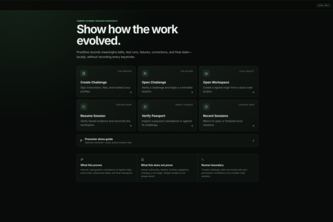
What the company appears to be: Proofline is a self-reported local desktop application that creates tamper-evident process passports for programming work. The author describes it as a tool for recording and verifying the evolution of code, including checkpoints, runs, failures, corrections, and final states — all without uploading private source code.
What changed: The project was submitted to the OpenAI 2026 hackathon, indicating an early-stage development effort with a focus on privacy-preserving, offline verification of programming workflows. It is described as a single-person effort built using Tauri, React, Rust, and other technologies.
Single most important open question: Is there any evidence that Proofline has been adopted or used beyond the author’s own development environment?
What The Product Actually Is
The description states that Proofline is a local desktop app. It records programming work as a tamper-evident process passport, which includes:
- Semantic-save checkpoints;
- File changes and reconciliations;
- Successful and failed runs;
- Exact executables, arguments, working directories, outputs, exit codes, and durations;
- Profile adaptations made for the solver’s local environment;
- Privacy-preserving focus, paste, and large-insertion signals;
- The exact workspace state used by every run;
- A signed final checkpoint.
This passport is exported as a portable .proofline file that can be verified offline. It supports structured execution profiles and arbitrary challenge files.
Inference: The product appears to be a local-first tool for capturing and verifying code workflows, with strong emphasis on cryptographic integrity, privacy, and offline verification.
Positioning & Claim Evolution
The author states that Proofline started from the question: “What if that process could be packaged as portable, verifiable evidence without recording every keystroke or uploading private source code?”
It is positioned for use in technical interviews, code review, and education, where users want to inspect how a solution evolved—not only whether it works.
The author also notes that Proofline does not claim to prove identity, authorship, originality, or the absence of AI assistance. It focuses on cryptographic integrity of the recorded process.
Inference: The positioning is niche and privacy-focused, targeting use cases where reproducibility and tamper-evidence are more important than public sharing or collaboration.
Target Customer & ICP
The description states that Proofline is useful for:
- Technical interviews;
- Code review;
- Education, particularly in inspecting how a solution evolved.
It also mentions that it can be used by teachers and students to examine the process behind a code submission.
Inference: The target customer appears to be technical educators, interviewers, or developers working in controlled environments (e.g., academic or internal review settings). It is not described as a general-purpose tool for open-source or public collaboration.
Business Model & Pricing Evidence
The description does not mention any pricing model, revenue streams, or monetization strategy. The project is presented as a single-person hackathon submission, with no indication of commercial intent or customer acquisition.
Not evidenced: No evidence of business model or pricing.
Technical & Delivery Signals
- Built using Tauri 2, React, TypeScript, and Rust.
- Uses Monaco editor for code editing.
- Rust core handles:
- Canonical serialization;
- BLAKE3 commitments;
- Ed25519 signatures;
- Event-chain replay;
- Content-addressed workspace objects;
- SQLite-backed sessions;
- Structured command execution without shell;
- Artifact export and offline verification.
- Frontend communicates with Rust via a narrow typed command boundary.
- No filesystem, shell, clipboard, or network permissions are granted to the frontend.
Inference: The technical stack suggests a secure, local-first architecture, with strong cryptographic integrity and minimal privilege exposure. It is designed for offline verification and privacy-preserving workflows.
Traction & Maturity Signals
The project was submitted to the OpenAI 2026 hackathon, indicating an early-stage development effort.
It is described as a single-person effort (1 team member) with no mention of users, customers, or adoption beyond the author’s own use.
Not evidenced: No evidence of traction, revenue, or customer base. The project is not described as having been used in production or at scale.
Competitive Context
The description does not reference any competitors or similar tools. It is unclear whether Proofline is positioned against existing code review tools, workflow capture systems, or educational platforms.
Not evidenced: No competitive landscape or comparison to existing products.
Open Questions & Risks
- Single-person development effort: Indicates limited resources and potential scalability issues.
- No traction or customer data: The tool has not been adopted beyond the author’s own use.
- Hackathon submission: Suggests a prototype or proof-of-concept, not a mature product.
- No commercial model or pricing: No indication of monetization strategy.
- Limited platform support: Currently only supports Linux; no Windows or macOS support mentioned.
Inference: The project is in an early stage and may not yet be ready for commercial adoption or widespread use.
Questions the description leaves open
- What specific use cases are you targeting, and how do you plan to validate those needs?
- Are there any users or partners currently testing Proofline beyond the author’s own workflow?
- How do you intend to scale beyond a single developer’s use case?
- What is your roadmap for platform support (Windows/macOS)?
- Is there any plan to integrate with existing development environments or educational platforms?
Overall Assessment
Not evidenced: No evidence of revenue, customers, or traction to assess investment or partnership viability.
The project is described as a single-person hackathon submission, built for local-first, privacy-preserving workflows. It shows strong technical execution and a clear niche but lacks any commercial or adoption signals.
Confidence level: Low — based on self-reported evidence only, with no third-party validation or traction data.
User Stories BotA demo video on every pull request
Get a demo video on every new feature
GitHub App that watches your pull requests and records a narrated, captioned demo.
Save time on demo prep and make informed decisions faster with a video walkthrough of every new feature.
Source
Submitted to the OpenAI 2026 hackathon on Devpost. Project home on Devpost. Back to the full gallery on Devpost.
This competitive analysis was produced by top-founders.com (opens in a new tab)
Generated by a language model from this project's public Devpost page — its tagline, the author's own write-up and any built-with tags listed there — as captured in August 2026. Short quotations are the author's words. It is an opinion on the idea as a business, not on the people behind it, and it reflects the description as published then. If the project has moved on, request a correction below. The analysis is not independent research and contains no verified traction, revenue or customer data.
An independent guide by KFG International LLC — not affiliated with, endorsed by, or connected to Devpost or OpenAI.