

Archive position — measured, not model output
0 likes on Devpost
2,263 of the 7,850 archived projects have more likes, and 5,587 share exactly 0 — so this project's #6,128 place in the like-ranked listing is a tie-break inside that group, not a ranking.
Projects (log scale)
Likes on Devpost. ▲ marks this project's group.
Show the figures
| Likes | Projects | Share of archive |
|---|---|---|
| 0 | 5,587 | 71.2% |
| 1 | 1,758 | 22.4% |
| 2 | 284 | 3.6% |
| 3–4 | 132 | 1.7% |
| 5–9 | 75 | 1.0% |
| 10+ | 14 | 0.2% |
 User Stories BotA demo video on every pull request
Get a demo video on every new feature
GitHub App that watches your pull requests and records a narrated, captioned demo.
Save time on demo prep and make informed decisions faster with a video walkthrough of every new feature.
Executive Summary
What the company appears to be
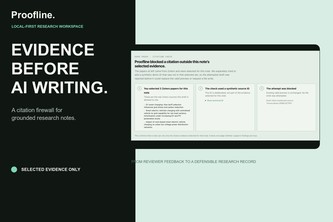
ProofLine is a self-reported local-first research assistant tool designed for academic researchers. It integrates with Zotero, Obsidian, and Overleaf, enabling users to process supervisor feedback into citation-safe drafts using selected evidence from their library.
What changed
The author states they built ProofLine to solve personal problems in managing scattered research materials and AI-assisted writing workflows during thesis work. The tool is described as a local Node.js application with a browser UI, integrating with Zotero via its Desktop API and leveraging Ollama or OpenAI for retrieval and drafting.
Single most important open question
Is there any evidence of real-world usage, adoption, or traction beyond the author’s own thesis work?
Note: All claims are self-reported by the author. No independent verification is available. This analysis is based entirely on the project description provided.
What The Product Actually Is
The description states that ProofLine is a local-first Node.js application with a browser UI, built to help researchers process feedback into grounded notes using selected sources from Zotero.
It uses:
- A workflow core storing task decisions, selected evidence, and revision history.
- Zotero read-only access via its Desktop API.
- Local Ollama embeddings for retrieval (with fallback metadata).
- Codex CLI for generating validated task graphs and drafts only from chosen evidence.
- Judge mode with deterministic fixture data for demos.
The tool is described as not modifying Zotero, and citations are checked before preview to ensure only approved sources appear in drafts.
Inference: The product appears to be a developer-facing research assistant, not a consumer-grade tool. It is built around local workflows and citation control.
Positioning & Claim Evolution
The author positions ProofLine as a solution for researchers who want to use AI without letting it take over their decisions. Key claims include:
- It helps manage scattered research materials (supervisor comments, papers in Zotero, notes in Obsidian, writing in Overleaf).
- It allows users to decide which papers count as evidence.
- It prevents unapproved citations from appearing in drafts.
- It supports “Claim Traceback” — a feature that connects a note back through chosen papers, approved tasks, and original feedback.
The positioning is self-described as a tool for academic researchers who want to maintain control over their research decisions while using AI.
Inference: The product evolved from personal need rather than market demand. It is positioned as a research decision support system, not a general-purpose AI writing assistant.
Target Customer & ICP
The description states that ProofLine was built for academic researchers working on thesis-level projects, particularly those using tools like Zotero, Obsidian, and Overleaf.
It targets users who:
- Have scattered research materials.
- Want to use AI to assist in writing but not lose control of their sources.
- Need citation safety and traceability.
Inference: The ICP is likely a small cohort of academic researchers or graduate students working on long-form research projects, with no evidence of broader market segmentation or customer acquisition.
Business Model & Pricing Evidence
The description does not mention any pricing model, revenue streams, or monetization strategy. It only describes the tool as a local-first application and a personal project.
Not evidenced: No business model, pricing, or monetization details are provided.
Technical & Delivery Signals
The author states that ProofLine is:
- A Node.js application with a browser UI.
- Built using Codex CLI, GPT-5.6, and local tools like Ollama.
- Uses Zotero Desktop API in read-only mode.
- Employs local embeddings for retrieval, with fallback to metadata.
- Includes Judge Mode that runs without credentials or Zotero installation.
Inference: The technical stack is minimal and developer-focused. It emphasizes local execution and control over data flow, which may appeal to privacy-conscious users but limits scalability.
Traction & Maturity Signals
The description does not provide any evidence of:
- Revenue
- Customers
- Usage metrics
- Product adoption
- Market traction
It only mentions:
- A demo using deterministic fixture data
- 184 out of 184 tests passing
- The author’s own thesis work as the use case
Not evidenced: No signs of real-world usage or product-market fit beyond the author’s personal experience.
Competitive Context
The description does not mention any competitors. However, based on its functionality (research assistant, citation control, integration with Zotero/Obsidian/Overleaf), it may compete with:
- Tools for managing academic writing and citations
- AI-assisted research platforms
- Local-first note-taking tools with citation support
Inference: The competitive landscape is not described. It appears to be a niche tool for academic researchers, possibly filling an unmet need in citation safety and traceability.
Open Questions & Risks
Key risks include:
- No evidence of real-world usage or adoption.
- Single-person team (1 member) may limit scalability or product development speed.
- Local-first design may hinder broader market appeal or ease of use for non-developers.
- No pricing, monetization, or business model described.
- Self-reported only: No external validation or third-party data.
Inference: The tool is in a very early stage and lacks any commercial traction or clear path to product-market fit.
Questions the description leaves open
- What specific academic use cases have you tested ProofLine with beyond your own thesis?
- How do you plan to scale beyond a single-user, local-first model?
- Have you validated the need for citation control and traceability in real research workflows?
- Are there any plans to integrate with other tools or platforms beyond Zotero/Obsidian/Overleaf?
- What is your roadmap for monetization or product evolution?
Overall Assessment
Not evidenced: No data on revenue, customers, traction, or financials.
Assessment: ProofLine appears to be a personal project built by one developer to solve a personal research problem. It has no demonstrated commercial traction, business model, or market validation. The tool is described as local-first and niche, with no evidence of broader adoption or scalability.
It may be of interest for:
- Early-stage product development or proof-of-concept investment
- Academic or research-focused partnerships
- Developer tools or AI-assisted writing ecosystems
But it is not ready for large-scale commercial investment or partnership without further validation and traction.
User Stories BotA demo video on every pull request
Get a demo video on every new feature
GitHub App that watches your pull requests and records a narrated, captioned demo.
Save time on demo prep and make informed decisions faster with a video walkthrough of every new feature.
Source
Submitted to the OpenAI 2026 hackathon on Devpost. Project home on Devpost. Back to the full gallery on Devpost.
This competitive analysis was produced by top-founders.com (opens in a new tab)
Generated by a language model from this project's public Devpost page — its tagline, the author's own write-up and any built-with tags listed there — as captured in August 2026. Short quotations are the author's words. It is an opinion on the idea as a business, not on the people behind it, and it reflects the description as published then. If the project has moved on, request a correction below. The analysis is not independent research and contains no verified traction, revenue or customer data.
An independent guide by KFG International LLC — not affiliated with, endorsed by, or connected to Devpost or OpenAI.