

Archive position — measured, not model output
2 likes on Devpost
221 of the 7,850 archived projects have more likes, and 284 share exactly 2 — so this project's #241 place in the like-ranked listing is a tie-break inside that group, not a ranking.
Projects (log scale)
Likes on Devpost. ▲ marks this project's group.
Show the figures
| Likes | Projects | Share of archive |
|---|---|---|
| 0 | 5,587 | 71.2% |
| 1 | 1,758 | 22.4% |
| 2 | 284 | 3.6% |
| 3–4 | 132 | 1.7% |
| 5–9 | 75 | 1.0% |
| 10+ | 14 | 0.2% |
 User Stories BotA demo video on every pull request
Get a demo video on every new feature
GitHub App that watches your pull requests and records a narrated, captioned demo.
Save time on demo prep and make informed decisions faster with a video walkthrough of every new feature.
Executive Summary
What the company appears to be
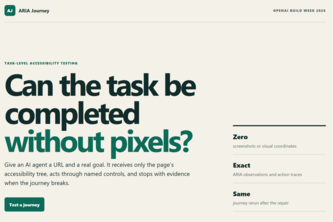
ARIA Journey is a self-reported tool that uses an AI agent to simulate web tasks through semantic-only accessibility structures (i.e., without visual cues), aiming to identify invisible barriers in web interfaces for users relying on assistive technologies.
What changed
The author states this is a new project built during OpenAI Build Week, inspired by prior work on voice-first accessibility. It represents a shift from rule-based accessibility checking to task-based simulation using an AI agent.
Single most important open question
Does ARIA Journey actually simulate real user journeys reliably enough to be useful for developers, or does it fail in ways that make its output misleading?
What The Product Actually Is
The description states that ARIA Journey:
- Puts an AI agent into a "digital blindfold" — meaning the agent receives only semantic accessibility data (headings, fields, buttons) and not visual information.
- Uses GPT-5.6 to perform real web tasks such as reserving a room.
- Operates without seeing screenshots or pixels; it relies on named accessible controls.
- Creates grounded Markdown repair briefs for Codex when the agent fails to complete a task.
- Is designed to help solo developers and small teams find accessibility issues early.
The author also notes that:
- It was built using TypeScript, Express, Playwright, OpenAI API, Docker, Render, GitHub Actions.
- The demo includes both broken and repaired versions of pages to show how the agent identifies failures.
- Codex was used as a development collaborator throughout the process.
Inference Based on the author's own description, ARIA Journey is an experimental tool that simulates accessibility barriers using AI agents in a controlled environment. It is not described as a commercial product or platform with users or customers.
Positioning & Claim Evolution
The author claims:
- ARIA Journey asks a more human question: “Can someone actually finish what they came here to do?”
- Unlike traditional tools that return scores, this tool focuses on task completion.
- It is meant to be an early warning system for solo developers and small teams who may not realize their interfaces contain invisible barriers.
- It is not a certification tool or replacement for disabled testers or accessibility professionals.
The positioning evolved from:
- A personal curiosity about accessibility gaps in web design.
- An exploration of how AI might simulate real user experiences without visual input.
- A practical solution aimed at developers who lack dedicated accessibility testing resources.
Inference The product is positioned as a developer tool for early-stage accessibility validation, not as a full-fledged audit or certification system. It emphasizes its role in helping developers detect problems before users encounter them.
Target Customer & ICP
The description states:
- ARIA Journey is designed for solo developers and small teams.
- These users may not realize their interfaces contain invisible barriers.
- The tool aims to help these users arrive at deeper reviews better prepared.
There is no mention of enterprise customers, large organizations, or specific industries beyond general web development.
Inference The ICP appears to be individual developers or small development teams working on websites or applications where accessibility is a concern but not yet prioritized or fully implemented. No evidence suggests targeting larger enterprises or accessibility agencies.
Business Model & Pricing Evidence
The description does not provide any information about:
- Revenue streams
- Pricing models
- Monetization strategy
- Customer acquisition plans
- Subscription tiers or usage-based pricing
Not evidenced
Technical & Delivery Signals
The author states:
- Built with technologies including: aria, chromium, codex, css3, docker, express.js, github, gpt-5.6, html5, node.js, openai, playwright, render, typescript.
- Uses GPT-5.6 to operate the journey itself.
- Receives task, page accessibility structure, and previous action history.
- Chooses limited actions or reports success/failure.
- Produces Markdown repair briefs for Codex.
- Includes automated tests, Docker deployment, and GitHub Actions.
Inference The tool is built in a modern stack with clear integration points (e.g., Playwright for browser automation, OpenAI API for AI agent behavior). It uses TypeScript and Express.js for backend logic. However, the author does not describe how it scales or integrates into existing workflows beyond local demos.
Traction & Maturity Signals
The description states:
- This is a project built during OpenAI Build Week.
- It includes a controlled demo showing broken and repaired pages.
- The demo allows users to experience the mouse-only barrier themselves.
- It has been submitted to a hackathon (Devpost).
- There is no mention of actual users, customers, or adoption metrics.
Not evidenced
Competitive Context
The description does not provide:
- Names of competitors
- Market positioning relative to existing accessibility tools
- Comparison with other AI-based or rule-based accessibility platforms
Not evidenced
Open Questions & Risks
Key risks and open questions based on the self-reported account:
- Lack of real-world validation: The tool is described as a demo, not a production-ready platform.
- Limited scope: It only works with specific tasks and pages; no evidence of scalability or support for complex journeys.
- AI agent reliability: No indication that GPT-5.6 consistently identifies or resolves accessibility issues reliably.
- No commercial viability: No mention of monetization, customer base, or long-term roadmap beyond personal goals.
- Dependency on external tools: Relies heavily on Codex and OpenAI APIs — both of which could change or become unavailable.
Inference The project is experimental and likely not ready for commercial use. Its utility depends on the accuracy and consistency of GPT-5.6, which may vary significantly across different scenarios.
Questions the description leaves open
- What are the actual limitations of the AI agent in simulating real user behavior?
- How does it handle edge cases or complex interactions that aren’t covered in the demo?
- Is there any testing or validation done beyond the controlled demo environment?
- What is the intended path from this prototype to a usable product for developers?
- Are there plans to expand beyond the current browser-based simulation to mobile or desktop apps?
- How does it ensure that Markdown repair briefs are actionable and accurate?
Overall Assessment
The author describes ARIA Journey as an experimental tool built during a hackathon, with no evidence of traction, revenue, or customer adoption.
It is not described as a commercial product or platform with users or customers. The project appears to be a proof-of-concept for developer-focused accessibility validation using AI agents.
Assessment Not suitable for investment or partnership at this stage. It lacks demonstrated market need, scalability, or commercial viability. It may evolve into something valuable, but currently, it is a prototype without evidence of real-world utility or traction.
User Stories BotA demo video on every pull request
Get a demo video on every new feature
GitHub App that watches your pull requests and records a narrated, captioned demo.
Save time on demo prep and make informed decisions faster with a video walkthrough of every new feature.
Source
Submitted to the OpenAI 2026 hackathon on Devpost. Project home on Devpost. Back to the full gallery on Devpost.
This competitive analysis was produced by top-founders.com (opens in a new tab)
Generated by a language model from this project's public Devpost page — its tagline, the author's own write-up and any built-with tags listed there — as captured in August 2026. Short quotations are the author's words. It is an opinion on the idea as a business, not on the people behind it, and it reflects the description as published then. If the project has moved on, request a correction below. The analysis is not independent research and contains no verified traction, revenue or customer data.
An independent guide by KFG International LLC — not affiliated with, endorsed by, or connected to Devpost or OpenAI.