

Archive position — measured, not model output
2 likes on Devpost
221 of the 7,850 archived projects have more likes, and 284 share exactly 2 — so this project's #243 place in the like-ranked listing is a tie-break inside that group, not a ranking.
Projects (log scale)
Likes on Devpost. ▲ marks this project's group.
Show the figures
| Likes | Projects | Share of archive |
|---|---|---|
| 0 | 5,587 | 71.2% |
| 1 | 1,758 | 22.4% |
| 2 | 284 | 3.6% |
| 3–4 | 132 | 1.7% |
| 5–9 | 75 | 1.0% |
| 10+ | 14 | 0.2% |
 User Stories BotA demo video on every pull request
Get a demo video on every new feature
GitHub App that watches your pull requests and records a narrated, captioned demo.
Save time on demo prep and make informed decisions faster with a video walkthrough of every new feature.
Executive Summary
Company: Astralis
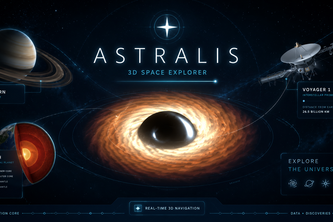
Self-reported purpose: A 3D space learning app that allows users to explore the solar system, planets, missions, stars, and black holes through an interactive experience.
Key claim: To turn the universe into a classroom you can explore.
What changed: The project is a hackathon submission (Devpost entry for OpenAI 2026 hackathon). It represents an early-stage prototype with no evidence of revenue, customers or product-market fit.
Single most important open question: Is there a viable commercial path beyond the hackathon demo, and does the team have a plan to scale beyond a proof-of-concept?
What The Product Actually Is
The description states that Astralis is a 3D space learning app built with React, TypeScript, Three.js, and other web technologies. It allows users to:
- Move through the Solar System
- Inspect planets
- Follow orbits
- Control time
- Explore missions
- View planetary interiors
- Ask an AI guide questions about what they see
It also includes Sky Mode, Stars Explorer, and a Black Hole mode.
The app is described as a single, integrated product that connects different modes of exploration without feeling disconnected. The team built it using tools like Codex for faster iteration, and focused on 3D scenes, camera movement, performance, and interactions.
Evidence: Self-reported by the authors.
Confidence: Low — no independent verification or user data.
Positioning & Claim Evolution
The author states that Astralis was built because most space apps feel either too basic or too technical, and they wanted something you could actually explore, not just read.
The tagline is: “Astralis turns the universe into a classroom you can explore.”
This positions the product as an educational tool for astronomy with a strong emphasis on interactivity and immersive experience. The claim is that it bridges the gap between simple space apps and overly technical tools by offering a user-friendly, exploratory interface.
The long-term goal, according to the authors, is to turn Astralis into a full platform for learning astronomy through exploration, suggesting an evolution from a prototype to a more comprehensive product.
Evidence: Self-reported.
Confidence: Low — no evidence of market positioning or user feedback.
Target Customer & ICP
The description does not state the target customer or ICP (Ideal Customer Profile) explicitly.
However, based on the app’s nature as a 3D educational tool for astronomy, it is likely aimed at:
- Students and educators
- Science enthusiasts
- Learners interested in space and planetary science
There is no indication of specific demographics, usage scenarios, or customer segments beyond general interest in space education.
Evidence: Inferred from product description.
Confidence: Low — no evidence of target customer definition or segmentation.
Business Model & Pricing Evidence
The project description does not mention any business model, pricing, or monetization strategy.
It is unclear whether the app will be:
- Freemium
- Subscription-based
- Paid one-time purchase
- B2B (e.g., schools, museums)
- B2C (individual learners)
There is no evidence of revenue streams, pricing tiers, or monetization plans beyond the hackathon demo.
Evidence: Not evidenced.
Confidence: Very low — no commercial strategy described.
Technical & Delivery Signals
The team used:
- React
- TypeScript
- Three.js
- React Three Fiber
- Zustand
- Tailwind CSS
- Codex
They also mention:
- Building 3D scenes
- Camera movement and performance optimization
- Handling large-scale data (e.g., planetary distances)
- Interactions between modes
The team notes that they spent significant time on:
- Camera movement
- Performance
- Labels
- Transitions between modes
This suggests a technical focus on user experience, 3D rendering, and interactivity.
Evidence: Self-reported.
Confidence: Medium — the tech stack is detailed, but no delivery or scalability data.
Traction & Maturity Signals
The project is described as a hackathon submission, submitted to the OpenAI 2026 hackathon on Devpost.
There is no evidence of traction, such as:
- Users
- Revenue
- Customers
- Product-market fit
- Adoption metrics
- Iteration history or product development beyond the demo
The authors describe it as a proof-of-concept and mention future plans, but no data supports current usage or impact.
Evidence: Not evidenced.
Confidence: Very low — no traction or maturity indicators.
Competitive Context
The description does not provide any information about:
- Competitors
- Market landscape
- Existing players in the 3D space education or astronomy learning space
It is unclear whether there are existing tools or platforms that offer similar experiences, nor how Astralis would differentiate itself.
Evidence: Not evidenced.
Confidence: Very low — no competitive analysis provided.
Open Questions & Risks
- No commercialization plan: No mention of pricing, monetization, or business model.
- Low traction: The project is a hackathon demo with no evidence of adoption or user feedback.
- Unproven market demand: No indication that there’s a real need for this product beyond the prototype.
- Limited team size: Only two members, which may limit execution and scalability.
- Technical complexity without validation: 3D rendering and performance are complex; no evidence of how they’ve addressed these at scale.
- No user data or feedback: The app is described as a demo, not a product in use.
Evidence: Inferred from lack of evidence.
Confidence: Medium — based on absence of key signals.
Questions the description leaves open
- What is the intended business model for Astralis? How do you plan to monetize it?
- Who are your target users, and how did you identify them?
- Have you tested the app with real users or educators? What feedback have you received?
- What are the key technical challenges you've faced in scaling the 3D experience?
- How do you plan to expand beyond the current features (e.g., missions, stars, black holes)?
- What is your roadmap for product development and user engagement?
- Are there any partnerships or integrations with schools, museums, or educational platforms?
- Do you have a plan to build a sustainable team or raise funding?
Overall Assessment
Not evidenced.
The project is described as a hackathon demo, with no evidence of:
- Revenue
- Customers
- Product-market fit
- Commercial strategy
- Team traction or scalability
It is an early-stage idea, likely in the prototype phase. The team has technical capability (based on tech stack), but there is no indication that it has moved beyond a proof-of-concept.
Confidence: Very low — this is not a product ready for investment or partnership at this stage.
User Stories BotA demo video on every pull request
Get a demo video on every new feature
GitHub App that watches your pull requests and records a narrated, captioned demo.
Save time on demo prep and make informed decisions faster with a video walkthrough of every new feature.
Source
Submitted to the OpenAI 2026 hackathon on Devpost. Project home on Devpost. Back to the full gallery on Devpost.
This competitive analysis was produced by top-founders.com (opens in a new tab)
Generated by a language model from this project's public Devpost page — its tagline, the author's own write-up and any built-with tags listed there — as captured in August 2026. Short quotations are the author's words. It is an opinion on the idea as a business, not on the people behind it, and it reflects the description as published then. If the project has moved on, request a correction below. The analysis is not independent research and contains no verified traction, revenue or customer data.
An independent guide by KFG International LLC — not affiliated with, endorsed by, or connected to Devpost or OpenAI.