

Archive position — measured, not model output
2 likes on Devpost
221 of the 7,850 archived projects have more likes, and 284 share exactly 2 — so this project's #245 place in the like-ranked listing is a tie-break inside that group, not a ranking.
Projects (log scale)
Likes on Devpost. ▲ marks this project's group.
Show the figures
| Likes | Projects | Share of archive |
|---|---|---|
| 0 | 5,587 | 71.2% |
| 1 | 1,758 | 22.4% |
| 2 | 284 | 3.6% |
| 3–4 | 132 | 1.7% |
| 5–9 | 75 | 1.0% |
| 10+ | 14 | 0.2% |
 User Stories BotA demo video on every pull request
Get a demo video on every new feature
GitHub App that watches your pull requests and records a narrated, captioned demo.
Save time on demo prep and make informed decisions faster with a video walkthrough of every new feature.
Executive Summary
What the company appears to be
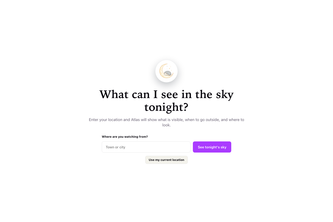
Atlas is a self-reported personal astronomy app for smartphone users, built as a progressive web app (PWA) with offline capabilities. The author describes it as an app that answers "what can I see tonight, and is it worth stepping outside?" and guides users to observe celestial objects using only their phone.
What changed
The project was submitted to the OpenAI 2026 hackathon on Devpost. It is a solo effort by Liam Arbuckle, who describes building a tool for stargazers with minimal equipment.
Single most important open question
Is there evidence of user adoption or engagement beyond the author's own experience?
The description states that Atlas is a personal astronomy app built as a PWA using React, TypeScript, Vite, and various astronomical libraries. It provides personalized sky plans based on location, weather, and timing, with offline-first design and camera tips for phone-based observation.
There is no evidence of revenue, customers, or traction beyond the author's own account. The project appears to be a prototype or proof-of-concept built for a hackathon, with no indication of commercial deployment or user base.
What The Product Actually Is
The description states that Atlas is:
- A progressive web app (PWA) built with React, TypeScript, and Vite
- Designed to answer "what can I see tonight, and is it worth stepping outside?"
- A tool for helping users identify visible astronomical objects from their location
- Capable of providing pointing guidance, best viewing windows, camera tips, reminders, and a journal for logging attempts
- Built with offline-first capabilities using IndexedDB and Dexie
- Powered by astronomy-engine, satellite.js, weather scoring, and PocketBase backend
- Intended to be installable on mobile devices
The author describes it as an app that helps users "answer one simple question: 'What can I actually see tonight, from where I am, with the equipment I have?'" It is designed for beginners who may not own telescopes or know astronomical jargon.
Positioning & Claim Evolution
The description states that Atlas:
- Positions itself as an app that answers "what can I see tonight, and is it worth stepping outside?"
- Is built to help users with minimal equipment (just eyes and a smartphone)
- Aims to make astronomy approachable instead of intimidating
- Focuses on practicality over technical precision
- Helps users build a personal observing record
- Became less about perfect astrophotography and more about encouraging regular looking up
The author claims the app balances "precision with approachability" by considering factors like weather, moonlight, altitude, timing, light pollution, event type, equipment, and phone-camera feasibility. It is positioned as helping users overcome barriers of confidence, timing, and knowing what counts as a successful first experience.
Target Customer & ICP
The description states that Atlas targets:
- People who love stargazing but live in cities or have minimal equipment
- Users who are "the sort of person to have spent thousands on telescopes and other equipment for stargazing" but now only have eyes and a smartphone
- Beginners who may not own telescopes, know constellations, or understand astronomical jargon
- People who want to "get the most out of the night sky" with minimal tools
The author notes that the biggest barrier to astronomy is often not equipment, but confidence, timing, and knowing what counts as a successful first experience. The app is positioned for users who are interested in stargazing but may be discouraged by technical complexity or lack of proper equipment.
Business Model & Pricing Evidence
Not evidenced.
The description does not contain any information about pricing, monetization strategy, or business model. There is no mention of paid features, subscriptions, advertising, or revenue streams.
Technical & Delivery Signals
The description states that Atlas:
- Is built as a React, TypeScript, and Vite progressive web app
- Uses astronomy-engine for real sky positioning
- Uses satellite.js for satellite passes
- Uses weather and sky-condition scoring for tonight recommendations
- Has an offline-first IndexedDB layer with Dexie
- Uses PocketBase for backend services including sky events, user observations, watchlists, demo access, and community features
- Includes scheduled ingestion scripts to collect and normalize astronomical events
- Turns collected data into a ranked "tonight" plan readable for beginners
- Is installable on mobile devices
The author notes that the app is designed for imperfect conditions (clouds, cities, bad timing, limited gear) and emphasizes offline-first design because stargazing often happens away from perfect connectivity.
Traction & Maturity Signals
Not evidenced.
There is no evidence of user adoption, engagement metrics, customer base, or any traction indicators. The description states that this was a hackathon project built by one person (Liam Arbuckle) and does not mention any users beyond the author's own experience.
The author describes it as a prototype or proof-of-concept, with no indication of commercial deployment or user base. The project is described as being submitted to a hackathon, suggesting it may be early-stage development.
Competitive Context
Not evidenced.
The description does not contain any information about competitors, market positioning relative to other astronomy apps, or competitive landscape. There is no mention of existing products in this space or how Atlas differentiates from them.
Open Questions & Risks
Inferences based on the description:
- The project appears to be a solo effort (one team member) with no evidence of traction or commercial deployment
- It was built for a hackathon, suggesting it may be early-stage development without proven market demand
- There is no evidence of revenue, customers, or user engagement beyond the author's own account
- The app is described as a "personal astronomy app" that helps users with minimal equipment, but there's no indication of how this addresses broader market needs or scalability
- The lack of any commercial or user data makes it difficult to assess viability or growth potential
Questions the description leaves open
- What specific user problems are you solving, and how do you know these problems exist?
- Have you validated your concept with actual users beyond yourself?
- How do you plan to monetize this app if you're targeting casual stargazers?
- What is your roadmap for scaling beyond a single developer?
- How do you plan to acquire users in the astronomy community?
- What are the technical challenges of maintaining accurate astronomical data feeds at scale?
- How do you define success for this product, and what metrics will you track?
Overall Assessment
Not evidenced.
The description provides no information about funding rounds, valuations, or investment history. There is no indication of whether this project has received any investment or partnership interest beyond its submission to a hackathon. The author states that the project was submitted to the OpenAI 2026 hackathon and built by one person, with no evidence of commercial traction or investor interest.
The project appears to be early-stage development without proven market demand or user engagement. Without evidence of revenue, customers, or traction, it is difficult to assess its investment potential or partnership viability.
User Stories BotA demo video on every pull request
Get a demo video on every new feature
GitHub App that watches your pull requests and records a narrated, captioned demo.
Save time on demo prep and make informed decisions faster with a video walkthrough of every new feature.
Source
Submitted to the OpenAI 2026 hackathon on Devpost. Project home on Devpost. Back to the full gallery on Devpost.
This competitive analysis was produced by top-founders.com (opens in a new tab)
Generated by a language model from this project's public Devpost page — its tagline, the author's own write-up and any built-with tags listed there — as captured in August 2026. Short quotations are the author's words. It is an opinion on the idea as a business, not on the people behind it, and it reflects the description as published then. If the project has moved on, request a correction below. The analysis is not independent research and contains no verified traction, revenue or customer data.
An independent guide by KFG International LLC — not affiliated with, endorsed by, or connected to Devpost or OpenAI.