

Archive position — measured, not model output
0 likes on Devpost
2,263 of the 7,850 archived projects have more likes, and 5,587 share exactly 0 — so this project's #4,171 place in the like-ranked listing is a tie-break inside that group, not a ranking.
Projects (log scale)
Likes on Devpost. ▲ marks this project's group.
Show the figures
| Likes | Projects | Share of archive |
|---|---|---|
| 0 | 5,587 | 71.2% |
| 1 | 1,758 | 22.4% |
| 2 | 284 | 3.6% |
| 3–4 | 132 | 1.7% |
| 5–9 | 75 | 1.0% |
| 10+ | 14 | 0.2% |
 User Stories BotA demo video on every pull request
Get a demo video on every new feature
GitHub App that watches your pull requests and records a narrated, captioned demo.
Save time on demo prep and make informed decisions faster with a video walkthrough of every new feature.
Executive Summary
Project: focustrack
Self-reported basis: The analysis is based entirely on the author's own description of focustrack, submitted as part of a Devpost entry for the OpenAI 2026 hackathon. No external verification or historical data are available.
What it appears to be: A productivity and parental control application designed to help families manage time, stay focused, and build healthy habits through scheduling, habit tracking, journaling, and device usage controls.
What changed: The project is a single-person effort (samson wamai) submitted as a hackathon entry. It does not appear to have evolved from prior versions or received funding beyond its initial development phase.
Single most important open question: Is there any evidence of user adoption, revenue, or traction that would indicate whether this product has real market demand?
What The Product Actually Is
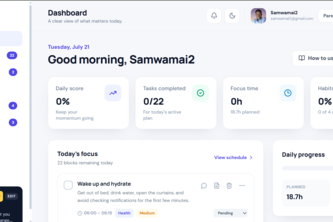
The description states that focustrack is an "all-in-one productivity and parental control app" that helps families plan their days, stay focused, and build healthy habits. It includes features such as:
- Daily schedule creation and management
- Habit tracking and goal setting
- Journaling for clarity and reflection
- Ready-made templates for planning
- Workspace sharing with family and friends
- Motivational quotes
- Parental controls for device usage (app limits, activity schedules)
The app is described as designed to help both adults and children make the most of their time while staying safe and balanced.
Evidence: The author's own write-up.
Confidence: Low — this is a self-reported feature list without validation or demonstration.
Positioning & Claim Evolution
The project positions itself as a solution for families seeking to balance productivity with well-being, especially in managing screen time and distractions. It claims to combine:
- Productivity tools (scheduling, habit tracking)
- Parental control features (device usage limits)
- Emotional and reflective elements (journaling, quotes)
It also emphasizes its holistic approach to time management and the emotional side of parenting and self-discipline.
Evidence: The author's own write-up.
Confidence: Low — this is a self-stated positioning, not validated by market data or user feedback.
Target Customer & ICP
The description indicates that focustrack targets:
- Families (both adults and children)
- Parents looking to manage their kids’ device usage
- Individuals seeking better time management and focus
It also mentions a desire to support both tech-savvy and non-technical users, suggesting an inclusive approach to its ICP.
Evidence: The author's own write-up.
Confidence: Low — no evidence of customer segmentation or user testing.
Business Model & Pricing Evidence
The description does not include any information about pricing, monetization, or business model. There is no mention of subscriptions, freemium tiers, or paid features.
Evidence: Not evidenced.
Confidence: Very low — no commercial details provided.
Technical & Delivery Signals
The project was built using:
- Firebase
- Java
- JavaScript
It was submitted as a hackathon entry (OpenAI 2026), indicating it is likely in an early-stage prototype or MVP form. The author notes challenges around cross-device compatibility and balancing simplicity with feature richness.
Evidence: The author's own write-up and technology tags.
Confidence: Low — no evidence of production deployment, scalability, or performance metrics.
Traction & Maturity Signals
There is no evidence of traction, revenue, user adoption, or customer base. The project is described as a single-person effort (samson wamai) submitted to a hackathon and has not been publicly launched or monetized.
Evidence: Not evidenced.
Confidence: Very low — no data on usage, retention, or market response.
Competitive Context
The description does not mention any competitors or how focustrack differentiates from existing solutions in the productivity or parental control space.
Evidence: Not evidenced.
Confidence: Low — no competitive analysis or positioning relative to other tools.
Open Questions & Risks
- Single-person development: No team, no external validation, no scalability evidence.
- No commercial traction: No revenue, customers, or product-market fit data.
- Unproven market demand: The app is described as a hackathon submission with no indication of real-world usage.
- Lack of monetization strategy: No pricing, business model or revenue path described.
- Unclear technical maturity: Built in a short timeframe (hackathon), likely not production-ready.
Evidence: Inferred from self-reporting and absence of data.
Confidence: Medium — based on the lack of evidence for key commercial signals.
Questions the description leaves open
- What is your definition of “traction” for this product, and how do you plan to measure it?
- Have you tested this with any real users or families?
- How do you plan to monetize the app?
- What are the key assumptions about user behavior that underpin your design decisions?
- Do you have a roadmap for scaling beyond the current MVP?
- Are there any existing tools in this space that you’re directly competing with, and how do you differ?
Overall Assessment
Not evidenced.
This is a hackathon submission by one individual (samson wamai). There is no evidence of product-market fit, revenue, customer traction, or commercial viability. The project has not been launched, monetized, or validated in any way beyond the author’s own description.
Confidence: Very low — this is a self-reported idea with no external validation or data to support its potential for investment or partnership.
User Stories BotA demo video on every pull request
Get a demo video on every new feature
GitHub App that watches your pull requests and records a narrated, captioned demo.
Save time on demo prep and make informed decisions faster with a video walkthrough of every new feature.
Source
Submitted to the OpenAI 2026 hackathon on Devpost. Project home on Devpost. Back to the full gallery on Devpost.
This competitive analysis was produced by top-founders.com (opens in a new tab)
Generated by a language model from this project's public Devpost page — its tagline, the author's own write-up and any built-with tags listed there — as captured in August 2026. Short quotations are the author's words. It is an opinion on the idea as a business, not on the people behind it, and it reflects the description as published then. If the project has moved on, request a correction below. The analysis is not independent research and contains no verified traction, revenue or customer data.
An independent guide by KFG International LLC — not affiliated with, endorsed by, or connected to Devpost or OpenAI.