

Archive position — measured, not model output
2 likes on Devpost
221 of the 7,850 archived projects have more likes, and 284 share exactly 2 — so this project's #246 place in the like-ranked listing is a tie-break inside that group, not a ranking.
Projects (log scale)
Likes on Devpost. ▲ marks this project's group.
Show the figures
| Likes | Projects | Share of archive |
|---|---|---|
| 0 | 5,587 | 71.2% |
| 1 | 1,758 | 22.4% |
| 2 | 284 | 3.6% |
| 3–4 | 132 | 1.7% |
| 5–9 | 75 | 1.0% |
| 10+ | 14 | 0.2% |
 User Stories BotA demo video on every pull request
Get a demo video on every new feature
GitHub App that watches your pull requests and records a narrated, captioned demo.
Save time on demo prep and make informed decisions faster with a video walkthrough of every new feature.
Executive Summary
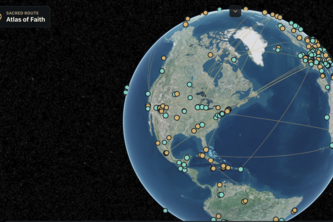
What the company appears to be: Atlas of Faith is a self-reported 3D interactive globe application that visualizes religious journeys and traditions through geography. The author states it contains 590 routes and 1,820 bilingual stations (German/English) related to religion, history, and place. It was built using React, TypeScript, CesiumJS, and AI tools including Codex and GPT-5.6.
What changed: The project evolved from a small personal experiment exploring the Bible's geographical narrative into a larger educational tool covering multiple traditions. The author reports using AI to structure content, audit quality, and improve interface design during Build Week.
Single most important open question: Is there any evidence of user engagement or adoption beyond the single developer's personal use? The description states no revenue, customers, or traction data exist — only self-reported development history.
What The Product Actually Is
The description states that Atlas of Faith is a "bilingual 3D atlas for exploring religious narratives, historical developments, and living traditions through geography." It currently contains 590 routes and 1,820 stations in German and English. Each station presents information under three categories: Meaning, History, and Place & Spread.
The application uses CesiumJS for 3D visualization, React for frontend, TypeScript for type safety, Vite for build tooling, and is deployed via Cloudflare Pages. The author reports building the entire product with Codex and GPT-5.6, including content structuring, quality audits, and interface improvements.
Not evidenced: actual user experience, functionality beyond what's described, or whether it functions as a web app or desktop application.
Positioning & Claim Evolution
The author states that Atlas of Faith began as an experiment to show his father how AI could be useful. It started as a small Bible-based globe but evolved into a broader educational tool covering multiple religions and traditions.
The project's positioning shifted from being potentially a "game" to becoming a structured learning platform with editorial standards. The author notes that the interface now distinguishes between belief, historical evidence, and geographic interpretation rather than presenting them as one.
Claims:
- "Atlas of Faith is a bilingual 3D atlas for exploring religious narratives..."
- "The project became the useful AI example I originally wanted to create for my father."
- "The most honest design decision is not to draw a route or not to place a marker."
Not evidenced: market positioning, target audience beyond the developer's personal use, or competitive differentiation.
Target Customer & ICP
The description states that Atlas of Faith was initially intended as an example for the author’s father — someone who is religious and skeptical of AI utility. The author also mentions using it as a learning tool for themselves, exploring traditions they previously knew little about.
No evidence provided regarding:
- Specific customer segments beyond the developer
- Educational institutions or users outside the personal context
- Demographics or user personas
Not evidenced: defined ICP, target market size, or intended end-users beyond the creator.
Business Model & Pricing Evidence
The description does not state any business model or pricing information. The author describes building the product entirely with AI tools and mentions no monetization strategy, subscriptions, or sales channels.
Not evidenced: revenue model, pricing structure, or commercial intent.
Technical & Delivery Signals
The application is built using:
- Frontend: React, TypeScript, Vite
- Visualization: CesiumJS
- Deployment: Cloudflare Pages
- AI tools used: Codex, GPT-5.6
The author reports using AI for content structuring, quality audits, and interface improvements. They also note that all station texts can be exported, searched, and reviewed outside the interface.
Not evidenced:
- Technical performance metrics
- Scalability or infrastructure details
- API or integration capabilities
- Security or data handling practices
Traction & Maturity Signals
The description states that Atlas of Faith was built during Build Week and that it started as a small prototype before growing into a larger project. The author notes that the product was "already existing" prior to Build Week but was less structured.
No evidence provided regarding:
- User engagement or retention
- Customer acquisition or usage statistics
- Product maturity beyond initial development
- Any form of public release or distribution
Not evidenced: traction, adoption, or user feedback.
Competitive Context
The description does not mention any competitors or existing products in the space. The author focuses on their own development process and personal motivations rather than market positioning or competitive analysis.
Not evidenced:
- Direct competitors
- Market size or trends
- Similar tools or platforms in the religious geography or educational visualization space
Open Questions & Risks
Several risks are implied by the description:
- Lack of user data: No evidence of actual users, adoption, or feedback.
- Content quality concerns: The author notes issues with source diversity and editorial consistency.
- Single-person development: Only one team member is mentioned, raising questions about scalability or long-term maintenance.
- AI dependency: Heavy reliance on AI tools may limit control over content accuracy or future evolution.
- Ethical considerations: The project deals with sensitive topics like Indigenous traditions, and the author acknowledges limitations in representation.
Not evidenced:
- Risk mitigation strategies
- Financial sustainability
- Long-term roadmap or scalability plans
Questions the description leaves open
- What is the intended audience beyond the developer’s personal use?
- Are there any users or early adopters who have provided feedback?
- How does the project plan to address source diversity and ethical representation of traditions?
- Is there a plan for monetization or commercial viability?
- What are the technical limitations or scalability concerns with the current architecture?
- How will content quality be maintained as more routes and stations are added?
- Has the developer considered partnerships with educational institutions or religious organizations?
Overall Assessment
The description is entirely self-reported and unverified, with no evidence of revenue, customers, traction, or commercial activity beyond the author’s personal development efforts.
This project appears to be a prototype or proof-of-concept built by one individual using AI tools. There is no indication of a scalable business model, target market, or user base.
Assessment: Not evidenced as a viable investment or partnership opportunity at this stage. The project lacks commercial due-diligence signals such as revenue, users, or product-market fit. It remains a personal development effort with unclear path to monetization or growth.
User Stories BotA demo video on every pull request
Get a demo video on every new feature
GitHub App that watches your pull requests and records a narrated, captioned demo.
Save time on demo prep and make informed decisions faster with a video walkthrough of every new feature.
Source
Submitted to the OpenAI 2026 hackathon on Devpost. Project home on Devpost. Back to the full gallery on Devpost.
This competitive analysis was produced by top-founders.com (opens in a new tab)
Generated by a language model from this project's public Devpost page — its tagline, the author's own write-up and any built-with tags listed there — as captured in August 2026. Short quotations are the author's words. It is an opinion on the idea as a business, not on the people behind it, and it reflects the description as published then. If the project has moved on, request a correction below. The analysis is not independent research and contains no verified traction, revenue or customer data.
An independent guide by KFG International LLC — not affiliated with, endorsed by, or connected to Devpost or OpenAI.