

Archive position — measured, not model output
2 likes on Devpost
221 of the 7,850 archived projects have more likes, and 284 share exactly 2 — so this project's #248 place in the like-ranked listing is a tie-break inside that group, not a ranking.
Projects (log scale)
Likes on Devpost. ▲ marks this project's group.
Show the figures
| Likes | Projects | Share of archive |
|---|---|---|
| 0 | 5,587 | 71.2% |
| 1 | 1,758 | 22.4% |
| 2 | 284 | 3.6% |
| 3–4 | 132 | 1.7% |
| 5–9 | 75 | 1.0% |
| 10+ | 14 | 0.2% |
 User Stories BotA demo video on every pull request
Get a demo video on every new feature
GitHub App that watches your pull requests and records a narrated, captioned demo.
Save time on demo prep and make informed decisions faster with a video walkthrough of every new feature.
Executive Summary
What the company appears to be
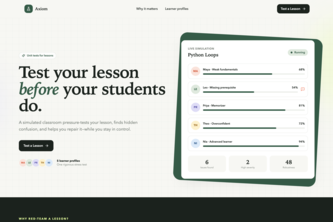
Axiom is a curriculum stress-testing platform built for educators. The product uses AI agents to simulate student behavior and assess lesson clarity before classroom delivery.
What changed
The project description indicates this was built as a hackathon submission (OpenAI 2026) with a team of two developers. It is not evidenced that any commercial version or product has launched beyond the prototype stage.
Single most important open question
Is there evidence of real educator adoption or feedback that would suggest demand for this tool beyond the prototype phase?
What The Product Actually Is
The description states that Axiom is a curriculum stress-testing platform. It helps teachers identify where lessons might cause confusion, suggests targeted improvements, and verifies those changes before teaching to students.
Key technical elements include:
- Upload of lesson and assessment files (with answer keys)
- Parsing into structured outputs with stable IDs
- Use of GPT-5.6 for curriculum analysis
- Generation of five learner profiles ranging from novice to expert
- Concurrent simulation using GPT-4o mini agents
- Psychometric calibration via Item Response Theory
- Grading engine written in TypeScript
- Export functionality to PDF
The system is described as running on Next.js, PostgreSQL, Supabase, and integrates with OpenAI APIs.
Inference The product appears to be a prototype or proof-of-concept built for a hackathon. It is not evidenced that it has been commercialized or deployed beyond this stage.
Positioning & Claim Evolution
The description states the company's tagline: "Pressure-test your curriculum before it reaches the classroom."
It claims:
- Software is tested before shipping, but school lessons are not.
- Teachers often discover issues only after students struggle.
- Axiom provides a practice run using simulated learners to uncover confusion and suggest improvements.
Inference The positioning is that of an AI-powered diagnostic tool for educators, aimed at improving lesson design quality. It positions itself as filling a gap in educational technology similar to how software testing tools exist in other industries.
Target Customer & ICP
The description states:
- Teachers are the primary users.
- The platform helps them find where lessons could cause confusion.
- It supports both lesson plans and assessments.
Inference The target customer is educators, particularly those who create curriculum or lesson plans. The ICP seems to be teachers in K-12 or higher education settings, though no specific grade level or subject area is mentioned.
Business Model & Pricing Evidence
There is no evidence of pricing, monetization strategy, or business model in the description.
Not evidenced No mention of subscription tiers, per-user fees, institutional licensing, or any revenue model.
Technical & Delivery Signals
The project uses:
- GPT-5.6 and GPT-4o mini
- Next.js 15 + React 19
- Supabase (PostgreSQL)
- Codex CLI for development
- Vitest for testing
- Zod for validation
- NDJSON streams for live updates
The system includes:
- Learner profile generation
- Concurrent simulation orchestration
- Psychometric calibration
- Grading engine
- Export to PDF
Inference The technical stack suggests a modern full-stack application with AI integration. However, there is no evidence of production deployment or scalability beyond the prototype.
Traction & Maturity Signals
The description states:
- Built by two developers (Thomas Simon and Noel Thomas)
- Submitted to OpenAI 2026 hackathon
- Tested with five teachers/professors
- Teachers reported that Axiom made real improvements to their lessons
Not evidenced No revenue, customer base, or usage metrics beyond the initial testing phase.
Competitive Context
The description does not mention competitors directly. However, it implies a gap in educational technology compared to other industries like healthcare, finance, and manufacturing where stress-testing tools exist.
Inference Axiom positions itself as addressing an underserved market in EdTech. It is unclear whether there are existing tools that perform similar functions or if this is a novel approach.
Open Questions & Risks
- Unverified claims: The description makes strong claims about impact without evidence of real-world traction.
- Prototype-only status: No indication of commercialization, product launch, or user base beyond initial testing.
- Privacy constraints: The project acknowledges limitations due to FERPA and privacy concerns, which may affect future scalability.
- AI bias risk: The description notes that model-based grading can be wrong or reflect shared biases.
Questions the description leaves open
- What specific feedback did the five teachers give about Axiom’s suggestions?
- Has there been any formal pilot testing with more than five educators?
- Are there plans to collect real student data for training behavioral models, and how will privacy be handled?
- How is the product currently being tested or validated outside of the hackathon environment?
- What are the technical and financial barriers to scaling beyond the prototype?
Overall Assessment
Not evidenced No information on revenue, customer traction, or market validation exists in the description.
Inference This appears to be a promising idea with potential for commercialization, but it is currently at the prototype stage. The lack of any verified user base, revenue, or product-market fit makes early-stage investment speculative. A partnership or follow-on funding would depend heavily on demonstrating traction and validating the core value proposition beyond the hackathon phase.
User Stories BotA demo video on every pull request
Get a demo video on every new feature
GitHub App that watches your pull requests and records a narrated, captioned demo.
Save time on demo prep and make informed decisions faster with a video walkthrough of every new feature.
Source
Submitted to the OpenAI 2026 hackathon on Devpost. Project home on Devpost. Back to the full gallery on Devpost.
This competitive analysis was produced by top-founders.com (opens in a new tab)
Generated by a language model from this project's public Devpost page — its tagline, the author's own write-up and any built-with tags listed there — as captured in August 2026. Short quotations are the author's words. It is an opinion on the idea as a business, not on the people behind it, and it reflects the description as published then. If the project has moved on, request a correction below. The analysis is not independent research and contains no verified traction, revenue or customer data.
An independent guide by KFG International LLC — not affiliated with, endorsed by, or connected to Devpost or OpenAI.