

Archive position — measured, not model output
2 likes on Devpost
221 of the 7,850 archived projects have more likes, and 284 share exactly 2 — so this project's #249 place in the like-ranked listing is a tie-break inside that group, not a ranking.
Projects (log scale)
Likes on Devpost. ▲ marks this project's group.
Show the figures
| Likes | Projects | Share of archive |
|---|---|---|
| 0 | 5,587 | 71.2% |
| 1 | 1,758 | 22.4% |
| 2 | 284 | 3.6% |
| 3–4 | 132 | 1.7% |
| 5–9 | 75 | 1.0% |
| 10+ | 14 | 0.2% |
 User Stories BotA demo video on every pull request
Get a demo video on every new feature
GitHub App that watches your pull requests and records a narrated, captioned demo.
Save time on demo prep and make informed decisions faster with a video walkthrough of every new feature.
Executive Summary
What the company appears to be
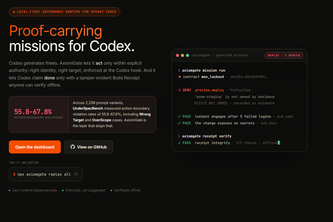
AxiomGate is a self-reported local-first governance runtime for OpenAI Codex, designed to enforce boundaries on agent behavior and validate completion with machine evidence.
What changed
The project description reflects an evolution from a general concern about agent overreach (e.g., "action-boundary violation rates of 55.8 to 67.8%") to a specific technical solution that compiles missions into versioned contracts, enforces policy at the hook level, and gates completion on evidence.
Single most important open question
Is there any evidence of real-world usage or adoption beyond the author's own demonstrations?
What The Product Actually Is
The description states that AxiomGate is a "local-first governance runtime for OpenAI Codex." It operates through five governed stages:
- Plan: Objective and acceptance criteria compile into a hashed contract before Codex writes a line.
- Guard: Identity resolved, policy enforced at the Codex hook, not suggested in a prompt.
- Run: Codex builds under a sandbox and an intent boundary, with usage ledgered.
- Verify: Tests and scanners produce machine evidence; model claims are inadmissible.
- Prove: Completion is gated on evidence and sealed in a tamper-evident Build Receipt.
AxiomGate generates receipts that record the contract hash, a SHA-256 chained evidence trail, criterion citations, and the completion assessment. These receipts can be verified offline with no account required.
The system integrates through native Codex surfaces rather than wrapping them:
- Hooks for PreToolUse and PermissionRequest enforcement
- An MCP server exposing six tools (read-only except approve)
- A Codex plugin and marketplace manifest
- A custom read-only verifier agent
It also uses PatchPilot for dependency verification, and approvals reach a phone over Telegram using Bot API long polling only.
Inference: The product appears to be a framework or toolset that enforces governance rules on Codex-based agents by introducing checkpoints and evidence-based validation at each stage of execution.
Positioning & Claim Evolution
The description claims AxiomGate addresses a gap in current agent behavior: "nothing checks whether they stayed inside the boundary you intended, or whether 'done' was ever true."
It positions itself as a solution to:
- Action-boundary violations (e.g., 55.8–67.8% failure rate reported by UnderSpecBench)
- Misalignment between model claims and actual execution
- Lack of enforcement when permissions live in editable config files
The evolution from claim to product is framed around:
- Identifying the root problem: "Permissions usually live in a config file the agent itself can edit"
- Solving it with a runtime that enforces policy at the hook level
- Ensuring evidence-based validation ("Model claims are inadmissible")
- Providing tamper-evident receipts
Inference: The positioning has shifted from a general critique of AI agents to a specific technical architecture aimed at enforcing boundaries and validating outcomes.
Target Customer & ICP
The description does not name specific customers or use cases beyond the context of OpenAI Codex. It implies that users are developers or teams who:
- Use OpenAI Codex for automation
- Want to enforce strict governance over agent actions
- Require verifiable completion proofs
It suggests a focus on enterprise or advanced developer workflows where compliance and auditability matter.
Inference: The target ICP likely includes developers or engineering teams working with AI agents in regulated environments or those requiring high assurance of execution integrity.
Business Model & Pricing Evidence
There is no evidence of pricing, revenue models, or monetization strategies in the project description. The author states that AxiomGate is built using Codex end-to-end and integrates with native surfaces, but does not describe how it would be sold or consumed commercially.
Not evidenced: No indication of business model, pricing tiers, or customer acquisition strategy.
Technical & Delivery Signals
The system uses:
- Native Codex hooks (PreToolUse, PermissionRequest)
- MCP server exposing six tools
- Codex plugin and marketplace manifest
- A custom read-only verifier agent
- SHA-256 chained evidence trails
- Dependency verification via PatchPilot
- Telegram Bot API for approvals
It supports deterministic regressions:
- Wrong-target ownership denial
- Exact-command approval binding
- Missing-evidence completion blocking
The system is designed to be installable and usable without login or credentials after initial setup.
Inference: The technical approach involves deep integration with Codex internals, sandboxing, and cryptographic chaining for evidence integrity.
Traction & Maturity Signals
There is no evidence of traction, customers, or adoption beyond the authors’ own demonstrations. The project was submitted to an OpenAI hackathon, indicating early-stage development.
The description mentions:
- A 23-case regression suite
- Fixing a critical bypass in their own system
- Demo orchestrator labeling scenes as REPLAY, SAMPLE, or STORED LIVE EVIDENCE
Not evidenced: No data on usage, revenue, customer base, or product maturity beyond prototype-level functionality.
Competitive Context
The description does not mention competitors or direct market comparisons. It focuses on the problem of agent overreach and lack of enforcement rather than positioning itself against existing tools.
Inference: The space is likely emerging, with no clear category leaders yet. AxiomGate may be addressing a niche in AI governance for automated agents.
Open Questions & Risks
- No real-world usage or adoption: The project is described as a hackathon submission with no evidence of production use.
- Self-reported claims without corroboration: Many assertions (e.g., violation rates, enforcement effectiveness) are unverified.
- Limited team size (2 members): Suggests limited capacity for scaling or commercial development.
- No pricing or monetization strategy: Indicates no clear path to revenue generation.
- Dependency on Codex only: If Codex becomes obsolete or changes APIs, AxiomGate may not be portable.
Inference: The risk of misalignment between stated goals and actual product viability is high due to lack of external validation or traction.
Questions the description leaves open
- What specific real-world use cases have you tested AxiomGate in?
- How does it handle edge cases where Codex behavior deviates from expected patterns?
- Have you validated its effectiveness against actual agent deployments, not just demos?
- Is there a plan to support other AI agents beyond Codex?
- What is the roadmap for commercialization or monetization?
- How do you intend to scale beyond the current two-person team?
Overall Assessment
Confidence Level: Low
The description is entirely self-reported and unverified. It lacks any evidence of traction, revenue, customers, or even a clear business model. The project appears to be an early-stage prototype submitted to a hackathon.
While the technical approach shows some sophistication in governance enforcement, there is no indication that AxiomGate has moved beyond proof-of-concept level development.
Conclusion: Not ready for investment or partnership consideration without further evidence of product-market fit, adoption, or commercial viability.
User Stories BotA demo video on every pull request
Get a demo video on every new feature
GitHub App that watches your pull requests and records a narrated, captioned demo.
Save time on demo prep and make informed decisions faster with a video walkthrough of every new feature.
Source
Submitted to the OpenAI 2026 hackathon on Devpost. Project home on Devpost. Back to the full gallery on Devpost.
This competitive analysis was produced by top-founders.com (opens in a new tab)
Generated by a language model from this project's public Devpost page — its tagline, the author's own write-up and any built-with tags listed there — as captured in August 2026. Short quotations are the author's words. It is an opinion on the idea as a business, not on the people behind it, and it reflects the description as published then. If the project has moved on, request a correction below. The analysis is not independent research and contains no verified traction, revenue or customer data.
An independent guide by KFG International LLC — not affiliated with, endorsed by, or connected to Devpost or OpenAI.