

Archive position — measured, not model output
0 likes on Devpost
2,263 of the 7,850 archived projects have more likes, and 5,587 share exactly 0 — so this project's #4,175 place in the like-ranked listing is a tie-break inside that group, not a ranking.
Projects (log scale)
Likes on Devpost. ▲ marks this project's group.
Show the figures
| Likes | Projects | Share of archive |
|---|---|---|
| 0 | 5,587 | 71.2% |
| 1 | 1,758 | 22.4% |
| 2 | 284 | 3.6% |
| 3–4 | 132 | 1.7% |
| 5–9 | 75 | 1.0% |
| 10+ | 14 | 0.2% |
 User Stories BotA demo video on every pull request
Get a demo video on every new feature
GitHub App that watches your pull requests and records a narrated, captioned demo.
Save time on demo prep and make informed decisions faster with a video walkthrough of every new feature.
Executive Summary
What the company appears to be
Folio is a self-reported AI-assisted investment research tool that extracts information from SEC filings and other public sources to generate institutional-grade analysis for retail investors. The author describes it as an auditable, point-in-time investment research framework that follows a structured methodology (trend → industry → basket → ticker → evidence) and shows every citation, calculation, and doubt behind each conclusion.
What changed
The project description indicates this is a hackathon submission (Devpost entry for OpenAI 2026 hackathon), built over a short timeframe with a single developer. It represents an experimental system that the author claims can extract and validate financial data from public filings to produce readable reports, with a focus on transparency and auditability.
Single most important open question
Is Folio's self-reported functionality — particularly its deterministic extraction of SEC filings and ability to generate auditable reports — actually working as described, or is this an untested prototype?
What The Product Actually Is
The description states that Folio is:
- An auditable, point-in-time investment research framework
- That follows a path: trend → industry → basket → ticker → evidence
- A system that extracts information from primary sources like SEC filings and company investor-relations pages
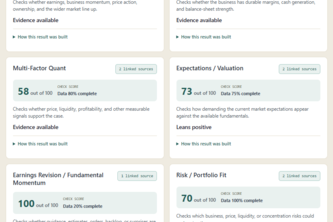
- Designed to weigh companies across six lenses: CAN SLIM, quality/compounder, multi-factor quant, expectations/valuation, earnings revision/fundamental momentum, risk/portfolio fit
- A web app (Evidence Desk) built for Build Week that includes:
- Research library
- Theme reports
- Side-by-side company comparison
- Deep ticker reports
- Immutable current and historical snapshots
- Bounded GPT-5.6 Q&A with deterministic validation
The author claims it uses deterministic extraction to store findings in a database, and that every conclusion shows its work through citations and traceable calculations.
Evidence Self-reported by the author; no independent verification or demonstration provided.
Positioning & Claim Evolution
The description states:
- Folio aims to make institutional-grade research accessible to retail investors
- It is positioned as a system that goes beyond AI hype, focusing on building an auditable system that finds primary source documents
- The author emphasizes that the tool shows every citation, calculation, and doubt behind each conclusion
- It is described as a research framework, not just a reporting tool
The claim evolution appears to be:
- Initial inspiration: Discovery of market winners through public filings
- Problem identification: Time required for retail investors to analyze filings manually
- Solution proposition: AI-powered system that automates this with deterministic extraction and auditability
- Product realization: A web app that allows users to explore trends, industries, and companies using structured research lenses
Evidence Self-reported claims; no external validation or market positioning data.
Target Customer & ICP
The description states:
- Folio is designed for retail investors
- It aims to make institutional-grade analysis available to those who don’t have time or expertise to read every filing
- The system supports "layperson" readability, with claims inspectable and uncertainties stated instead of hidden
Evidence Self-reported; no explicit segmentation, customer personas, or user research.
Business Model & Pricing Evidence
The description states:
- Folio currently runs locally with a user's own OPENAI_API_KEY
- The next steps include:
- A hosted version with accounts and job queues
- Commercially licensed data (paid providers for resale)
- Billing and launch compliance including subscriptions, terms of service, and legal review
There is no mention of pricing models, monetization strategies, or revenue streams in the current version.
Evidence Self-reported; no pricing, monetization, or revenue data.
Technical & Delivery Signals
The description states:
- Built with Python 3.11, FastAPI, SQLite
- Uses deterministic extraction engines and AI tools like GPT-5.6 (via Codex), Claude Design/Code
- The system uses deterministic validation for Q&A answers
- Includes a test suite of ~1,800 automated tests
- The demo route was rehearsed live end-to-end in under 90 seconds
- The architecture is described as having three pillars: find documents → extract information → write the report
The author also notes:
- Challenges with source acquisition, database writes, and publication were gated behind independent second-model QA
- The system uses structured output, Responses API with store=False, and no tools for Q&A
- The UI was redesigned based on user feedback that the first screen was wrong
Evidence Self-reported; no external validation or performance metrics.
Traction & Maturity Signals
The description states:
- This is a hackathon submission
- It was built by one person (Desmond Leo)
- The system includes 1,800 automated tests
- It has been tested in live demos
- The author mentions user feedback that led to UI redesign
There is no evidence of:
- Customers or users
- Revenue or monetization
- Product-market fit or adoption
- Growth metrics or usage data
Evidence Not evidenced.
Competitive Context
The description does not mention any competitors, nor does it provide context about the competitive landscape for AI-assisted investment research tools.
Evidence Not evidenced.
Open Questions & Risks
Inferences based on self-reported information:
- The system is a single-developer hackathon project, which raises questions about scalability and long-term viability
- It relies heavily on AI agents (GPT-5.6, Claude) for implementation, but the author notes that AI agents naturally use technical vocabulary and can be misleading without deep involvement in planning
- The system is described as not yet production-ready — it requires a lot of cleanup before beta, including security reviews and consolidation of pipelines
- It currently runs locally with user API keys, which suggests limited commercialization or ease-of-use for end users
- The author notes that the system only retrieves about 50% of needed information, indicating incomplete data coverage
Evidence Self-reported; no third-party validation or risk analysis.
Questions the description leaves open
- What is the actual performance of the deterministic extraction engine? Can it reliably extract and validate financial data from SEC filings?
- How does the system handle missing or inconsistent data in filings, especially when dealing with complex financial structures?
- Is there a plan to scale beyond the current single developer team, and what are the technical challenges in doing so?
- What is the expected timeline for moving from the current prototype to a hosted, commercial version?
- How does Folio differentiate itself from existing tools that offer SEC filing analysis or AI-powered stock research?
- What are the legal implications of providing investment research without explicit advice or regulatory compliance?
Overall Assessment
Confidence Level Low — this is a self-reported, unverified prototype, built by one person as part of a hackathon.
Assessment Summary
Folio appears to be an experimental system that the author claims can extract and analyze SEC filings with deterministic validation and transparency. It is not evidenced to have traction, revenue, or adoption. The project is in early development and lacks commercialization signals. While it shows ambition and technical execution, there is no evidence of product-market fit, scalability, or a clear path to monetization.
Investment/Partnership Recommendation
Not recommended for investment or partnership at this stage. The system needs significant development, validation, and user testing before any commercial viability can be assessed.
User Stories BotA demo video on every pull request
Get a demo video on every new feature
GitHub App that watches your pull requests and records a narrated, captioned demo.
Save time on demo prep and make informed decisions faster with a video walkthrough of every new feature.
Source
Submitted to the OpenAI 2026 hackathon on Devpost. Project home on Devpost. Back to the full gallery on Devpost.
This competitive analysis was produced by top-founders.com (opens in a new tab)
Generated by a language model from this project's public Devpost page — its tagline, the author's own write-up and any built-with tags listed there — as captured in August 2026. Short quotations are the author's words. It is an opinion on the idea as a business, not on the people behind it, and it reflects the description as published then. If the project has moved on, request a correction below. The analysis is not independent research and contains no verified traction, revenue or customer data.
An independent guide by KFG International LLC — not affiliated with, endorsed by, or connected to Devpost or OpenAI.