

Archive position — measured, not model output
2 likes on Devpost
221 of the 7,850 archived projects have more likes, and 284 share exactly 2 — so this project's #250 place in the like-ranked listing is a tie-break inside that group, not a ranking.
Projects (log scale)
Likes on Devpost. ▲ marks this project's group.
Show the figures
| Likes | Projects | Share of archive |
|---|---|---|
| 0 | 5,587 | 71.2% |
| 1 | 1,758 | 22.4% |
| 2 | 284 | 3.6% |
| 3–4 | 132 | 1.7% |
| 5–9 | 75 | 1.0% |
| 10+ | 14 | 0.2% |
 User Stories BotA demo video on every pull request
Get a demo video on every new feature
GitHub App that watches your pull requests and records a narrated, captioned demo.
Save time on demo prep and make informed decisions faster with a video walkthrough of every new feature.
Executive Summary
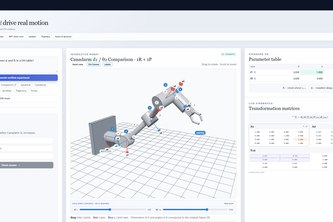
AxisLab, as described by its author, is an interactive educational tool for robotics students that translates natural-language questions into verified, 3D learning experiences. The product combines generative AI for lesson customization with deterministic code to ensure mathematical accuracy and consistency.
The project appears to be a student-led hackathon submission—a prototype built in a short timeframe (likely a "Build Week") with no evidence of revenue, customers or traction beyond the authors' own testing and deployment. It is not yet a commercial product but rather an experimental educational tool.
The single most important open question is:
What is the actual educational impact of AxisLab, and how does it compare to traditional teaching methods?
This cannot be answered from the self-reported description alone.
What The Product Actually Is
The description states that AxisLab:
- Transforms a student's question into an interactive 3D lesson
- Provides six connected learning modules covering robotics concepts such as DH parameters, Jacobians, trajectory planning, and forces
- Uses React, TypeScript, Three.js, FastAPI, Pydantic, Docker, and Railway for its technical stack
- Includes AI-assisted lesson generation with deterministic verification of mathematical correctness
- Allows students to manipulate 3D models, sliders, coordinate frames, transformation matrices, equations, and scored questions
It is described as a learning tool that connects equations, visible motion, direct manipulation, and assessment.
Inference: Based on the technical stack and modules listed, AxisLab appears to be a web-based educational application designed for STEM students, particularly those studying robotics. It integrates AI for personalization while maintaining deterministic verification of core mathematical components.
Positioning & Claim Evolution
The author claims that:
- Existing tools in robotics education are either static or unreliable when using generative AI
- AxisLab fills a gap by combining AI with verified, deterministic components
- The tool aims to make abstract concepts "click" through interactive 3D visualization and equation synchronization
Positioning:
AxisLab positions itself as an interactive educational platform that bridges the gap between traditional robotics instruction and modern AI-enhanced learning.
Claim evolution:
- Initial claim: “I wish I had this while studying robotics”
- Evolved to: “A verified, interactive 3D lesson that makes equations visible and difficult concepts click”
There is no evidence of prior versions or market positioning beyond this single submission. The product has not been commercialized or scaled.
Target Customer & ICP
The description states:
- AxisLab targets robotics students
- It is designed for use in a course setting, particularly where complex topics like coordinate transformations, Jacobians, and trajectory planning are taught
- It supports both self-directed learning and potentially instructor-led instruction
ICP (Ideal Customer Profile):
- Robotics students at university or advanced high school levels
- Educators looking to supplement traditional teaching with interactive tools
Not evidenced:
- No specific demographic data, usage patterns, or institutional adoption.
Business Model & Pricing Evidence
The description does not mention:
- Any pricing model
- Revenue streams
- Monetization strategy
- Customer acquisition plans
- Subscription or licensing models
Inference: Given that this is a hackathon project with no commercial deployment or funding mentioned, it likely has no established business model at this time.
Technical & Delivery Signals
The description states:
- Built using React, TypeScript, Vite, Three.js, FastAPI, Pydantic, Docker, Railway
- Uses GPT-5.6 for final development and verification
- Includes automated tests (21 backend, 20 frontend)
- Deployed as a public HTTPS service on Railway
- Has fallback lessons when AI is unavailable
Delivery signals:
- A public, no-login HTTPS deployment
- Reviewed local lessons included for offline functionality
- Deterministic verification of mathematical correctness
- AI-generated content never controls numerical answers or scoring
Not evidenced:
- No mention of scalability, performance metrics, or production-grade infrastructure beyond a single deployment.
Traction & Maturity Signals
The description states:
- 21 passing backend tests and 20 passing frontend tests
- Public, no-login HTTPS deployment
- A working prototype with six modules
- Codex was used as an implementation partner during development
Not evidenced:
- No customer base or user feedback
- No revenue or monetization data
- No evidence of ongoing usage or retention metrics
- No indication of product iteration beyond this version
Absence of evidence: There is no signal of traction, adoption, or growth beyond the initial build.
Competitive Context
The description states:
- Existing robotics tools are usually designed for research or engineering, not for interactive explanation and personalized learning
- Generative AI can explain topics but cannot reliably generate accurate 3D models without deterministic oversight
No explicit competitors are named. However, the context implies a space that includes:
- Traditional textbooks and static slides
- Research-oriented robotics simulation tools (e.g., ROS, MATLAB/Simulink)
- Educational platforms using generative AI for STEM subjects
Not evidenced:
- No competitive analysis or market sizing data
- No indication of existing players in this niche
Open Questions & Risks
Key risks:
- Unproven educational effectiveness: The author states that the tool is experimental and has not been tested in real classrooms.
- Dependency on AI for customization without proven reliability: While deterministic verification is used, the system still relies heavily on generative AI for lesson generation.
- No commercial viability or scalability: This is a hackathon project with no evidence of monetization or long-term strategy.
- Limited scope and maturity: Only six modules are implemented; expansion plans are speculative.
Open questions:
- No mention of institutional partnerships, pilot programs, or user testing
- No indication of how the tool would scale beyond a single developer’s prototype
- No evidence of any funding, team size, or roadmap beyond this version
Questions the description leaves open
- What specific educational outcomes have you observed from using AxisLab in practice?
- How do you plan to validate its effectiveness compared to traditional teaching methods?
- Are there any plans for instructor-facing features or classroom integration?
- What are the key assumptions behind the AI-driven lesson generation, and how do they hold up under scrutiny?
- How would you scale this beyond a single developer prototype?
- Have you considered how to integrate accessibility standards into the interface?
- Is there any plan to monetize or commercialize AxisLab?
Overall Assessment
Not evidenced: No financials, traction, or market data are available.
Confidence level: Low — this is a student-led hackathon project, not a commercial venture.
Assessment:
AxisLab is an experimental educational prototype that shows promise in bridging the gap between generative AI and deterministic learning. However, it lacks any evidence of traction, revenue, or market validation. It is not yet a product suitable for investment or partnership unless further development and testing are conducted.
It may be valuable as a proof-of-concept or research tool, but there is no indication that it has reached a stage where it can be considered a viable business or educational platform.
User Stories BotA demo video on every pull request
Get a demo video on every new feature
GitHub App that watches your pull requests and records a narrated, captioned demo.
Save time on demo prep and make informed decisions faster with a video walkthrough of every new feature.
Source
Submitted to the OpenAI 2026 hackathon on Devpost. Project home on Devpost. Back to the full gallery on Devpost.
This competitive analysis was produced by top-founders.com (opens in a new tab)
Generated by a language model from this project's public Devpost page — its tagline, the author's own write-up and any built-with tags listed there — as captured in August 2026. Short quotations are the author's words. It is an opinion on the idea as a business, not on the people behind it, and it reflects the description as published then. If the project has moved on, request a correction below. The analysis is not independent research and contains no verified traction, revenue or customer data.
An independent guide by KFG International LLC — not affiliated with, endorsed by, or connected to Devpost or OpenAI.