

Archive position — measured, not model output
1 like on Devpost
505 of the 7,850 archived projects have more likes, and 1,758 share exactly 1 — so this project's #2,211 place in the like-ranked listing is a tie-break inside that group, not a ranking.
Projects (log scale)
Likes on Devpost. ▲ marks this project's group.
Show the figures
| Likes | Projects | Share of archive |
|---|---|---|
| 0 | 5,587 | 71.2% |
| 1 | 1,758 | 22.4% |
| 2 | 284 | 3.6% |
| 3–4 | 132 | 1.7% |
| 5–9 | 75 | 1.0% |
| 10+ | 14 | 0.2% |
 User Stories BotA demo video on every pull request
Get a demo video on every new feature
GitHub App that watches your pull requests and records a narrated, captioned demo.
Save time on demo prep and make informed decisions faster with a video walkthrough of every new feature.
Executive Summary
What the company appears to be
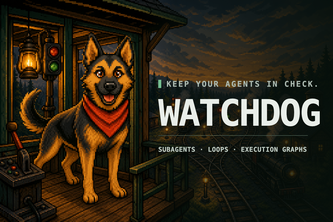
Watchdog is a self-reported local-first control plane for managing subagents, agentic loops, and execution graphs. The author describes it as an operator interface that provides visibility into agent behavior, including tool use, token consumption, model configuration, and orchestration structure. It supports two agent harnesses (Codex CLI and Pi) and offers three interfaces: a pixel-art dashboard ("Yard"), a detailed debugging view ("Operator"), and terminal-based tools (TUI/CLI). The product is built using TypeScript, Node.js, React, and Playwright.
What changed
The project was submitted to the OpenAI 2026 hackathon. It represents an early-stage prototype or proof-of-concept tool developed by one individual (Samarth Saxena) with no external funding or team support. The author states that it was built almost entirely using Codex and GPT-5.6 Sol.
Single most important open question
Is there any evidence of real-world usage or adoption beyond the author’s own development environment?
Note: This analysis is based solely on the self-reported, unverified account provided by the author. No revenue, customer data, traction, or independent verification has been included.
What The Product Actually Is
- The description states that Watchdog is a "local-first operator control plane for subagents, agentic loops, and execution graphs."
- It provides interfaces to inspect and intervene in agent behavior:
- The Yard: A pixel-art dashboard showing agents as trains moving through an execution.
- Operator: A detailed debugging view for graphs, activity, evidence, warnings, and controls.
- TUI/CLI: Terminal-first workflows.
- Watchdog connects to Codex App Server and Pi via their respective APIs or extension systems.
- It normalizes runtime events and presents them in a unified model across integrations.
- Traces stay local; completed sessions can be reopened in read-only replay mode.
- Built with tools including codex-cli, mcp, node.js, openai, pi, playwright, react, react-ink, typescript, vite, websockets.
Confidence: Low — this is a self-reported technical description without external validation or demonstration of actual functionality beyond the author’s own use case.
Positioning & Claim Evolution
- The author positions Watchdog as a solution to increasing complexity and lack of control in autonomous agent systems.
- It aims to give users visibility into what subagents are doing, allow intervention when needed, and help understand token usage or misconfigurations.
- The product is framed as a developer tool for inspecting, constraining, debugging, and understanding complex agent execution environments.
- The author notes that the tool emerged from the observation that “users are currently unhappy with [subagents] as they become harder to understand and control.”
- There is no mention of commercial positioning or target market beyond developer tooling.
Inference: The positioning suggests a niche within the growing field of agent-based development, but lacks clarity on how it differentiates from existing observability tools or agent frameworks.
Target Customer & ICP
- Not evidenced.
- The description does not identify specific customer segments or personas.
- No indication of whether Watchdog targets enterprise developers, startups, or individual hobbyists.
- The project is described as being built for personal use and experimentation, with no mention of a broader market strategy.
Finding: Absence of evidence regarding target customers or ideal customer profile (ICP).
Business Model & Pricing Evidence
- Not evidenced.
- No information about pricing models, monetization strategies, or revenue streams is provided.
- The project appears to be an open-source or prototype tool built for a hackathon.
Finding: No evidence of business model or pricing strategy.
Technical & Delivery Signals
- Watchdog integrates with Codex CLI and Pi agent harnesses.
- Uses TypeScript, Bun, React, Vite, Playwright, and React Ink.
- Supports local trace storage and read-only replay mode.
- Provides three distinct interfaces: Yard (dashboard), Operator (debug view), TUI/CLI.
- Handles complex runtime concepts like:
- Subagent topology
- Execution graphs with branches, joins, verifiers, loops
- Token usage tracking
- Model configuration discrepancies
- Built using Codex and GPT-5.6 Sol for development.
Confidence: Medium — the technical architecture is described in detail, but no evidence of production deployment or scalability.
Traction & Maturity Signals
- Not evidenced.
- No mention of users, customers, installations, or usage metrics.
- The project was submitted to a hackathon and built by one person.
- No indication of product maturity beyond prototype status.
Finding: No evidence of traction or adoption beyond the author’s own development.
Competitive Context
- Not evidenced.
- No mention of competitors or similar tools in the market.
- The author does not reference existing agent monitoring, debugging, or orchestration platforms.
Finding: Absence of competitive landscape analysis or awareness of prior art.
Open Questions & Risks
- Single-person development: The project is built by one individual with no team or external support. This raises concerns about long-term maintenance and scalability.
- Limited integrations: Only two agent harnesses (Codex CLI and Pi) are supported, which may limit its appeal in a broader ecosystem.
- Prototype nature: Built for a hackathon; no evidence of production-readiness or long-term roadmap.
- No commercial viability: No indication of monetization strategy or business model.
- Dependency on proprietary tools: Relies heavily on Codex and GPT-5.6 Sol, which may not be accessible to others.
Inference: The tool is likely experimental and not yet ready for enterprise adoption or widespread use.
Questions the description leaves open
- What specific problems do you see in current agent orchestration tools that Watchdog solves?
- How does Watchdog handle edge cases like nested loops, retries, and model misconfigurations?
- Are there any plans to expand support for other agent harnesses beyond Codex and Pi?
- What is the expected timeline for moving from prototype to a stable product?
- Have you tested Watchdog with real-world workflows or teams?
- How do you plan to monetize or sustain this project long-term?
Note: These questions are based on the self-reported description and aim to probe deeper into unverified claims.
Overall Assessment
- Not evidenced.
- No financial data, funding history, or investment interest is mentioned.
- The project appears to be an early-stage prototype with no clear commercialization path.
- While technically interesting, there is insufficient evidence of traction, market demand, or scalability to warrant further due diligence.
Assessment: Not ready for investment or partnership consideration. Requires significant development and validation before any strategic interest can be assessed.
User Stories BotA demo video on every pull request
Get a demo video on every new feature
GitHub App that watches your pull requests and records a narrated, captioned demo.
Save time on demo prep and make informed decisions faster with a video walkthrough of every new feature.
Source
Submitted to the OpenAI 2026 hackathon on Devpost. Project home on Devpost. Back to the full gallery on Devpost.
This competitive analysis was produced by top-founders.com (opens in a new tab)
Generated by a language model from this project's public Devpost page — its tagline, the author's own write-up and any built-with tags listed there — as captured in August 2026. Short quotations are the author's words. It is an opinion on the idea as a business, not on the people behind it, and it reflects the description as published then. If the project has moved on, request a correction below. The analysis is not independent research and contains no verified traction, revenue or customer data.
An independent guide by KFG International LLC — not affiliated with, endorsed by, or connected to Devpost or OpenAI.