

Archive position — measured, not model output
0 likes on Devpost
2,263 of the 7,850 archived projects have more likes, and 5,587 share exactly 0 — so this project's #6,130 place in the like-ranked listing is a tie-break inside that group, not a ranking.
Projects (log scale)
Likes on Devpost. ▲ marks this project's group.
Show the figures
| Likes | Projects | Share of archive |
|---|---|---|
| 0 | 5,587 | 71.2% |
| 1 | 1,758 | 22.4% |
| 2 | 284 | 3.6% |
| 3–4 | 132 | 1.7% |
| 5–9 | 75 | 1.0% |
| 10+ | 14 | 0.2% |
 User Stories BotA demo video on every pull request
Get a demo video on every new feature
GitHub App that watches your pull requests and records a narrated, captioned demo.
Save time on demo prep and make informed decisions faster with a video walkthrough of every new feature.
Executive Summary
Project: Proofline Japan
Self-reported basis: The analysis is based entirely on the project description provided by the caller — its name, tagline, the author's own write-up, and technology stack. No external verification or historical data are available.
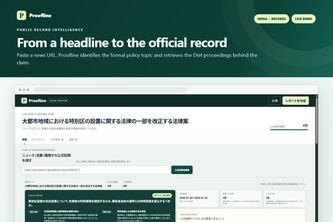
What it appears to be: A React/TypeScript web application that connects news articles to official Japanese legislative records (National Diet), using GPT-5.6 for analysis while preserving source links and clearly marking unverified claims.
What changed: The project was built as part of the OpenAI 2026 hackathon, with a focus on improving public information access through structured research workflows that trace claims back to official sources.
Single most important open question: Does Proofline Japan have any users or customers beyond its creator? If not, what is the path from prototype to product traction?
What The Product Actually Is
The description states that Proofline Japan is a React and TypeScript application built with:
- Cloudflare
- GPT-5.6
- Codex
- National Diet Library records
- Next.js, OpenAI, Tailwind, Vite
It is described as an application that:
- Takes news URLs, bill names, or legislator names
- Retrieves related National Diet proceedings and official records
- Generates evidence-constrained issue briefs using GPT-5.6
- Visualizes deliberation time, speaking share, timelines, and legislator activity
- Provides source-linked research reports
Inference: It appears to be a research tool for journalists or researchers working with Japanese legislative content.
Not evidenced: No information on whether it is live, how many users it has, or if it generates revenue.
Positioning & Claim Evolution
The author states that Proofline Japan aims to:
- Make verification of news claims faster
- Avoid hiding uncertainty by linking findings back to original public records
- Not automatically label a claim as true or false
- Preserve “uncertainty instead of inventing a conclusion”
It positions itself as an alternative to AI summaries that may mislead by presenting unsupported conclusions as facts.
Inference: The product is positioned as a trustworthy, evidence-based research assistant, not a general-purpose summarizer.
Not evidenced: No mention of competitors or how it differentiates from existing tools (e.g., government portals, news aggregators).
Target Customer & ICP
The description states that Proofline Japan:
- Turns a news URL, bill name, or legislator name into a verifiable research case
- Retrieves statements with speaker, chamber, committee, date, and source URL
- Builds timelines and legislator activity summaries
Inference: The target customer appears to be journalists, researchers, or policy analysts who need to verify legislative claims.
Not evidenced: No information on:
- How many such users exist
- Whether the tool is used by media organizations or academic institutions
- If there are any institutional partnerships or pilot programs
Business Model & Pricing Evidence
The description does not state:
- Any pricing model
- Revenue streams
- Monetization strategy
- Subscription plans or usage fees
Inference: It is unclear if the tool is intended to be monetized, or whether it’s a prototype for future development.
Not evidenced: No evidence of any business model beyond its self-reported function as a research tool.
Technical & Delivery Signals
The project was built using:
- React and TypeScript
- Next.js, Tailwind, Vite
- GPT-5.6 (for analysis)
- Codex (for architecture and implementation)
- Cloudflare (for deployment or backend)
It is described as a working live application that uses real news URLs and official Diet records.
Inference: The tool is functional and built with modern web stack, suggesting some level of technical maturity.
Not evidenced: No information on:
- Scalability
- Data ingestion pipeline
- API access or integration points
- Performance metrics
Traction & Maturity Signals
The description states that Proofline Japan:
- Is a working live application
- Uses real news URLs and official Diet records
- Handles missing or misleading information gracefully
- Was built for the OpenAI 2026 hackathon
Inference: The tool is at a prototype stage, with some functional capability but no evidence of adoption or user base.
Not evidenced: No data on:
- Number of users
- Frequency of use
- Customer feedback or retention
- Revenue or monetization
Competitive Context
The description does not mention:
- Competitors in the legislative research space
- Similar tools or platforms that already exist
- How Proofline Japan compares to existing public record search engines or AI research assistants
Inference: It is unclear whether this tool addresses a gap in the market, or if similar solutions already exist.
Not evidenced: No competitive landscape analysis or differentiation strategy provided.
Open Questions & Risks
- No users or customers: The project appears to be a prototype with no evidence of traction.
- Unproven business model: No indication of monetization or revenue generation.
- Limited scope: Focus is on National Diet records, which may limit its broader appeal.
- Dependency on GPT-5.6: If the tool relies heavily on one AI model, it may be vulnerable to changes in availability or pricing.
- Single founder: The team size is listed as 1, raising questions about scalability and long-term maintenance.
Not evidenced: No evidence of:
- Market demand
- User feedback
- Funding or investment
- Product-market fit
Questions the description leaves open
- Is Proofline Japan currently used by any journalists, researchers, or media organizations?
- What is the plan for monetization or scaling beyond the hackathon prototype?
- How does it handle data privacy and access to official records in Japan?
- Are there plans to expand beyond National Diet records into local assemblies or other government bodies?
- What are the technical limitations of the current system, especially around data ingestion and processing?
- How is the accuracy of GPT-5.6 results validated or audited?
Overall Assessment
Not evidenced: No information on:
- Valuation
- Funding rounds
- Investors or partners
- Strategic fit for potential acquirers or investors
Inference: At this stage, Proofline Japan is a conceptual prototype with potential, but lacks evidence of traction, revenue, or clear path to market. It may be suitable for early-stage investment or partnership if the founders can demonstrate user adoption and scalability.
Confidence level: Low — based on limited self-reported evidence and absence of external validation or metrics.
User Stories BotA demo video on every pull request
Get a demo video on every new feature
GitHub App that watches your pull requests and records a narrated, captioned demo.
Save time on demo prep and make informed decisions faster with a video walkthrough of every new feature.
Source
Submitted to the OpenAI 2026 hackathon on Devpost. Project home on Devpost. Back to the full gallery on Devpost.
This competitive analysis was produced by top-founders.com (opens in a new tab)
Generated by a language model from this project's public Devpost page — its tagline, the author's own write-up and any built-with tags listed there — as captured in August 2026. Short quotations are the author's words. It is an opinion on the idea as a business, not on the people behind it, and it reflects the description as published then. If the project has moved on, request a correction below. The analysis is not independent research and contains no verified traction, revenue or customer data.
An independent guide by KFG International LLC — not affiliated with, endorsed by, or connected to Devpost or OpenAI.