

Archive position — measured, not model output
0 likes on Devpost
2,263 of the 7,850 archived projects have more likes, and 5,587 share exactly 0 — so this project's #6,131 place in the like-ranked listing is a tie-break inside that group, not a ranking.
Projects (log scale)
Likes on Devpost. ▲ marks this project's group.
Show the figures
| Likes | Projects | Share of archive |
|---|---|---|
| 0 | 5,587 | 71.2% |
| 1 | 1,758 | 22.4% |
| 2 | 284 | 3.6% |
| 3–4 | 132 | 1.7% |
| 5–9 | 75 | 1.0% |
| 10+ | 14 | 0.2% |
 User Stories BotA demo video on every pull request
Get a demo video on every new feature
GitHub App that watches your pull requests and records a narrated, captioned demo.
Save time on demo prep and make informed decisions faster with a video walkthrough of every new feature.
Executive Summary
What the company appears to be
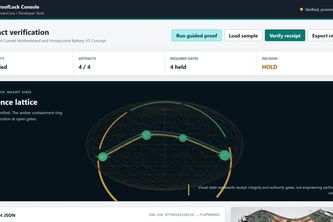
ProofLock Console is a self-reported developer tool designed to verify file integrity and enforce authorization gates in software development workflows. The author states it uses SHA-256 hashing, Web Crypto, and Python CLI for artifact verification, with a focus on separating questions of identity, evidence support, and authorization.
What changed
The project was submitted as part of the OpenAI 2026 hackathon. It is described as an experimental tool built in a short timeframe, with no commercial traction or revenue reported.
Single most important open question
Is ProofLock Console intended for production use, or is it a proof-of-concept with limited scalability and integration capabilities?
What The Product Actually Is
The description states that ProofLock Console:
- Loads a bounded JSON receipt.
- Recomputes its canonical SHA-256 identity.
- Resolves only repository-contained artifact paths.
- Rehashes declared files.
- Evaluates authority gates separately from file integrity.
It includes a browser app built with HTML, CSS, and JavaScript using Web Crypto, and a matching Python CLI for local automation and CI. It also uses Pytest to test receipt tampering, path traversal, invalid or duplicate gates, artifact mismatches, and attempts to promote while required gates remain open.
Inference The tool is described as a verification system that checks file integrity and enforces access control based on declared gates — not a general-purpose development platform or SaaS offering.
Positioning & Claim Evolution
The author states:
- AI-assisted development can move faster than the evidence behind a claim.
- The tool makes the gap between polished results and underlying evidence visible.
Claim
ProofLock Console is positioned as a solution to the problem of false confidence in AI-generated or automated development outputs.
Inference It is not described as a commercial product, but rather an experimental tool submitted for a hackathon. No claims about market adoption, scalability, or competitive differentiation are made.
Target Customer & ICP
The description states:
- The tool is built for developers and CI/CD environments.
- It uses Python CLI and browser app interfaces.
- It integrates with repository artifacts and tests.
Inference The intended users appear to be software engineers working in development or CI/CD pipelines, who want to verify artifact integrity and enforce access control.
Not evidenced No specific customer segments, personas, or use cases beyond the hackathon demo are described.
Business Model & Pricing Evidence
The description states:
- The tool is a self-contained demo with no pricing model.
- It includes a Python CLI and browser app for local automation and CI.
- No mention of licensing, subscriptions, or monetization.
Inference There is no evidence of a business model or pricing structure. The project appears to be experimental and not intended for commercial sale.
Technical & Delivery Signals
The description states:
- Built with HTML5, CSS3, JavaScript, Python, Web Crypto, Pytest.
- Uses SHA-256 hashing and canonical path resolution.
- Implements a trust model that separates artifact identity, evidence support, and authorization.
- Includes tests for receipt tampering, path traversal, invalid gates, and artifact mismatches.
Inference The tool is technically grounded in cryptographic principles and designed with security in mind. However, no evidence of production deployment or scalability is provided.
Traction & Maturity Signals
The description states:
- The bundled demo verifies four real repository artifacts.
- All hashes match, but the result remains "HOLD" because required gates are not yet open.
- The tool was submitted to a hackathon.
- Next steps include independent reproduction run, signed receipt adapters, and CI integrations.
Inference There is no evidence of customer adoption, revenue, or usage beyond the demo. The project is described as experimental and incomplete.
Competitive Context
The description states:
- No direct competitors are named.
- It is a hackathon submission with no commercial context.
- It focuses on artifact integrity and access control in development workflows.
Inference No competitive landscape is described, nor is there evidence of prior market analysis or differentiation from existing tools.
Open Questions & Risks
- The tool is described as experimental and submitted to a hackathon — no commercial viability or scalability is evident.
- No evidence of customer feedback, usage metrics, or adoption.
- No mention of security audits, production deployment, or integration with major CI/CD platforms.
- The author is a single individual (team size: 1), suggesting limited resources for product development or support.
Questions the description leaves open
- What are the intended use cases beyond the hackathon demo?
- Is there any plan to integrate ProofLock Console into existing CI/CD pipelines or platforms?
- How does it handle edge cases like large files, cross-platform compatibility, or integration with proprietary systems?
- Are there any plans for commercialization or monetization?
- What is the roadmap beyond the current demo and planned extensions?
Overall Assessment
Not evidenced No evidence of revenue, customers, traction, or commercial viability is provided.
Inference Given that this is a hackathon submission with no reported adoption, funding, or product-market fit, it does not appear to be a viable investment or partnership opportunity at this time. The tool may have potential as a proof-of-concept, but lacks the maturity and evidence of traction required for due-diligence consideration in a commercial context.
User Stories BotA demo video on every pull request
Get a demo video on every new feature
GitHub App that watches your pull requests and records a narrated, captioned demo.
Save time on demo prep and make informed decisions faster with a video walkthrough of every new feature.
Source
Submitted to the OpenAI 2026 hackathon on Devpost. Project home on Devpost. Back to the full gallery on Devpost.
This competitive analysis was produced by top-founders.com (opens in a new tab)
Generated by a language model from this project's public Devpost page — its tagline, the author's own write-up and any built-with tags listed there — as captured in August 2026. Short quotations are the author's words. It is an opinion on the idea as a business, not on the people behind it, and it reflects the description as published then. If the project has moved on, request a correction below. The analysis is not independent research and contains no verified traction, revenue or customer data.
An independent guide by KFG International LLC — not affiliated with, endorsed by, or connected to Devpost or OpenAI.