

Archive position — measured, not model output
2 likes on Devpost
221 of the 7,850 archived projects have more likes, and 284 share exactly 2 — so this project's #239 place in the like-ranked listing is a tie-break inside that group, not a ranking.
Projects (log scale)
Likes on Devpost. ▲ marks this project's group.
Show the figures
| Likes | Projects | Share of archive |
|---|---|---|
| 0 | 5,587 | 71.2% |
| 1 | 1,758 | 22.4% |
| 2 | 284 | 3.6% |
| 3–4 | 132 | 1.7% |
| 5–9 | 75 | 1.0% |
| 10+ | 14 | 0.2% |
 User Stories BotA demo video on every pull request
Get a demo video on every new feature
GitHub App that watches your pull requests and records a narrated, captioned demo.
Save time on demo prep and make informed decisions faster with a video walkthrough of every new feature.
Executive Summary
What the company appears to be
Apprentice is a self-reported tool that automates the process of fine-tuning small language models (LMs) for extraction and classification tasks, using a workflow that includes capturing production traffic, verifying outputs, optimizing prompts via DSPy GEPA, training small models on verified data, and enforcing an eval gate to prevent bad models from shipping. The system is described as being built with a combination of AI agents (specifically Codex), LLMs (including GPT-5.6), and standard software engineering tools like FastAPI, Next.js, Python, PostgreSQL, etc.
What changed
The project description states that the team built a system to automate model fine-tuning for small models, with a focus on reducing cost while maintaining quality by using human-verified data as the basis for training and evaluation. It also includes a mechanism to detect drift in production and trigger retraining only when necessary.
Single most important open question
Is there any evidence of real-world usage or adoption of this system beyond the hackathon demo? The description does not include any information about customers, revenue, or actual deployment in production environments — all claims are self-reported and unverified.
What The Product Actually Is
The description states that Apprentice is a system designed to automate fine-tuning small language models for tasks like extraction and classification. It uses the following steps:
- Capture: Two lines of SDK to start capturing production traffic.
- Verify: Rows become gold (human-checked) or silver (deterministic checks passed). Others remain raw.
- Optimize: DSPy GEPA rewrites prompts against verified data.
- Train: A small model is fine-tuned on gold rows only.
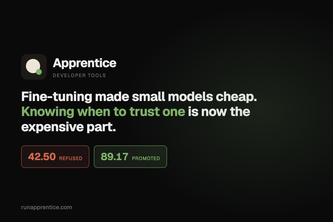
- Eval gate: Every candidate is scored on held-out gold. It is either promoted or refused — no human override.
- Watch for drift: Console charts captured traffic and feedback, offering a retrain only when enough new gold has arrived.
The system enforces a refusal path: models that fail the eval gate do not ship, and teams continue paying for the working model instead.
Inference The product appears to be an automated pipeline for managing small-model deployment in production with built-in quality control. It is not a general-purpose LLM platform but rather a tool focused on reducing cost and risk in fine-tuning workflows.
Positioning & Claim Evolution
The description states that the core positioning is:
“Fine-tuning made small models cheap. Knowing when to trust one is now the expensive part.”
This suggests a shift from traditional approaches where teams rely on frontier models for all tasks, even those that could be handled by cheaper alternatives.
It also claims:
“Swapping a frontier model for a small fine-tuned one is a two-hour job. Convincing an engineering lead that quality won't quietly fall over on the 3% of inputs nobody looked at is the part that never happens.”
This implies a narrative around trust and risk management in AI deployment, where the real challenge isn’t cost but reliability.
Inference The positioning evolves from a technical solution (fine-tuning small models) to a commercial one (reducing risk for engineering teams who are hesitant to adopt cheaper alternatives).
Target Customer & ICP
The description does not explicitly state target customers or personas. However, it implies that the primary users are:
- Engineering leads or product teams working with LLMs in production.
- Organizations using frontier models for extraction/classification tasks and looking to reduce costs.
- Teams that want to avoid the risk of deploying subpar models without human oversight.
Inference The ICP likely includes mid-to-large tech companies or engineering teams who are already using LLMs but are constrained by cost, reliability, or trust issues with small models.
Business Model & Pricing Evidence
There is no evidence in the description of a pricing model or business model. The authors do not mention monetization strategies, subscription tiers, usage-based billing, or any commercial arrangements.
Not evidenced.
Technical & Delivery Signals
The system is built using:
- Tools: Codex (as implementing engineer), DSPy GEPA, FastAPI, Next.js, Python, PostgreSQL, Supabase, React, TypeScript, etc.
- LLMs: GPT-5.6-sol, GPT-5.6-luna
- Methodology: AGENTS.md workflow, bounded contracts, git worktrees, mypy/ruff/pytest checks, mandatory human review
The authors describe:
- A structured pipeline from capture to eval gate.
- Use of a drift panel to detect model degradation in production.
- A focus on correctness over speed — e.g., fixing bugs related to cost accounting and prompt optimization.
Inference The technical approach shows a strong emphasis on engineering rigor, code quality, and safety. It suggests that the team values reproducibility and auditability in their AI workflows.
Traction & Maturity Signals
The description does not include any evidence of traction or maturity:
- No customers or users.
- No revenue or monetization data.
- No product usage metrics.
- No production deployments beyond the hackathon context.
- No mention of partnerships, integrations, or external validation.
Not evidenced.
Competitive Context
The description does not provide any information about competitors or market positioning relative to other tools in the LLM fine-tuning or model management space.
Not evidenced.
Open Questions & Risks
Several risks and open questions are present based on the self-reported account:
- No real-world usage: The system is described only as a hackathon project with no evidence of adoption.
- Unverified claims: All assertions about performance, cost savings, or reliability are self-reported without external validation.
- Risk of over-optimization: The example shows that optimizing against vague signals can lead to wrong results — this is a known issue in prompt engineering and model evaluation.
- Trust in AI agents: The system relies heavily on Codex and other AI tools, which introduces risk if those systems fail or behave unexpectedly.
- Lack of transparency: There is no public benchmarking data or open-source release beyond the GitHub repo.
Inference The project may be technically impressive but lacks commercial viability or traction without further evidence.
Questions the description leaves open
- What real-world use cases have you tested this system on?
- Have you validated the cost savings and performance improvements in actual production environments?
- How do you plan to scale the eval gate mechanism across different types of tasks or domains?
- Are there any known limitations or edge cases where the system fails?
- What is your long-term roadmap for monetization or product development?
- Can you share more details about how the drift detection works in practice?
Overall Assessment
The description indicates that Apprentice is a hackathon project built by two individuals with a strong technical foundation and clear intent to solve a problem in LLM deployment. However, there is no evidence of traction, revenue, or customer adoption.
Assessment This is an early-stage idea with potential, but it lacks commercial validation or maturity indicators. It requires further due diligence to assess whether the described solution can be scaled into a viable product or business model.
Confidence Level Low — based on self-reported evidence only, no external verification or data points.
User Stories BotA demo video on every pull request
Get a demo video on every new feature
GitHub App that watches your pull requests and records a narrated, captioned demo.
Save time on demo prep and make informed decisions faster with a video walkthrough of every new feature.
Source
Submitted to the OpenAI 2026 hackathon on Devpost. Project home on Devpost. Back to the full gallery on Devpost.
This competitive analysis was produced by top-founders.com (opens in a new tab)
Generated by a language model from this project's public Devpost page — its tagline, the author's own write-up and any built-with tags listed there — as captured in August 2026. Short quotations are the author's words. It is an opinion on the idea as a business, not on the people behind it, and it reflects the description as published then. If the project has moved on, request a correction below. The analysis is not independent research and contains no verified traction, revenue or customer data.
An independent guide by KFG International LLC — not affiliated with, endorsed by, or connected to Devpost or OpenAI.