

Archive position — measured, not model output
0 likes on Devpost
2,263 of the 7,850 archived projects have more likes, and 5,587 share exactly 0 — so this project's #6,127 place in the like-ranked listing is a tie-break inside that group, not a ranking.
Projects (log scale)
Likes on Devpost. ▲ marks this project's group.
Show the figures
| Likes | Projects | Share of archive |
|---|---|---|
| 0 | 5,587 | 71.2% |
| 1 | 1,758 | 22.4% |
| 2 | 284 | 3.6% |
| 3–4 | 132 | 1.7% |
| 5–9 | 75 | 1.0% |
| 10+ | 14 | 0.2% |
 User Stories BotA demo video on every pull request
Get a demo video on every new feature
GitHub App that watches your pull requests and records a narrated, captioned demo.
Save time on demo prep and make informed decisions faster with a video walkthrough of every new feature.
Executive Summary
What the company appears to be
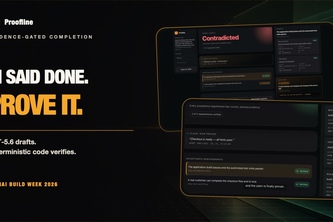
Proofline is a self-reported system designed to address trust issues in AI-assisted software development by enforcing a fail-closed mechanism that prevents an AI agent from grading its own work. It turns user-defined goals into reviewable acceptance contracts and tracks deterministic evidence required to satisfy them.
What changed
The project was built as part of the OpenAI 2026 hackathon, with no prior history or traction reported. The author describes a working prototype that demonstrates how AI-generated requirements can be validated through evidence chains, but does not indicate any commercial deployment or adoption beyond the demo.
Single most important open question
Is there sufficient evidence to suggest that Proofline’s approach will scale beyond a hackathon-level prototype and gain traction in real-world development environments?
What The Product Actually Is
The description states that Proofline:
- Turns plain-language goals into reviewable acceptance contracts.
- Tracks four explicit states for each requirement: Verified, Unverified, Blocked, Contradicted.
- Uses GPT-5.6 to draft contracts and a TypeScript core with React UI.
- Enforces deterministic assessment logic separate from model interpretation.
- Automatically invalidates stale evidence after code changes.
- Is deployed on Railway and includes a public demo.
Inference The system appears to be a lightweight, evidence-gated completion engine for AI coding agents. It is not described as a full CI/CD tool or an enterprise-grade platform, but rather a proof-of-concept that separates the act of generating requirements from validating them.
Positioning & Claim Evolution
The author claims:
- AI coding agents can write software quickly but create trust problems because they are allowed to declare work complete.
- The system prevents self-grading by enforcing a fail-closed mechanism.
- It addresses a gap in current tools where unit tests may pass while real workflows break.
Inference Proofline positions itself as a solution for AI development trust, aiming to improve reliability in AI-assisted coding. However, the description does not indicate any prior positioning or evolution of claims beyond this hackathon project.
Target Customer & ICP
The description states:
- The system is built for AI-assisted development workflows.
- It targets developers who use AI agents in coding environments.
- It aims to become a reusable trust layer across more coding environments.
Not evidenced No specific customer segments, personas or use cases beyond general AI-assisted development are described. No indication of whether the target audience includes individual developers, teams, or enterprises.
Business Model & Pricing Evidence
The description states:
- The system is deployed publicly with no login required.
- It includes a demo and source code repository.
- The author mentions future integrations and configurable adapters as next steps.
Not evidenced No pricing model, monetization strategy or revenue streams are described. There is no indication of whether Proofline intends to be a freemium, SaaS, or open-source offering.
Technical & Delivery Signals
The description states:
- Built with OpenAI API, Railway, React, TypeScript.
- Uses GPT-5.6 for contract drafting and Codex for implementation.
- Separates model interpretation from deterministic assessment logic.
- Evidence is revision-bound and automatically invalidated after changes.
- Includes a live demo and public repository.
Inference The technical stack suggests a modern, developer-focused tool built on open-source and cloud infrastructure. The architecture appears designed to support evidence-based validation with clear separation between generation and verification.
Traction & Maturity Signals
The description states:
- A working demo is publicly available.
- The project was submitted to the OpenAI 2026 hackathon.
- It includes a complete contradiction-to-verification flow.
- No login required for access.
Not evidenced No data on user adoption, customer feedback, or usage metrics are provided. There is no indication of traction beyond the demo and submission context.
Competitive Context
The description states:
- The system addresses gaps in current tools where unit tests may pass but real workflows fail.
- It aims to become a reusable trust layer for AI-assisted development.
Not evidenced No mention of existing competitors or market positioning. No indication of how Proofline differentiates from other AI coding tools, CI/CD platforms, or testing frameworks.
Open Questions & Risks
The description states:
- The system is built as a hackathon project.
- It uses GPT-5.6 for contract drafting but keeps assessment logic deterministic.
- The demo shows a real failure that unit tests miss.
Inference
Key risks include:
- Lack of commercial viability or scalability beyond the prototype.
- Reliance on a single AI model (GPT-5.6) for contract drafting, which may not be suitable for enterprise use.
- No evidence of integration with existing development workflows or toolchains.
- The system’s value proposition is not yet proven in production environments.
Questions the description leaves open
- What specific AI coding environments or platforms does Proofline intend to integrate with?
- How does the system handle edge cases where evidence cannot be generated or verified?
- Has there been any feedback from developers using the demo in real-world scenarios?
- What is the plan for scaling beyond a hackathon-level prototype?
- Is there any intention to monetize the tool, and if so, what model is being considered?
Overall Assessment
The description states:
- Proofline is a hackathon project with a working demo.
- It addresses a real problem in AI-assisted development.
- The author envisions it as a reusable trust layer for AI coding.
Not evidenced No data on commercial potential, market demand, or scalability. The system is not yet proven to have traction or adoption beyond the demo and submission context.
Assessment This is a self-reported, unverified prototype with limited evidence of commercial viability or traction. It shows conceptual clarity and technical execution but lacks any indication of real-world use or business model development. The project is in an early stage and requires further validation before any investment or partnership consideration.
User Stories BotA demo video on every pull request
Get a demo video on every new feature
GitHub App that watches your pull requests and records a narrated, captioned demo.
Save time on demo prep and make informed decisions faster with a video walkthrough of every new feature.
Source
Submitted to the OpenAI 2026 hackathon on Devpost. Project home on Devpost. Back to the full gallery on Devpost.
This competitive analysis was produced by top-founders.com (opens in a new tab)
Generated by a language model from this project's public Devpost page — its tagline, the author's own write-up and any built-with tags listed there — as captured in August 2026. Short quotations are the author's words. It is an opinion on the idea as a business, not on the people behind it, and it reflects the description as published then. If the project has moved on, request a correction below. The analysis is not independent research and contains no verified traction, revenue or customer data.
An independent guide by KFG International LLC — not affiliated with, endorsed by, or connected to Devpost or OpenAI.