

Archive position — measured, not model output
0 likes on Devpost
2,263 of the 7,850 archived projects have more likes, and 5,587 share exactly 0 — so this project's #6,125 place in the like-ranked listing is a tie-break inside that group, not a ranking.
Projects (log scale)
Likes on Devpost. ▲ marks this project's group.
Show the figures
| Likes | Projects | Share of archive |
|---|---|---|
| 0 | 5,587 | 71.2% |
| 1 | 1,758 | 22.4% |
| 2 | 284 | 3.6% |
| 3–4 | 132 | 1.7% |
| 5–9 | 75 | 1.0% |
| 10+ | 14 | 0.2% |
 User Stories BotA demo video on every pull request
Get a demo video on every new feature
GitHub App that watches your pull requests and records a narrated, captioned demo.
Save time on demo prep and make informed decisions faster with a video walkthrough of every new feature.
Executive Summary
What the company appears to be
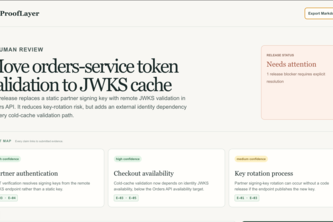
Prooflayer is a self-reported AI-assisted tool for software release decision-making. The author describes it as a single-user demo that transforms code diffs into structured, evidence-backed release briefs. It is built with client-side technologies and uses Codex and GPT-5.6 for implementation.
What changed
The project description reflects an evolution from a general AI coding assistant gap to a focused tool for trust in software releases — specifically addressing the lack of evidence-based decision-making in release workflows.
The single most important open question
Is there a real market need for a structured, evidence-backed release brief that requires human confirmation before approval? The author does not state whether this has been validated with users or teams beyond the demo.
What The Product Actually Is
The description states that Prooflayer is a tool that takes a code change (diff), context and title, and generates an output including:
- Impact map
- Risk register
- List of open unknowns
- Test plan
- Rollout/rollback checklist
Each item links to an evidence reference in a dedicated drawer. The tool exports the final brief to Markdown.
The author claims it uses Codex for scaffolding and UI flow, and GPT-5.6 for structuring the analysis (e.g., separating evidence, risk, and unknowns into distinct categories).
It is built as a single-page client-side application using Next.js 16, React 19, TypeScript, and Tailwind CSS 4.
Evidence The description states this.
Inference This is a demo tool for release decision-making that emphasizes human confirmation over AI autonomy.
Positioning & Claim Evolution
The author positions Prooflayer as addressing a gap in AI-assisted development: teams can write code faster but not faster at deciding whether to trust it. It is described as turning AI-generated diffs into court-like evidence-backed release briefs, where claims are tied to verifiable sources.
The product evolved from the idea that “AI approves, human rubber-stamps” patterns should be avoided. The tool is designed to support rather than make decisions, with a hard block on release approval until all human confirmations are checked.
Evidence The description states this.
Inference The positioning reflects a shift toward trust and verification in AI-assisted workflows, not just automation.
Target Customer & ICP
The author does not name specific customer segments or personas. However, the tool is described as targeting release owners or teams making software release decisions.
It is built for single-user demo use, but the “what’s next” section suggests future features like authenticated repository ingestion, role-based approvals, and integrations with deployment tools — indicating a move toward team-level adoption.
Evidence The description states this.
Inference The ICP likely includes software engineers or DevOps teams working in release workflows, though no explicit segmentation is provided.
Business Model & Pricing Evidence
There is no mention of pricing, monetization, or business model in the description. The tool is described as a demo with no backend or API keys required.
Evidence Not evidenced.
Inference If this evolves into a product, it may be SaaS-based, but no evidence supports this claim.
Technical & Delivery Signals
The app is built using:
- Next.js 16 (App Router)
- React 19
- TypeScript
- Tailwind CSS 4
- Client-side only (no backend or network calls)
It uses Codex for scaffolding and GPT-5.6 for structuring the analysis.
The demo is designed to run locally with npm install && npm run dev, without API keys or external dependencies.
Evidence The description states this.
Inference This suggests a lightweight, self-contained tool that prioritizes local execution and minimal infrastructure.
Traction & Maturity Signals
There is no evidence of revenue, customers, or adoption beyond the demo. The project was submitted to a hackathon (OpenAI 2026), and the author notes it’s a single-user demo with no live model calls or integrations.
Evidence Not evidenced.
Inference The tool is in early-stage development, likely pre-product-market fit.
Competitive Context
The description does not mention competitors. It does not reference existing tools for release decision-making or AI-assisted code review.
Evidence Not evidenced.
Inference This may be a niche area with limited direct competition, but no evidence supports this.
Open Questions & Risks
- Over-reliance on demo-only functionality: The tool is described as a single-user demo with no backend or live model calls.
- No validation of market need: There is no evidence that teams actually struggle with trust in release decisions or that they would adopt such a tool.
- Unproven scalability: The “what’s next” section suggests future features, but there is no indication of traction or user feedback to validate these.
- Self-reported claims only: All descriptions are author-driven and unverified.
Evidence Not evidenced.
Inference The lack of real-world use cases or customer data raises concerns about product-market fit.
Questions the description leaves open
- What specific pain points in release decision-making led to the creation of Prooflayer?
- Have you tested this with actual teams or engineers in a release workflow?
- How do you plan to validate that teams need structured evidence-backed briefs rather than just AI-generated summaries?
- What is your roadmap for moving from demo to product, and how will you monetize it?
- Are there any existing tools or workflows that this would integrate with or replace?
Overall Assessment
The description states that Prooflayer is a single-user demo built as part of a hackathon submission. No evidence exists of revenue, customers, traction, or even a clear business model.
Evidence Not evidenced.
Inference At this stage, the project appears to be an early-stage idea with no commercial viability demonstrated. It may have potential if validated by users and evolved into a product with real integrations and adoption — but as of now, it is not a viable investment or partnership opportunity based on the self-reported description alone.
User Stories BotA demo video on every pull request
Get a demo video on every new feature
GitHub App that watches your pull requests and records a narrated, captioned demo.
Save time on demo prep and make informed decisions faster with a video walkthrough of every new feature.
Source
Submitted to the OpenAI 2026 hackathon on Devpost. Project home on Devpost. Back to the full gallery on Devpost.
This competitive analysis was produced by top-founders.com (opens in a new tab)
Generated by a language model from this project's public Devpost page — its tagline, the author's own write-up and any built-with tags listed there — as captured in August 2026. Short quotations are the author's words. It is an opinion on the idea as a business, not on the people behind it, and it reflects the description as published then. If the project has moved on, request a correction below. The analysis is not independent research and contains no verified traction, revenue or customer data.
An independent guide by KFG International LLC — not affiliated with, endorsed by, or connected to Devpost or OpenAI.