

Archive position — measured, not model output
2 likes on Devpost
221 of the 7,850 archived projects have more likes, and 284 share exactly 2 — so this project's #238 place in the like-ranked listing is a tie-break inside that group, not a ranking.
Projects (log scale)
Likes on Devpost. ▲ marks this project's group.
Show the figures
| Likes | Projects | Share of archive |
|---|---|---|
| 0 | 5,587 | 71.2% |
| 1 | 1,758 | 22.4% |
| 2 | 284 | 3.6% |
| 3–4 | 132 | 1.7% |
| 5–9 | 75 | 1.0% |
| 10+ | 14 | 0.2% |
 User Stories BotA demo video on every pull request
Get a demo video on every new feature
GitHub App that watches your pull requests and records a narrated, captioned demo.
Save time on demo prep and make informed decisions faster with a video walkthrough of every new feature.
Executive Summary
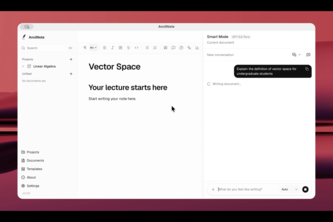
What the company appears to be: AnvilNote is a desktop-based document editor that combines a visual writing interface with AI-assisted drafting and rewriting capabilities. It supports export to PDF and DOCX formats using Typst and Microsoft Word-compatible rendering, respectively. The product is built around a local-first approach, storing user API keys securely and offering an optional "Smart Mode" AI assistant.
What changed: The project evolved from a simple note-taking tool into a structured document workflow that includes visual editing, AI-assisted writing, and multi-format export capabilities. It was submitted to the OpenAI 2026 hackathon.
Single most important open question: Does AnvilNote have any commercial traction or revenue-generating activity beyond its author's personal use?
What The Product Actually Is
The description states that AnvilNote is a desktop application built with Electron, React, Next.js, Tiptap, and Node.js. It features:
- A visual document editor using Tiptap
- Typst-based PDF rendering
- DOCX export that preserves mathematical expressions as editable content
- Smart Mode, an AI writing assistant powered by OpenAI's API
- Support for various document elements: paragraphs, headings, lists, quotations, math expressions, code blocks, and tables
- A bring-your-own-key model for API access
The product is described as a local-first tool designed to help users move from rough ideas to polished documents without requiring knowledge of markup languages like LaTeX or Typst.
Evidence: The author's own write-up describes the core functionality and technical stack. No independent verification exists.
Positioning & Claim Evolution
The description states that AnvilNote was created because the author was dissatisfied with existing note-taking tools — specifically, those that either lack polish in exports or require learning complex markup languages. It positions itself as a quieter workflow tool for lecture notes, reports, study materials, and technical documents.
It claims to offer a balance between ease-of-use and quality output by allowing users to write naturally in a visual editor and then export content as well-structured PDFs or editable Word documents.
The evolution of the positioning is described as shifting from a basic note-taking tool to a complete document workflow that includes editing, AI assistance, previewing, and multi-format export.
Evidence: The author's own account describes the initial inspiration and how the product evolved. No external validation or market positioning data provided.
Target Customer & ICP
The description states that AnvilNote targets users who write lecture notes, reports, study materials, and technical documents. It is designed for individuals seeking a calm writing environment that helps them transition from rough ideas to publishable content without choosing between convenience and quality.
It also implies a user base interested in academic or professional documentation where formatting consistency matters but learning new tools isn't desired.
Evidence: The author's own description outlines the intended use cases. No data on actual customer segments or personas provided.
Business Model & Pricing Evidence
The description states that AnvilNote uses a "bring-your-own-key" model, meaning users connect their own OpenAI API key and the desktop application stores it through a trusted system boundary instead of placing it in browser storage.
There is no mention of any pricing structure, subscription plans, or monetization strategy beyond the use of third-party APIs. No revenue streams or business model details are evident.
Evidence: The author's own write-up mentions the API key handling but does not describe any commercial model. No pricing information provided.
Technical & Delivery Signals
The description indicates that AnvilNote is built using:
- React, Next.js, Tiptap for the web editor
- Node.js and Express for the API layer
- Typst for PDF rendering
- Electron for desktop packaging
- Structured Outputs with Zod validation for AI interactions
- Separate packages for editor, API, renderer, and AI writer components
It also mentions that Smart Mode uses a provider-independent document AST, strict schema validation, prompt profiles, token estimation, and safe conversion between provider output and AnvilNote documents.
The system includes diagnostics to track missing fields in AI responses and normalization steps to handle minor inconsistencies.
Evidence: The author's own write-up describes the architecture and technical decisions. No delivery metrics or performance data available.
Traction & Maturity Signals
There is no evidence of any traction, revenue, customer base, or adoption metrics beyond what the author states. The project is described as a personal endeavor with no external validation or usage statistics.
The team size is listed as one person (Anthony Sung), and there are no mentions of users, customers, or product-market fit indicators.
Evidence: Not evidenced. No data on traction or maturity provided.
Competitive Context
The description does not provide any information about competitors or the competitive landscape. It only describes AnvilNote's own features and design choices.
No mention is made of similar tools in the market, nor how AnvilNote differentiates from them.
Evidence: Not evidenced. No competitive analysis or market positioning data provided.
Open Questions & Risks
- Lack of commercial traction: The project appears to be a solo effort with no evidence of revenue, customers, or product-market fit.
- Single-person team: With only one developer, scalability and long-term maintenance are concerns.
- Dependency on external APIs: Reliance on OpenAI's API for AI features introduces risk if pricing or availability changes.
- No monetization strategy: No clear path to revenue generation beyond API usage.
- Limited maturity: The project is described as a hackathon submission, suggesting early-stage development.
Evidence: Inferred from the lack of any commercial data, single developer team, and reliance on external services. No direct evidence of risks provided.
Questions the description leaves open
- What is your plan for monetization or revenue generation?
- How do you intend to scale beyond a single developer?
- Have you identified any target users or customers yet?
- What are the key assumptions underlying your product design and feature set?
- Are there any known limitations in terms of document compatibility or export fidelity?
- How do you plan to handle potential API rate limits or pricing changes from OpenAI?
- What is the timeline for adding new features or expanding support for additional operating systems?
Evidence: These questions are based on the self-reported nature of the project and its lack of commercial traction.
Overall Assessment
There is no evidence of any commercial activity, revenue, or customer base. The project is described as a personal endeavor submitted to a hackathon with no indication of market validation or product-market fit.
It is unclear whether this represents a viable business opportunity or simply an experimental tool.
Evidence: Not evidenced. No commercial viability or investment potential indicated in the description.
User Stories BotA demo video on every pull request
Get a demo video on every new feature
GitHub App that watches your pull requests and records a narrated, captioned demo.
Save time on demo prep and make informed decisions faster with a video walkthrough of every new feature.
Source
Submitted to the OpenAI 2026 hackathon on Devpost. Project home on Devpost. Back to the full gallery on Devpost.
This competitive analysis was produced by top-founders.com (opens in a new tab)
Generated by a language model from this project's public Devpost page — its tagline, the author's own write-up and any built-with tags listed there — as captured in August 2026. Short quotations are the author's words. It is an opinion on the idea as a business, not on the people behind it, and it reflects the description as published then. If the project has moved on, request a correction below. The analysis is not independent research and contains no verified traction, revenue or customer data.
An independent guide by KFG International LLC — not affiliated with, endorsed by, or connected to Devpost or OpenAI.