

Archive position — measured, not model output
0 likes on Devpost
2,263 of the 7,850 archived projects have more likes, and 5,587 share exactly 0 — so this project's #6,100 place in the like-ranked listing is a tie-break inside that group, not a ranking.
Projects (log scale)
Likes on Devpost. ▲ marks this project's group.
Show the figures
| Likes | Projects | Share of archive |
|---|---|---|
| 0 | 5,587 | 71.2% |
| 1 | 1,758 | 22.4% |
| 2 | 284 | 3.6% |
| 3–4 | 132 | 1.7% |
| 5–9 | 75 | 1.0% |
| 10+ | 14 | 0.2% |
 User Stories BotA demo video on every pull request
Get a demo video on every new feature
GitHub App that watches your pull requests and records a narrated, captioned demo.
Save time on demo prep and make informed decisions faster with a video walkthrough of every new feature.
Executive Summary
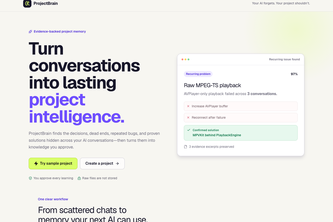
The description states that ProjectBrain is a tool for turning AI conversations into reusable project intelligence by extracting, consolidating, and preserving knowledge from chat exports. The author describes it as a personal project built with Next.js and LLMs like GPT-5.6 and Google Gemini, with support for multiple import formats and human review workflows.
What changed: The author reports building a prototype that imports various AI conversation formats (ChatGPT, Claude Code), classifies relevance locally, extracts reusable observations, and allows human review before exporting knowledge as structured files or Codex skills. It includes synthetic demos showing cross-conversation consolidation and style guide generation.
The single most important open question: Is there any evidence of actual usage, adoption, or traction beyond the author's own development work?
What The Product Actually Is
The description states that ProjectBrain:
- Imports ChatGPT exports, Claude Code session ZIP/JSONL files, generic JSON, Markdown, plain text, or pasted conversations
- Classifies relevance locally
- Extracts reusable observations in bounded batches
- Consolidates recurring issues across conversations
- Attaches source evidence to every finding
- Allows human review (accept, edit, reject, deprecate, resolve conflicts)
- Exports approved knowledge as PROJECT_BRAIN.md, PROJECT_LESSONS.md, AGENTS.md, STYLE_GUIDE.md, or repo-scoped Codex skill ZIP
The author describes it as a tool that "turns that forgotten history into reviewed, reusable project intelligence" and that "nothing becomes durable memory automatically."
Inference: Based on the description, ProjectBrain appears to be a local AI knowledge management tool for developers or content creators who want to preserve and reuse insights from AI conversations. It is not described as a SaaS product or platform with multi-tenant architecture.
Positioning & Claim Evolution
The author states:
- "Turn conversations into lasting project intelligence"
- "ProjectBrain learns from decisions, recurring problems, and best practices to help AI avoid repeated mistakes and continuously improve"
- "Important project knowledge is buried in AI conversations: decisions, failed approaches, corrections, and fixes that finally worked"
- "A new AI session rarely inherits that context, so teams repeat mistakes and spend tokens replaying history"
Inference: The positioning appears to be a developer tool for managing AI-generated knowledge and avoiding repetition. It claims to solve the problem of lost context in AI conversations by creating durable memory through structured extraction and human review.
The author's own write-up suggests this is a personal project, not a commercial product or platform with users or customers.
Target Customer & ICP
The description states:
- The tool supports import from ChatGPT exports, Claude Code session ZIP/JSONL files, generic JSON, Markdown, plain text, or pasted conversations
- It can export knowledge as PROJECT_BRAIN.md, PROJECT_LESSONS.md, AGENTS.md, STYLE_GUIDE.md, or repo-scoped Codex skill ZIP
Inference: The target customer appears to be individual developers or content creators who use AI tools like ChatGPT and Claude Code and want to preserve insights from their conversations. It is not described as targeting teams or organizations.
The author's own write-up suggests this is a personal project, not a product with defined customer segments.
Business Model & Pricing Evidence
Not evidenced.
The description does not state anything about pricing, monetization, or business model.
Technical & Delivery Signals
The description states:
- Built with Next.js, React, TypeScript, Tailwind CSS, Zod Structured Outputs, Vercel, Sentry, Better Stack, and privacy-minimized PostHog EU analytics
- Local relevance classification avoids unnecessary LLM calls
- Server-only provider adapters support OpenAI, direct Google Gemini, OpenRouter, and NVIDIA NIM with bounded inputs, output limits, timeouts, and controlled fallback
- Codex on GPT-5.6 was the primary engineering partner
- The public demo currently uses Gemini as its free-tier runtime provider
Inference: The technical stack suggests a modern web application with privacy-conscious design (e.g., EU analytics). It supports multiple LLM providers and includes structured outputs, automated tests, monitoring, uptime checks, and production QA.
Traction & Maturity Signals
Not evidenced.
The description does not state anything about revenue, customers, users, or adoption beyond the author's own development work. The project is described as a hackathon submission.
Competitive Context
Not evidenced.
The description does not mention any competitors or competitive landscape.
Open Questions & Risks
- The project is described as a personal effort by one person (Filip Bobinac)
- No evidence of revenue, customers, or traction
- The author states it's a hackathon submission
- No indication that the tool has been used beyond synthetic demos
- The lack of any commercial or user-facing elements raises questions about whether this is a prototype or a product in development
Inference: There is no evidence of market validation or commercial viability. The project appears to be an experimental prototype, not a product with traction or revenue.
Questions the description leaves open
- What is the actual usage or adoption beyond the author's own development?
- Are there any users or customers currently using ProjectBrain?
- How does the tool handle data privacy and compliance in real-world settings?
- Is there a plan to monetize this tool, and if so, what is the business model?
- What are the technical challenges that remain before it can be scaled for teams or organizations?
Overall Assessment
Not evidenced.
The description does not provide any information about funding, investment interest, or partnership opportunities. It is described as a personal project submitted to a hackathon with no indication of commercial traction or market validation.
User Stories BotA demo video on every pull request
Get a demo video on every new feature
GitHub App that watches your pull requests and records a narrated, captioned demo.
Save time on demo prep and make informed decisions faster with a video walkthrough of every new feature.
Source
Submitted to the OpenAI 2026 hackathon on Devpost. Project home on Devpost. Back to the full gallery on Devpost.
This competitive analysis was produced by top-founders.com (opens in a new tab)
Generated by a language model from this project's public Devpost page — its tagline, the author's own write-up and any built-with tags listed there — as captured in August 2026. Short quotations are the author's words. It is an opinion on the idea as a business, not on the people behind it, and it reflects the description as published then. If the project has moved on, request a correction below. The analysis is not independent research and contains no verified traction, revenue or customer data.
An independent guide by KFG International LLC — not affiliated with, endorsed by, or connected to Devpost or OpenAI.