

Archive position — measured, not model output
0 likes on Devpost
2,263 of the 7,850 archived projects have more likes, and 5,587 share exactly 0 — so this project's #6,091 place in the like-ranked listing is a tie-break inside that group, not a ranking.
Projects (log scale)
Likes on Devpost. ▲ marks this project's group.
Show the figures
| Likes | Projects | Share of archive |
|---|---|---|
| 0 | 5,587 | 71.2% |
| 1 | 1,758 | 22.4% |
| 2 | 284 | 3.6% |
| 3–4 | 132 | 1.7% |
| 5–9 | 75 | 1.0% |
| 10+ | 14 | 0.2% |
 User Stories BotA demo video on every pull request
Get a demo video on every new feature
GitHub App that watches your pull requests and records a narrated, captioned demo.
Save time on demo prep and make informed decisions faster with a video walkthrough of every new feature.
Executive Summary
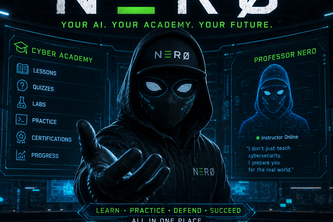
Project NERO: Adaptive AI Cyber Academy is a self-reported personal AI system built by one individual (Kim John Tuñacao) as part of a hackathon submission to the OpenAI 2026 hackathon. The author describes it as an adaptive cybersecurity learning platform embedded within a personal AI operating system, designed for beginners and independent learners.
The project is structured around specialized AI roles: Prime (communication), Forge (development), Sentinel (security), Professor NERO (teaching), and Executors (action execution). It includes a modular architecture with an emphasis on controlled change workflows and user approval processes. The core demonstration focuses on the NERO Cyber Academy, which offers interactive lessons, assessments, remediation, and progress tracking.
The author states that Project NERO was built using Python, a Steam Deck, and AI tools like ChatGPT (GPT-5.6) and Codex. It is not evidenced to have any revenue, customers, or traction beyond the author’s own development and demonstration.
Key commercial due-diligence read: The project is presented as a personal learning tool with no evidence of market adoption, product-market fit, or scalable business model. The claims about AI roles, adaptive teaching, and cybersecurity curriculum are self-reported and unverified. The single most important open question is whether the author has any plans to commercialize or scale beyond this prototype.
What The Product Actually Is
The description states that Project NERO is a personal AI system designed to combine learning, productivity, software development, and security into one unified environment. It includes:
- A modular architecture with specialized AI roles:
- Prime (communication)
- Forge (software development)
- Sentinel (security monitoring)
- Professor NERO (teaching)
- Executors (action execution)
- The NERO Cyber Academy is the core component, described as an adaptive cybersecurity learning platform for beginners.
- It uses a desktop application built on Python and a Steam Deck.
- Features include:
- Structured lessons
- Interactive assessments
- Technical explanation requirements
- Weak-topic remediation
- Reassessment workflows
- Progress tracking
- Career and portfolio planning
The system is described as having an approval-first workflow for changes, with backups, testing, and rollback options.
Inference: The system appears to be a prototype built by one person using AI tools (ChatGPT and Codex) and limited hardware. It is not evidenced to have any production or commercial use beyond the author’s personal learning and demonstration.
Positioning & Claim Evolution
The author positions Project NERO as:
- A personal AI operating system that integrates learning, productivity, and security.
- An adaptive cybersecurity academy for beginners.
- A tool designed to help learners turn knowledge into real-world skills.
- A system built to be accessible, especially for those starting with limited resources.
The project evolved from a personal idea during medical treatment into a functional desktop application. The author describes it as:
- Designed to guide users, test understanding, explain mistakes, and encourage practical application.
- Built around the needs of real learners.
- A system that supports both learning and development.
Inference: The positioning is aspirational and personal — not market-driven or validated. It reflects a single individual’s experience and goals, not a product with external validation or demand.
Target Customer & ICP
The description states that the NERO Cyber Academy is designed for:
- Beginners
- Independent learners
- Filipino learners, who may benefit from simplified English and Taglish explanations
It also mentions:
- Learners preparing for practical laboratory activities
- Those seeking career and portfolio readiness
The author notes that the system supports certification preparation, interview practice, and portfolio development.
Inference: The target customer is a self-directed beginner learner, possibly in a specific regional context (Filipino learners). No evidence of segmentation or targeting beyond this.
Business Model & Pricing Evidence
There is no evidence of a business model or pricing structure. The description states:
- The project was built as a personal learning tool
- It is not described as monetized or sold
- The author mentions future plans for school and student deployment options, but no commercial model is detailed
Inference: No commercial model is evident in the self-reported description.
Technical & Delivery Signals
The project was built using:
- Python
- Steam Deck
- Codex and ChatGPT (GPT-5.6)
- Linux, JSON, tkinter
It includes:
- Modular architecture
- Specialized AI roles
- Controlled workflows for system changes
- Assessment and remediation logic
- Progress tracking
The author states that parts of the wider NERO system are under active development.
Inference: The technical foundation is a prototype built with limited hardware and AI tools. It is not evidenced to be scalable or production-ready.
Traction & Maturity Signals
There is no evidence of traction, customers, or adoption beyond the author’s own use and demonstration.
The description states:
- The project was built during a personal challenge
- It includes a working Cyber Academy in the demo
- Some parts of the system are under active development
No data on user engagement, retention, revenue, or usage is provided.
Inference: No traction or maturity signals are evident. This is a prototype with no external validation.
Competitive Context
The description does not mention any competitors. It is unclear whether Project NERO is positioned against existing cybersecurity learning platforms or AI-powered productivity tools.
Inference: No competitive context is provided in the self-reported description.
Open Questions & Risks
- Single-person development: The system was built by one person, with no evidence of team or external support.
- No commercial model: No revenue, pricing, or monetization strategy is evident.
- Prototype-only: The project is described as a demo and prototype, not a product in production.
- Unverified claims: All features, AI roles, and functionality are self-reported without independent verification.
- Limited hardware constraints: Built on a Steam Deck, which may limit scalability or performance.
Inference: High risk of lack of traction, scalability, or commercial viability due to prototype nature and single-person development.
Questions the description leaves open
- What is the plan for scaling beyond this prototype?
- Are there any external users or pilot programs?
- How does the system differentiate from existing cybersecurity learning platforms?
- Is there a roadmap for monetization or commercial deployment?
- What are the technical limitations of the current architecture, and how will they be addressed?
- How is user feedback being collected or integrated into development?
- Are there any plans to integrate with existing LMS or enterprise systems?
- What is the long-term vision for the AI roles beyond the current prototype?
Overall Assessment
Not evidenced.
The project is described as a personal learning tool, built by one individual, and not demonstrated to have any commercial traction, revenue, or scalable business model. The claims are self-reported and unverified. There is no evidence of market demand, customer validation, or product-market fit.
Confidence level: Very low — based entirely on the author’s own account, with no external data or validation.
Assessment: Not ready for investment or partnership at this stage. It may be a promising idea in concept, but lacks any demonstrated commercial viability or traction.
User Stories BotA demo video on every pull request
Get a demo video on every new feature
GitHub App that watches your pull requests and records a narrated, captioned demo.
Save time on demo prep and make informed decisions faster with a video walkthrough of every new feature.
Source
Submitted to the OpenAI 2026 hackathon on Devpost. Project home on Devpost. Back to the full gallery on Devpost.
This competitive analysis was produced by top-founders.com (opens in a new tab)
Generated by a language model from this project's public Devpost page — its tagline, the author's own write-up and any built-with tags listed there — as captured in August 2026. Short quotations are the author's words. It is an opinion on the idea as a business, not on the people behind it, and it reflects the description as published then. If the project has moved on, request a correction below. The analysis is not independent research and contains no verified traction, revenue or customer data.
An independent guide by KFG International LLC — not affiliated with, endorsed by, or connected to Devpost or OpenAI.