

Archive position — measured, not model output
3 likes on Devpost
128 of the 7,850 archived projects have more likes, and 93 share exactly 3 — so this project's #204 place in the like-ranked listing is a tie-break inside that group, not a ranking.
Projects (log scale)
Likes on Devpost. ▲ marks this project's group.
Show the figures
| Likes | Projects | Share of archive |
|---|---|---|
| 0 | 5,587 | 71.2% |
| 1 | 1,758 | 22.4% |
| 2 | 284 | 3.6% |
| 3–4 | 132 | 1.7% |
| 5–9 | 75 | 1.0% |
| 10+ | 14 | 0.2% |
 User Stories BotA demo video on every pull request
Get a demo video on every new feature
GitHub App that watches your pull requests and records a narrated, captioned demo.
Save time on demo prep and make informed decisions faster with a video walkthrough of every new feature.
Executive Summary
The company appears to be a two-person team developing a simulated AI-powered IoT wearable healthcare system for real-time stroke risk prediction. The project is a hackathon submission that demonstrates integration of sensor simulation, cloud storage (ThingSpeak), machine learning analysis, and Telegram alerts — all within a self-reported prototype framework.
The author states the system uses simulated sensor data to predict stroke risk and send alerts via Telegram. No actual revenue, customers, or real-world deployment are evidenced. The project is described as a working prototype with no commercial traction.
The single most important open question
Is there any evidence that this system will function in real-world conditions with actual hardware sensors, or whether it has moved beyond the simulation stage?
What The Product Actually Is
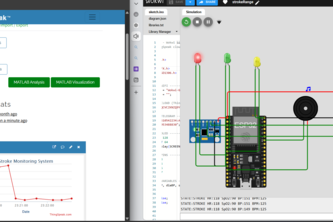
The description states that STROKE PREDICTICN is an AI-powered IoT wearable healthcare system designed for real-time stroke risk prediction. It uses:
- Simulated sensor data (Heart Rate, SpO₂, motion activity) via Wokwi platform
- Cloud-based storage and visualization through ThingSpeak
- Machine learning models to analyze health parameters and estimate stroke risk
- Telegram alerts to notify caregivers during emergencies
The system is described as a smart healthcare ecosystem that combines IoT, cloud computing, machine learning, and communication technologies.
Inference The product is not a commercial offering but a prototype demonstration, built for a hackathon. It does not include real hardware sensors or live patient monitoring.
Positioning & Claim Evolution
The author positions the system as a preventive healthcare solution that moves beyond reactive treatment to early warning of stroke risk.
Claims made:
- The system is designed to predict stroke risk before critical conditions occur
- It supports continuous monitoring and emergency alerts
- It integrates AI, IoT, and cloud technologies into one ecosystem
- It aims to reduce delayed medical response, which leads to severe consequences
Inference The positioning reflects a healthcare innovation narrative, focused on early detection and remote care. However, the description does not indicate any real-world testing or adoption.
Target Customer & ICP
The author states that the system is designed for:
- Patients at risk of stroke
- Caregivers or healthcare providers who need real-time alerts
- A remote monitoring use case
No specific customer segments, personas, or market targeting are detailed. The description does not indicate whether the system targets individuals, hospitals, clinics, or insurance providers.
Inference The ICP is likely healthcare professionals or caregivers, but no evidence of target customer validation or segmentation exists.
Business Model & Pricing Evidence
No business model or pricing information is provided in the description. The author does not state how the system would be monetized, whether it would be sold to end-users, healthcare institutions, or via subscription.
Inference There is no evidence of a commercial business model, and no pricing structure, licensing terms, or revenue streams are mentioned.
Technical & Delivery Signals
The project was built using:
- Wokwi for sensor simulation
- ThingSpeak for cloud data storage and visualization
- Telegram API for alerts
- C++ for embedded development (ESP32)
- Machine learning models for stroke risk prediction
The system is described as a working prototype, but no details are given about:
- Scalability of the ML model
- Data privacy or security measures
- Integration with real sensors or hardware
- System reliability or performance metrics
Inference The technical stack is hackathon-grade, using simulation and open-source platforms. No evidence of production-ready delivery or scalability.
Traction & Maturity Signals
The description states that the system:
- Is a working prototype
- Was built for a hackathon (OpenAI 2026)
- Demonstrates integration of multiple technologies
- Has been successfully demonstrated in a simulated environment
There is no evidence of real-world adoption, customer feedback, or product-market fit. No revenue, ARR, or user base are mentioned.
Inference The system is at the prototype stage, with no commercial traction or market validation.
Competitive Context
No competitive landscape is described in the project write-up. The author does not reference existing stroke prediction tools, wearable health systems, or IoT healthcare platforms.
Inference No evidence of awareness or positioning relative to competitors exists. The system appears to be independent of any known market context.
Open Questions & Risks
- Prototype-only: The system is described as a simulation-based prototype with no real-world deployment.
- No real sensors: The use of simulated data raises questions about validity and generalizability.
- No commercial model: No evidence of how the product would be monetized or sold.
- Limited team size: Only two members, which may limit execution capacity.
- Unverified claims: All claims are self-reported without third-party validation.
Inference The project is highly speculative, with no demonstrated path to commercialization or real-world impact.
Questions the description leaves open
- Has the system been tested with actual wearable hardware sensors?
- What is the accuracy of the machine learning model, and how was it trained?
- How does the system handle false positives in stroke risk prediction?
- Are there any plans to integrate with real healthcare systems or providers?
- What is the roadmap for moving from prototype to a scalable product?
- Is there any interest from healthcare institutions or patients in piloting this?
Overall Assessment
Not evidenced — The description does not provide sufficient information to assess commercial viability, traction, or investment potential.
The system is described as a hackathon prototype, with no evidence of:
- Real-world deployment
- Revenue or customer base
- Scalable business model
- Technical robustness beyond simulation
Inference This is a preliminary concept, not a product ready for investment or partnership. Any commercial potential remains speculative.
User Stories BotA demo video on every pull request
Get a demo video on every new feature
GitHub App that watches your pull requests and records a narrated, captioned demo.
Save time on demo prep and make informed decisions faster with a video walkthrough of every new feature.
Source
Submitted to the OpenAI 2026 hackathon on Devpost. Project home on Devpost. Back to the full gallery on Devpost.
This competitive analysis was produced by top-founders.com (opens in a new tab)
Generated by a language model from this project's public Devpost page — its tagline, the author's own write-up and any built-with tags listed there — as captured in August 2026. Short quotations are the author's words. It is an opinion on the idea as a business, not on the people behind it, and it reflects the description as published then. If the project has moved on, request a correction below. The analysis is not independent research and contains no verified traction, revenue or customer data.
An independent guide by KFG International LLC — not affiliated with, endorsed by, or connected to Devpost or OpenAI.