

Archive position — measured, not model output
0 likes on Devpost
2,263 of the 7,850 archived projects have more likes, and 5,587 share exactly 0 — so this project's #6,093 place in the like-ranked listing is a tie-break inside that group, not a ranking.
Projects (log scale)
Likes on Devpost. ▲ marks this project's group.
Show the figures
| Likes | Projects | Share of archive |
|---|---|---|
| 0 | 5,587 | 71.2% |
| 1 | 1,758 | 22.4% |
| 2 | 284 | 3.6% |
| 3–4 | 132 | 1.7% |
| 5–9 | 75 | 1.0% |
| 10+ | 14 | 0.2% |
 User Stories BotA demo video on every pull request
Get a demo video on every new feature
GitHub App that watches your pull requests and records a narrated, captioned demo.
Save time on demo prep and make informed decisions faster with a video walkthrough of every new feature.
Executive Summary
What the company appears to be
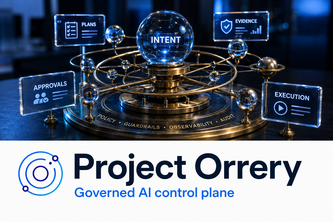
Project Orrery is a self-reported control-plane prototype for AI-enabled work that aims to govern autonomous AI systems through structured workflows, role separation, and evidence-based decision-making. It is described as a local-first system built with Python and codex/GPT-5.6, intended to allow AI agents to perform tasks while remaining accountable, observable, and under human authority.
What changed
The author states that Project Orrery emerged from a question about accountability in AI systems — specifically, who is responsible when AI performs organizational work. The project evolved from a collection of prompts into a working prototype with distinct workflow stages (planning, building, review, validation, approval) and an interface designed for operational control rather than chatbot interaction.
The single most important open question
Is there evidence that the system can scale beyond a local prototype to support real enterprise workflows, or does it remain a proof-of-concept with limited practical utility?
What The Product Actually Is
The description states that Project Orrery is a local-first control-plane prototype built using Python and tools like codex and GPT-5.6. It represents work as governed state, not unstructured conversation, and treats planning, execution, review, evidence collection, approvals, and reporting as structured workflow components.
It is described as an operational console, not a chatbot, emphasizing visibility into roles, workflow transitions, findings, approvals, and operator attention. The system enforces separation of responsibilities — for example, planners do not approve their own plans, and builders do not validate their own work.
The architecture is intended to be model- and tool-agnostic, allowing future integration of different AI systems based on capability, cost, privacy, or policy considerations.
Inference The product appears to be a workflow engine for AI-assisted tasks that prioritizes governance over automation speed. It is not a general-purpose AI assistant but a system for managing AI work within defined boundaries.
Positioning & Claim Evolution
The author positions Project Orrery as a control plane for AI-enabled work, inspired by mechanical orreries that model planetary systems. The core idea is to enable AI to do more work while remaining subordinate to explicit governance and human authority.
The project evolved from an initial question — “Who is accountable when AI begins performing real organizational work?” — into a prototype that demonstrates governed workflows across planning, building, review, validation, and operator approval.
It claims to address the gap between AI capability and organizational accountability, suggesting that current AI tools lack sufficient oversight mechanisms for enterprise use.
Inference The positioning is focused on governance and control in AI systems. It does not claim to be a general-purpose AI tool or platform but rather a framework for managing AI work within defined roles and controls.
Target Customer & ICP
The description states that the project was inspired by cybersecurity, governance, and enterprise technology environments. The author identifies a need in organizations adopting AI assistants, agents, and automation systems where accountability and control are paramount.
It is implied that the target audience includes enterprise users, especially those managing risk-sensitive or high-stakes work involving AI.
There is no explicit mention of specific industries, roles, or organizational sizes. The focus is on governance and accountability, not on a particular customer segment.
Inference The ICP likely includes enterprise teams responsible for cybersecurity, compliance, risk management, or governance — those who require structured control over AI-assisted work.
Business Model & Pricing Evidence
There is no evidence of a business model or pricing structure in the description. The project is described as a local-first prototype, not a commercial product.
The author does not state whether the system will be offered as SaaS, open-source, or another delivery method. There is no mention of monetization, licensing, or customer acquisition strategies.
Inference No business model or pricing evidence is provided. The project remains in prototype form and has no commercial traction or revenue data.
Technical & Delivery Signals
The system was built as a local-first control-plane prototype, using Python and browser-based interface. It uses tools like codex and GPT-5.6, though the exact model versions are not specified.
It is described as model- and tool-agnostic, with an architecture designed to support future integration of different AI systems based on capability or policy.
The interface is described as an operational console rather than a chatbot, emphasizing workflow state, role separation, and evidence collection.
There is no mention of scalability, deployment infrastructure, or cloud-native capabilities beyond the prototype stage.
Inference The technical approach is experimental and focused on control and governance. It lacks evidence of production-ready architecture or enterprise-scale delivery.
Traction & Maturity Signals
The project is described as a working local-first prototype, but there is no evidence of customer adoption, revenue, or usage metrics.
It was submitted to the OpenAI 2026 hackathon, suggesting it is in early development. There is no mention of funding, partnerships, or product-market fit.
The author notes that the system has evolved from a collection of prompts into a working prototype, but no evidence of iterative improvements, user feedback, or real-world testing is provided.
Inference The project is at an early stage with no demonstrated traction. It remains a prototype and lacks evidence of maturity or commercial viability.
Competitive Context
The description does not mention any direct competitors or similar products in the market. It is unclear whether Project Orrery is positioned against other AI workflow tools, governance platforms, or automation systems.
It appears to address a gap in AI governance and accountability, which may overlap with areas such as:
- AI governance platforms
- Workflow automation tools
- Enterprise AI control planes
However, no explicit competitive analysis or differentiation is provided.
Inference No competitive context is evident. The project does not appear to be part of an existing market landscape, nor is it positioned against known competitors.
Open Questions & Risks
- Prototype-only status: The system exists only as a local-first prototype with no evidence of real-world deployment or scalability.
- No commercial traction: There is no evidence of revenue, customers, or product-market fit.
- Unproven scalability: The architecture is described as model- and tool-agnostic, but there is no evidence that it can scale beyond a local prototype.
- Lack of business model clarity: No indication of how the system will be monetized or delivered to users.
- No user feedback or testing: No mention of real-world use cases, user testing, or iterative improvements.
Inference The project is in early development and lacks commercial viability or enterprise readiness. Risks include lack of traction, scalability issues, and unclear path to market.
Questions the description leaves open
- What specific workflows or use cases have you tested the prototype on?
- How does the system handle edge cases where AI agents get stuck in loops or fail to make progress?
- What are your plans for integrating with existing enterprise systems (e.g., source control, cloud platforms)?
- How do you plan to scale beyond a local prototype to support real operational workloads?
- Are there any known limitations of the current architecture that would prevent it from being used in production environments?
- What is the intended delivery model — open-source, SaaS, or another approach?
- Have you considered how the system will handle multi-tenant environments or cross-organizational workflows?
Overall Assessment
The project is described as a local-first prototype with no evidence of commercial traction, revenue, or customer adoption. It is positioned as a control plane for AI work that emphasizes governance and accountability.
There is no evidence of a business model, funding, or product-market fit. The system remains in early development and has not been tested in real-world enterprise environments.
Inference At this stage, the project is not suitable for investment or partnership consideration. It lacks the maturity, traction, or commercial clarity required to justify further due diligence or financial commitment.
User Stories BotA demo video on every pull request
Get a demo video on every new feature
GitHub App that watches your pull requests and records a narrated, captioned demo.
Save time on demo prep and make informed decisions faster with a video walkthrough of every new feature.
Source
Submitted to the OpenAI 2026 hackathon on Devpost. Project home on Devpost. Back to the full gallery on Devpost.
This competitive analysis was produced by top-founders.com (opens in a new tab)
Generated by a language model from this project's public Devpost page — its tagline, the author's own write-up and any built-with tags listed there — as captured in August 2026. Short quotations are the author's words. It is an opinion on the idea as a business, not on the people behind it, and it reflects the description as published then. If the project has moved on, request a correction below. The analysis is not independent research and contains no verified traction, revenue or customer data.
An independent guide by KFG International LLC — not affiliated with, endorsed by, or connected to Devpost or OpenAI.