

Archive position — measured, not model output
1 like on Devpost
505 of the 7,850 archived projects have more likes, and 1,758 share exactly 1 — so this project's #2,169 place in the like-ranked listing is a tie-break inside that group, not a ranking.
Projects (log scale)
Likes on Devpost. ▲ marks this project's group.
Show the figures
| Likes | Projects | Share of archive |
|---|---|---|
| 0 | 5,587 | 71.2% |
| 1 | 1,758 | 22.4% |
| 2 | 284 | 3.6% |
| 3–4 | 132 | 1.7% |
| 5–9 | 75 | 1.0% |
| 10+ | 14 | 0.2% |
 User Stories BotA demo video on every pull request
Get a demo video on every new feature
GitHub App that watches your pull requests and records a narrated, captioned demo.
Save time on demo prep and make informed decisions faster with a video walkthrough of every new feature.
Executive Summary
What the company appears to be
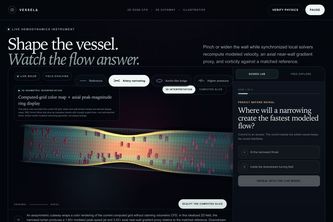
VesselDelta is a self-reported educational tool built as a browser-based instrument that visualizes blood vessel mechanics using live computational fluid dynamics (CFD) and a simplified wall stress model. It allows users to manipulate vessel geometry and observe real-time changes in flow behavior, pressure, and wall stress — all without requiring an account or server-side computation.
What changed
The author states they built VesselDelta to improve understanding of blood vessel mechanics beyond static illustrations by enabling interactive exploration of how changes in shape, pressure, and wall thickness affect fluid dynamics and mechanical stress. The project was submitted to the OpenAI 2026 hackathon.
Single most important open question — the commercial due-diligence read
Is there any evidence that VesselDelta has moved beyond a personal or academic prototype into a product with traction, revenue, or adoption? The description contains no data on users, usage, monetization, or market interest beyond its own self-report.
What The Product Actually Is
The description states:
- VesselDelta is a live vessel mechanics instrument that runs in a browser.
- It uses an original client-side D2Q9 BGK lattice-Boltzmann flow solver written in JavaScript.
- It includes a 3D cutaway visualization using Three.js, with red-cell tracers and editable vessel geometry.
- It features a separate wall stress lab using a thin-wall relation equation: circumferential stress = pressure × radius ÷ wall thickness.
- The interface allows users to choose four simple stories (narrowing, bulging, raising pressure, exploring pathways) and includes a guided tour and “Try it yourself” mode.
- It does not use server-side computation or require an account.
Inference The product is a browser-based educational simulation that combines computational modeling with interactive 3D visualization to teach concepts in hemodynamics.
Positioning & Claim Evolution
The description states:
- VesselDelta aims to make blood vessel mechanics understandable without medical background.
- It was built to address the static, misleading representations of blood vessels seen in textbooks and media.
- The author claims it is not clinical CFD, a medical device, or a treatment selector — but an educational instrument.
- It uses GPT-5.6 and Codex for engineering support and adversarial testing.
Inference The positioning evolved from a personal project to a tool that attempts to bridge the gap between complex medical concepts and public understanding through interactive simulation.
Target Customer & ICP
The description states:
- The target audience is people without a medical background who want to understand blood vessel mechanics.
- It is designed for educational use, including classroom or public testing.
- No specific customer segments or personas are named.
Inference The primary ICP appears to be students, educators, and general public interested in health literacy — though no evidence of actual users or adoption exists.
Business Model & Pricing Evidence
The description states:
- VesselDelta is an educational instrument.
- It does not require an account or server-side computation.
- No pricing model, monetization strategy, or revenue streams are mentioned.
- The author notes that any patient-specific or diagnostic version would require a different model and clinical validation.
Inference There is no evidence of a business model or pricing structure beyond the self-reported educational purpose.
Technical & Delivery Signals
The description states:
- Built with canvas-2D, Cloudflare Workers, Codex, GPT-5.6, lattice-Boltzmann, React, Three.js, TypeScript, Vinext, WebGL.
- Uses a D2Q9 BGK lattice-Boltzmann solver in JavaScript.
- Implements pull streaming, halfway bounce-back rigid walls, Zou-He boundaries, and parabolic velocity inlet.
- Includes 26 automated numerical and rendered checks, lint gates, dependency audits, and benchmarking.
- The entire system runs client-side with no server or API dependencies.
Inference The technical stack suggests a lightweight, client-side simulation built for accessibility and performance in the browser, with strong engineering rigor evident from testing and verification.
Traction & Maturity Signals
The description states:
- VesselDelta was submitted to the OpenAI 2026 hackathon.
- It includes a guided tour, interactive controls, and a “Try it yourself” mode.
- No evidence of user base, customer acquisition, or product adoption is provided.
Inference There is no evidence of traction, revenue, or user engagement beyond the author's own development and submission to a hackathon.
Competitive Context
The description states:
- The author initially claimed that browser-based blood-flow tools barely existed.
- They later revised this claim after discovering prior art.
- VesselDelta is described as a complete instrument combining direct vessel sculpting, live counterfactual CFD, and a separate wall lab.
Inference The competitive landscape includes other educational or visualization tools, but no specific competitors are named or analyzed in the description.
Open Questions & Risks
- The product is described as an educational prototype with no clinical validation or physician review.
- It is not a medical device or diagnostic tool, but it may be misused if not clearly labeled as such.
- No evidence of monetization, user base, or market traction exists.
- The author is a single individual (1-person team), which raises questions about scalability and long-term development.
Inference The main risk is that VesselDelta may not have evolved beyond a prototype, lacks commercial viability, and could be misinterpreted as clinical advice if not clearly demarcated.
Questions the description leaves open
- What specific educational or public health use cases are you targeting?
- Have you conducted any classroom or public testing yet?
- Are there plans to expand beyond the current scope (e.g., into clinical CFD, diagnostics, or mobile)?
- How do you plan to validate the accuracy of the simulations for educational purposes?
- What is your roadmap for scaling beyond a single-person development effort?
Overall Assessment
The description states:
- VesselDelta is an educational instrument with no revenue, customers, or traction.
- It was submitted as a hackathon project and has not been validated in real-world use.
- The author is a solo developer with no team or funding mentioned.
Inference There is no evidence of commercial viability, market traction, or investment-ready potential. The product remains in an early-stage prototype phase with no clear path to monetization or adoption beyond its own self-reporting.
User Stories BotA demo video on every pull request
Get a demo video on every new feature
GitHub App that watches your pull requests and records a narrated, captioned demo.
Save time on demo prep and make informed decisions faster with a video walkthrough of every new feature.
Source
Submitted to the OpenAI 2026 hackathon on Devpost. Project home on Devpost. Back to the full gallery on Devpost.
This competitive analysis was produced by top-founders.com (opens in a new tab)
Generated by a language model from this project's public Devpost page — its tagline, the author's own write-up and any built-with tags listed there — as captured in August 2026. Short quotations are the author's words. It is an opinion on the idea as a business, not on the people behind it, and it reflects the description as published then. If the project has moved on, request a correction below. The analysis is not independent research and contains no verified traction, revenue or customer data.
An independent guide by KFG International LLC — not affiliated with, endorsed by, or connected to Devpost or OpenAI.