

Archive position — measured, not model output
0 likes on Devpost
2,263 of the 7,850 archived projects have more likes, and 5,587 share exactly 0 — so this project's #4,132 place in the like-ranked listing is a tie-break inside that group, not a ranking.
Projects (log scale)
Likes on Devpost. ▲ marks this project's group.
Show the figures
| Likes | Projects | Share of archive |
|---|---|---|
| 0 | 5,587 | 71.2% |
| 1 | 1,758 | 22.4% |
| 2 | 284 | 3.6% |
| 3–4 | 132 | 1.7% |
| 5–9 | 75 | 1.0% |
| 10+ | 14 | 0.2% |
 User Stories BotA demo video on every pull request
Get a demo video on every new feature
GitHub App that watches your pull requests and records a narrated, captioned demo.
Save time on demo prep and make informed decisions faster with a video walkthrough of every new feature.
Executive Summary
What the company appears to be
FlakeFix is a self-verifying agent designed to detect, diagnose, fix, and rerun flaky pytest tests in software engineering environments. It operates as a closed-loop system that ensures fixes are proven before being reported as complete.
What changed
The project description indicates this is a hackathon submission (OpenAI 2026) with a team of three members. It represents a tool built to address the specific problem of flaky tests in CI/CD pipelines, particularly focusing on ensuring that fixes are actually verified rather than just claimed.
Single most important open question
Does FlakeFix demonstrate sufficient commercial viability or traction to warrant further due-diligence attention, or is it a proof-of-concept with limited market relevance?
What The Product Actually Is
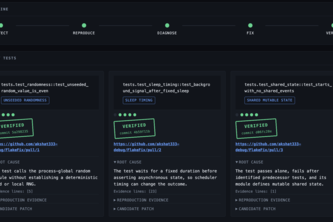
The description states that FlakeFix is "a closed-loop agent for exactly one bug class: flaky pytest tests." It performs the following actions:
- Detects flaky tests by running suites repeatedly with shuffled ordering
- Reproduces flake by isolating problematic tests and identifying polluting dependencies
- Diagnoses root causes into five categories (unseeded randomness, live clock, shared mutable state, fixed sleep timing, ambient filesystem state)
- Generates minimal, category-specific patches
- Verifies fixes in disposable git worktrees before committing and optionally opening PRs
The tool is described as operating on local paths or GitHub repositories, using a combination of deterministic static rules and OpenAI-backed models for diagnosis. It avoids touching the original working tree and uses git worktrees for verification.
Evidence Self-reported by authors; no external validation provided.
Positioning & Claim Evolution
The description claims FlakeFix is built to avoid "another AI code assistant that writes a plausible-looking fix" and instead focuses on proving its work through observation — never reporting success unless it has watched the fix pass twice in isolation.
It positions itself as a tool that "literally cannot claim success unless it has watched the fix pass, twice, in isolation."
Inference The positioning reflects an attempt to differentiate from typical AI code assistants by emphasizing verifiability and honesty over superficial fixes.
Evidence Self-reported by authors; no third-party claims or comparisons provided.
Target Customer & ICP
The description does not explicitly state target customers or ideal customer profiles (ICP). However, it implies that FlakeFix is aimed at software engineering teams working with pytest-based test suites and CI/CD pipelines.
It targets developers who deal with flaky tests in their development workflow and seek tools to automate detection and resolution while maintaining trust in the test suite.
Inference The tool likely appeals to engineering teams using Python, pytest, and GitHub for continuous integration.
Evidence Self-reported by authors; no explicit customer segmentation or persona data provided.
Business Model & Pricing Evidence
There is no evidence of a business model or pricing structure in the description. The project appears to be a hackathon submission without any indication of monetization plans or commercial intent beyond its demonstration.
Evidence Not evidenced.
Technical & Delivery Signals
The tool uses:
- Git worktrees for safe verification
- JUnit XML parsing for test result analysis
- OpenAI API integration (optional)
- Static rule-based diagnosis fallback
- Deterministic shuffling of tests for detection
- Real-time dashboards and command-line interface (
flakefix fix <repo>)
It claims to support:
- Detection via repeated test runs with shuffled ordering
- Reproduction by probing preceding tests
- Diagnosis with categorization into five classes
- Fix generation using minimal, category-specific patches
- Verification in isolated environments (git worktrees)
- PR creation via GitHub CLI
Evidence Self-reported by authors; no external validation or performance metrics provided.
Traction & Maturity Signals
There is no evidence of traction, revenue, customers, or adoption beyond the hackathon submission. The project has not demonstrated real-world usage or impact outside of internal testing and a negative result against a large repository (Delgan/loguru).
The authors note that it found zero flaky tests in Delgan/loguru — which they interpret as a success, not a failure.
Evidence Not evidenced.
Competitive Context
The description does not mention competitors or existing solutions. It implies that FlakeFix avoids the common pattern of "AI code assistants" that write plausible-looking fixes without verification.
It positions itself as distinct from typical AI tools by focusing on verifiability and honesty rather than just automation.
Inference The tool likely competes with general-purpose AI coding assistants, but no specific competitive landscape is described.
Evidence Not evidenced.
Open Questions & Risks
- Lack of commercial viability: No evidence of revenue, customers, or business model.
- Limited scope: Focuses only on one type of bug (pytest flaky tests) and one framework (pytest).
- Hackathon origin: The project is a hackathon submission with no indication of long-term development or productization.
- No external validation: All claims are self-reported; there is no independent verification or user feedback.
- Potential overengineering: The closed-loop system may be overly complex for its intended use case.
Evidence Self-reported by authors; no third-party data or market signals provided.
Questions the description leaves open
- What is the intended commercialization path for FlakeFix?
- Are there any plans to expand beyond pytest and Python?
- How do you plan to scale this from a hackathon prototype into a product?
- Have you identified any early adopters or use cases outside of the hackathon context?
- Is there any interest from enterprise customers or open-source projects in adopting this tool?
- What are the technical limitations or scalability concerns with the current implementation?
Overall Assessment
Based on the self-reported description, FlakeFix is a hackathon project that demonstrates a focused solution to a specific engineering problem (flaky tests). It does not show evidence of traction, revenue, or commercial viability.
The tool's emphasis on honesty and verifiability is notable but does not yet indicate a scalable business model or market demand.
Assessment Not ready for investment or partnership consideration at this stage. Further development, traction, and clarity around commercial intent are required before assessing potential value.
User Stories BotA demo video on every pull request
Get a demo video on every new feature
GitHub App that watches your pull requests and records a narrated, captioned demo.
Save time on demo prep and make informed decisions faster with a video walkthrough of every new feature.
Source
Submitted to the OpenAI 2026 hackathon on Devpost. Project home on Devpost. Back to the full gallery on Devpost.
This competitive analysis was produced by top-founders.com (opens in a new tab)
Generated by a language model from this project's public Devpost page — its tagline, the author's own write-up and any built-with tags listed there — as captured in August 2026. Short quotations are the author's words. It is an opinion on the idea as a business, not on the people behind it, and it reflects the description as published then. If the project has moved on, request a correction below. The analysis is not independent research and contains no verified traction, revenue or customer data.
An independent guide by KFG International LLC — not affiliated with, endorsed by, or connected to Devpost or OpenAI.