

Archive position — measured, not model output
0 likes on Devpost
2,263 of the 7,850 archived projects have more likes, and 5,587 share exactly 0 — so this project's #4,134 place in the like-ranked listing is a tie-break inside that group, not a ranking.
Projects (log scale)
Likes on Devpost. ▲ marks this project's group.
Show the figures
| Likes | Projects | Share of archive |
|---|---|---|
| 0 | 5,587 | 71.2% |
| 1 | 1,758 | 22.4% |
| 2 | 284 | 3.6% |
| 3–4 | 132 | 1.7% |
| 5–9 | 75 | 1.0% |
| 10+ | 14 | 0.2% |
 User Stories BotA demo video on every pull request
Get a demo video on every new feature
GitHub App that watches your pull requests and records a narrated, captioned demo.
Save time on demo prep and make informed decisions faster with a video walkthrough of every new feature.
Executive Summary
What the company appears to be
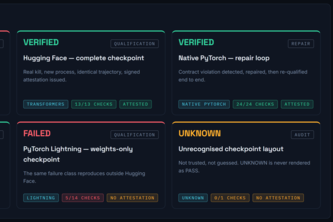
FlashPilot is a self-reported tool for testing ML training checkpoint recovery. The author states it stops training processes on purpose, compares resumed runs against control runs with zero numerical tolerance, and uses GPT-5.6 to diagnose failures. It claims to verify checkpoint integrity across different frameworks (e.g., Hugging Face, PyTorch Lightning) and offers storage savings (74% fewer recurring bytes in demo). The tool is built as a single-person project using AI-assisted development.
What changed
The project was submitted to the OpenAI 2026 hackathon. It emerged from research into SSD durability and ML checkpoint failures, with an aim to test whether resumed training actually reproduces results exactly.
Single most important open question
Is there any evidence of real-world usage or integration by ML practitioners or teams using PyTorch, Hugging Face or similar frameworks? The description states the tool works in a sandbox and can be demonstrated via browser, but does not indicate adoption or production use.
What The Product Actually Is
The description states that FlashPilot is a tool designed to test checkpoint recovery in machine learning training. It stops training processes intentionally ("kills your training"), resumes them in a new process, and compares the resumed run against an uninterrupted control run with zero tolerance (atol=0.0). It uses 24 deterministic checks for verification.
It claims to use GPT-5.6 for diagnosis of failures, but only after filtering evidence through guardrails — GPT never sees which failure was injected directly. The system also includes a "Recovery Gate" that enforces exact equality post-restart and is claimed to generalize across frameworks like Hugging Face and Lightning.
The tool is described as being built in one Codex thread over six days, with full integration of components including deterministic CPU workload, atomic checkpoint protocol, crash orchestration, and packaging. It supports FSDP, DeepSpeed, and other ML infrastructure paths.
Inference This appears to be a proof-of-concept or prototype tool for testing ML training reproducibility, not a commercial product yet.
Positioning & Claim Evolution
The author positions FlashPilot as a solution to a specific problem in ML: that most tools only test whether a checkpoint is "loadable", but not whether it's truly resumable. The project evolved from research into SSD durability and GitHub issues about silent failures during resume.
It claims to be the first tool that actually tests checkpoint recovery with zero tolerance, and that GPT-5.6 can help diagnose failures in a controlled way without seeing the injected failure directly.
Inference The positioning is narrow — focused on reproducibility testing for ML training checkpoints — rather than broader infrastructure or optimization tools. It’s framed as solving a niche but critical issue in ML engineering.
Target Customer & ICP
The description implies that FlashPilot targets ML practitioners, especially those using PyTorch, Hugging Face, Lightning, and related frameworks. The author mentions support for FSDP, DeepSpeed, and other tools used in large-scale training.
It is not clear if the tool is aimed at individual developers or teams managing distributed training pipelines.
Inference The ICP likely includes ML engineers working on large models or long-running training jobs where checkpoint integrity is critical. However, no evidence of customer interviews, use cases or feedback from users is provided.
Business Model & Pricing Evidence
Not evidenced.
The description does not mention any pricing model, monetization strategy, or business model. It is presented as a hackathon submission and prototype tool.
Technical & Delivery Signals
The author states that FlashPilot was built in one Codex thread over six days. It includes:
- Deterministic CPU workload
- Atomic checkpoint protocol
- Crash orchestration
- Recovery Gate with 24 checks at zero tolerance
- GPT-5.6 integration with typed schemas and guardrails
- Support for Hugging Face, Lightning, FSDP, DeepSpeed
- Browser sandbox demo
It also claims to support spot instance certification, public adapter contracts, and checkpoint conversion verification in future.
Inference The tool is technically sophisticated for a hackathon project, but lacks production-grade delivery signals (e.g., CI/CD, versioning, documentation beyond the GitHub repo).
Traction & Maturity Signals
Not evidenced.
There is no mention of users, customers, or adoption. The demo runs in a browser sandbox and can be recomputed by users, but there is no evidence of real-world usage or integration into ML pipelines.
Competitive Context
The description does not reference any direct competitors. It implies that current tools only test "loadability", not resumability, suggesting a gap in the market for checkpoint verification tools.
Inference There may be a niche for such tools, but no evidence of existing solutions or competitive landscape is provided.
Open Questions & Risks
- Unverified claims: The description makes strong technical claims (e.g., 24/24 deterministic checks, zero tolerance) without independent verification.
- Single-person project: The team size is listed as one, raising questions about scalability and long-term maintenance.
- No production use or adoption: No evidence of real-world usage or integration into ML workflows.
- GPT-5.6 dependency: The tool relies on a specific model version (GPT-5.6) that may not be available or stable in production.
- Limited scope: The tool is focused only on checkpoint recovery and does not appear to address broader ML infrastructure issues.
Questions the description leaves open
- What real-world training scenarios have you tested this with? Can you show evidence of failures being caught?
- How does FlashPilot handle edge cases like distributed training across multiple GPUs or nodes?
- Are there any known limitations in how it interacts with different checkpoint formats (e.g., PyTorch, Hugging Face)?
- What is the current maturity level of the tool? Is it ready for production use or still experimental?
- How do you plan to scale beyond a single-person development model?
Overall Assessment
Not evidenced.
There is no indication of funding, valuation, or investment interest in FlashPilot. The project is described as a hackathon submission and prototype with no commercial traction or business development signals. It may be a promising idea for a tool that could be built into a product, but there is no evidence yet of market demand or commercial viability.
User Stories BotA demo video on every pull request
Get a demo video on every new feature
GitHub App that watches your pull requests and records a narrated, captioned demo.
Save time on demo prep and make informed decisions faster with a video walkthrough of every new feature.
Source
Submitted to the OpenAI 2026 hackathon on Devpost. Project home on Devpost. Back to the full gallery on Devpost.
This competitive analysis was produced by top-founders.com (opens in a new tab)
Generated by a language model from this project's public Devpost page — its tagline, the author's own write-up and any built-with tags listed there — as captured in August 2026. Short quotations are the author's words. It is an opinion on the idea as a business, not on the people behind it, and it reflects the description as published then. If the project has moved on, request a correction below. The analysis is not independent research and contains no verified traction, revenue or customer data.
An independent guide by KFG International LLC — not affiliated with, endorsed by, or connected to Devpost or OpenAI.