

Archive position — measured, not model output
0 likes on Devpost
2,263 of the 7,850 archived projects have more likes, and 5,587 share exactly 0 — so this project's #6,097 place in the like-ranked listing is a tie-break inside that group, not a ranking.
Projects (log scale)
Likes on Devpost. ▲ marks this project's group.
Show the figures
| Likes | Projects | Share of archive |
|---|---|---|
| 0 | 5,587 | 71.2% |
| 1 | 1,758 | 22.4% |
| 2 | 284 | 3.6% |
| 3–4 | 132 | 1.7% |
| 5–9 | 75 | 1.0% |
| 10+ | 14 | 0.2% |
 User Stories BotA demo video on every pull request
Get a demo video on every new feature
GitHub App that watches your pull requests and records a narrated, captioned demo.
Save time on demo prep and make informed decisions faster with a video walkthrough of every new feature.
Executive Summary
What the company appears to be
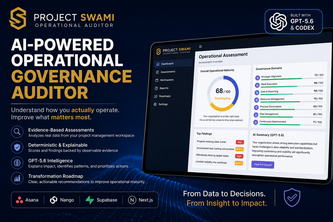
Project Swami Operational Auditor is a self-reported AI-powered platform that evaluates operational governance in project management workspaces (e.g., Asana, ClickUp, Jira, Monday.com). It claims to analyze observable evidence within these platforms to score operational maturity and generate transformation roadmaps. The product is built using Next.js, React, Supabase, OpenAI GPT-5.6, and integrates with project management tools via OAuth.
What changed
The author states that the original idea was an AI assistant for project management but evolved into a governance assessment tool focused on operational maturity. This shift reflects a move from feature duplication to addressing a perceived gap in how organizations assess their own execution capabilities.
Single most important open question — the commercial due-diligence read
Is there any evidence of real-world usage, customer feedback, or traction that supports the author’s claims about operational governance gaps and demand for such an assessment tool?
What The Product Actually Is
The description states:
- Project Swami Operational Auditor is an AI-powered operational governance assessment platform.
- It connects to project management workspaces (e.g., Asana, ClickUp, Jira, Monday.com).
- It evaluates operational maturity using the “Project Swami Operational Governance Framework” (PSOGF).
- It applies deterministic governance rules and scores key domains.
- It uses GPT-5.6 to explain business impact and generate executive recommendations.
- It produces an Operational Assessment Report and Transformation Roadmap.
Inference The product appears to be a SaaS platform that assesses how well project management tools are being used in practice, based on data within those platforms, rather than relying on interviews or surveys. It is designed for internal organizational use by consultants or leaders seeking insights into operational health.
Not evidenced
- Whether the platform actually integrates with any of the mentioned tools.
- Whether it has been tested or deployed in real environments.
- What specific metrics or scoring logic are used under PSOGF.
- How the deterministic rules and GPT-5.6 interact in practice.
Positioning & Claim Evolution
The description states:
- The original idea was an AI project management assistant, similar to existing tools like Asana or ClickUp.
- The author shifted focus to operational governance — evaluating whether a workspace supports reliable execution, reporting, decision-making, and scale.
- The key positioning is that it evaluates how organizations actually work, not how they believe they work.
Inference This suggests a move from a general-purpose AI assistant toward a niche solution for operational maturity auditing. It positions itself as a tool for leaders who want to understand the reliability of their project management systems and identify risks or improvements.
Not evidenced
- No evidence of prior product versions or user feedback.
- No indication of how this differs from existing governance tools or frameworks.
- No mention of any pilot customers or early adopters.
Target Customer & ICP
The description states:
- The author has experience helping organizations improve project management practices.
- It is aimed at companies that invest heavily in project management platforms but struggle with consistency, reliability, and leadership confidence in reporting.
- It supports the work of operational consultants who want to accelerate evidence collection and analysis.
Inference The primary target appears to be mid-to-large enterprises using project management tools like Asana, ClickUp, Jira, or Monday.com. These are likely internal teams or consultants looking for objective assessments of their own operations.
Not evidenced
- No specific customer personas or segments defined.
- No evidence of actual customers or use cases beyond the author’s personal experience.
- No indication of pricing models or whether it targets external clients or internal teams.
Business Model & Pricing Evidence
The description states:
- It is described as a SaaS product built with Next.js, React, Supabase, and Vercel.
- The author mentions building the product around three components: PSOGF, PSOM, PSAE.
- It includes integrations with multiple platforms (Asana, ClickUp, Jira, Monday.com).
- Future plans include consultant collaboration features and executive reporting.
Inference The business model likely involves a SaaS subscription or licensing model for access to the assessment engine and transformation roadmaps. The inclusion of integrations suggests it may be sold as a platform for teams or consultants.
Not evidenced
- No pricing information.
- No evidence of revenue streams, monetization strategy, or customer acquisition plans.
- No indication of whether it targets individual users or enterprise clients.
Technical & Delivery Signals
The description states:
- Built with Next.js, React, TypeScript, Tailwind CSS, Supabase, Nango, Vercel, OpenAI GPT-5.6.
- Uses deterministic logic for scoring and GPT-5.6 for interpretation.
- Integrates via OAuth and supports multi-tenant access controls.
- Developed through defined milestones with testing and review at each stage.
Inference The technical stack indicates a modern web application built on open-source and cloud infrastructure, with some AI integration. The separation of deterministic logic from GPT interpretation suggests an attempt to balance explainability with interpretability.
Not evidenced
- No evidence of actual deployment or live functionality.
- No information about scalability, performance, or security testing.
- No details on how the data normalization and rule application are implemented.
- No mention of API availability or developer access.
Traction & Maturity Signals
The description states:
- The author has spent years helping organizations improve project management practices.
- It was built during a hackathon (OpenAI 2026).
- Milestone-based development and testing were used.
- Future plans include expanding integrations, adding more governance domains, and enabling continuous monitoring.
Inference The product is in early development stage, likely pre-launch. The author’s background supports credibility but does not indicate traction or adoption.
Not evidenced
- No revenue data, customer base, or usage metrics.
- No evidence of user feedback or pilot programs.
- No indication of any beta users or early adopters.
- No mention of product-market fit or market validation.
Competitive Context
The description states:
- Platforms like Asana, ClickUp, Jira, and Monday.com already offer AI summaries, reporting, and task support.
- The author’s shift was toward operational governance rather than general AI assistance.
- No direct competitors are named.
Inference There is no clear competitor identified in the description. However, the space of project management analytics or governance tools is likely crowded with indirect substitutes (e.g., internal audit tools, consulting firms, or platform-native reporting features).
Not evidenced
- No competitive landscape analysis.
- No evidence of existing solutions addressing operational maturity in project workspaces.
- No indication of pricing or positioning relative to competitors.
Open Questions & Risks
The description states:
- The author built the product alone (team size: 0).
- It is a hackathon submission.
- There is no mention of any revenue, customers, or traction.
- GPT-5.6 is used for interpretation only; not for scoring.
Inference
Key risks include:
- Lack of team, resources, and validation.
- No evidence of real-world usage or product-market fit.
- Heavy reliance on AI interpretation without clear demonstration of its value.
- Unclear path to monetization or customer acquisition.
Open questions
- The product is described as a hackathon project with no commercial traction.
- No mention of any business model, pricing, or go-to-market strategy.
- The author’s experience is personal and not validated by third parties.
Questions the description leaves open
- What specific operational governance gaps have you observed in real-world settings?
- How do you plan to validate the accuracy of your deterministic rules and scoring logic?
- Have you tested the product with any actual users or organizations?
- What is your go-to-market strategy for reaching target customers (e.g., consultants, internal teams)?
- How will you ensure data privacy and multi-tenant security in a SaaS environment?
- What are the key assumptions behind your PSOGF framework, and how were they validated?
- Are there any existing partnerships or integrations with project management platforms?
- How do you plan to scale beyond the current hackathon prototype?
Overall Assessment
The description states:
- The product is a self-reported hackathon submission.
- It is built by one person (team size: 0).
- No evidence of revenue, customers, or traction.
- It is positioned as a tool for operational governance in project management workspaces.
Inference This is an early-stage idea with no demonstrated commercial viability. The author’s background suggests capability, but there is no evidence of product-market fit, customer demand, or sustainable business model.
Assessment Not ready for investment or partnership at this stage. Requires significant development, validation, and traction before any meaningful due-diligence evaluation can occur.
User Stories BotA demo video on every pull request
Get a demo video on every new feature
GitHub App that watches your pull requests and records a narrated, captioned demo.
Save time on demo prep and make informed decisions faster with a video walkthrough of every new feature.
Source
Submitted to the OpenAI 2026 hackathon on Devpost. Project home on Devpost. Back to the full gallery on Devpost.
This competitive analysis was produced by top-founders.com (opens in a new tab)
Generated by a language model from this project's public Devpost page — its tagline, the author's own write-up and any built-with tags listed there — as captured in August 2026. Short quotations are the author's words. It is an opinion on the idea as a business, not on the people behind it, and it reflects the description as published then. If the project has moved on, request a correction below. The analysis is not independent research and contains no verified traction, revenue or customer data.
An independent guide by KFG International LLC — not affiliated with, endorsed by, or connected to Devpost or OpenAI.