

Archive position — measured, not model output
0 likes on Devpost
2,263 of the 7,850 archived projects have more likes, and 5,587 share exactly 0 — so this project's #4,133 place in the like-ranked listing is a tie-break inside that group, not a ranking.
Projects (log scale)
Likes on Devpost. ▲ marks this project's group.
Show the figures
| Likes | Projects | Share of archive |
|---|---|---|
| 0 | 5,587 | 71.2% |
| 1 | 1,758 | 22.4% |
| 2 | 284 | 3.6% |
| 3–4 | 132 | 1.7% |
| 5–9 | 75 | 1.0% |
| 10+ | 14 | 0.2% |
 User Stories BotA demo video on every pull request
Get a demo video on every new feature
GitHub App that watches your pull requests and records a narrated, captioned demo.
Save time on demo prep and make informed decisions faster with a video walkthrough of every new feature.
Executive Summary
What the company appears to be
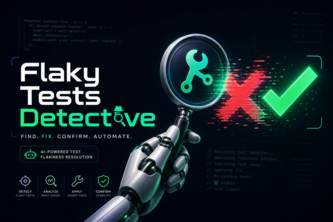
Flaky Tests Detective is a self-reported tool that automates the process of identifying, reproducing, classifying, fixing, and submitting pull requests for flaky tests in Python-based CI environments (specifically pytest). It uses targeted perturbations to force failure conditions, applies an LLM for diagnosis, and enforces deterministic validation before opening PRs.
What changed
The project is a self-contained hackathon submission that describes a proof-of-concept pipeline. No commercial product or traction has been reported beyond the author’s own account.
Single most important open question
Is there any evidence of real-world usage, adoption, or integration into CI/CD systems? The description does not indicate whether this tool is being used in production by teams or if it has moved beyond a prototype.
Note: This analysis is based entirely on the self-reported and unverified project description provided by the author. No external data, revenue figures, customer names, or traction metrics are available.
What The Product Actually Is
The description states that Flaky Tests Detective:
- Runs failing pytest tests through a five-stage pipeline: ingest → reproduce → classify → fix → PR.
- Reproduces flake deterministically using targeted perturbations (e.g., thread scheduling jitter, frozen clock, randomized test order).
- Identifies classic flake classes such as race conditions, time dependencies, shared state, and order dependency.
- Writes minimal, cause-specific patches using an LLM (via OpenAI’s Responses API) that are validated in code before being applied.
- Opens a pull request with a plain-language explanation and evidence table.
Inference: The tool is designed to reduce manual debugging time for CI flaky tests by automating diagnosis and fix generation. It is not described as a general-purpose test automation platform but rather a specific solution for one class of CI issues.
Positioning & Claim Evolution
The author claims:
- Flaky tests are a "special kind of misery" due to their unpredictable nature.
- The tool automates the entire red→green arc from CI failure to reviewed PR.
- It uses “perturbation as both forcing function and diagnosis.”
- The system avoids blind reliance on LLMs by enforcing strict schema validation and empirical checks.
Claim vs Fact: These are self-reported claims about intent, design philosophy, and problem-solving approach. There is no evidence of actual deployment or user feedback.
Target Customer & ICP
The description does not name specific customers or personas. However, it implies:
- Teams using Python-based CI systems (especially pytest).
- Developers or DevOps engineers who encounter flaky tests regularly.
- Organizations with CI/CD pipelines that include automated testing and GitHub Actions workflows.
Inference: The target audience is likely small to mid-sized engineering teams working in Python environments where test flakiness causes friction. No segmentation or customer data are provided.
Business Model & Pricing Evidence
Not evidenced.
Note: There is no mention of pricing, monetization strategy, or business model in the description.
Technical & Delivery Signals
The description states:
- Built with codex, Python, and uv.
- Uses a five-stage pipeline involving subprocess isolation, sitecustomize.py shims, and LLM integration.
- Perturbations are injected via trace hooks and pytest plugins.
- Validation is done through deterministic re-runs under the same perturbation conditions.
- The system includes structured JSON schema enforcement for LLM outputs.
Inference: The tool demonstrates technical sophistication in handling subprocess isolation, Python import mechanisms, and LLM integration within a controlled validation loop. However, it remains a prototype with no evidence of scalability or production readiness.
Traction & Maturity Signals
Not evidenced.
Note: No data on usage, adoption, or performance metrics are included. The project is described as a hackathon submission with no indication of real-world deployment or user feedback.
Competitive Context
Not evidenced.
Note: There is no mention of competitors or existing tools in the space. The author does not reference similar solutions or market positioning.
Open Questions & Risks
- Prototype-only status: The tool is described as a hackathon submission with no evidence of production use.
- LLM dependency: While bounded by schema and validation, the system still relies on an LLM for diagnosis — a potential point of failure if not properly controlled.
- Limited scope: It only addresses specific flake types (race condition, time dependency, shared state, order) and does not generalize beyond those patterns.
- No integration details: No mention of how it integrates with CI platforms like GitHub Actions or GitLab CI.
- Lack of feedback loop: No indication that the tool learns from past fixes or improves over time.
Inference: The tool is technically interesting but lacks commercial viability or traction signals. It may be a useful internal tool for one developer, but there’s no evidence it scales or solves a widespread problem.
Questions the description leaves open
- Has this been tested in real CI environments? What was the outcome?
- Are there any known edge cases where the perturbation strategy fails?
- How does the tool handle complex test suites with many interdependencies?
- Is there a plan to support more flake classes or other languages beyond Python?
- Have you considered how this would work in enterprise settings (e.g., authentication, permissions)?
- What is the expected latency between CI failure and PR creation?
- How do you ensure that the generated patches don’t introduce new bugs?
Overall Assessment
Not evidenced.
Note: No financials, funding history, or strategic alignment data are available. The project is a self-reported hackathon submission with no indication of commercial potential or investor interest. It may be a useful internal tool but lacks signs of broader market traction or scalability.
User Stories BotA demo video on every pull request
Get a demo video on every new feature
GitHub App that watches your pull requests and records a narrated, captioned demo.
Save time on demo prep and make informed decisions faster with a video walkthrough of every new feature.
Source
Submitted to the OpenAI 2026 hackathon on Devpost. Project home on Devpost. Back to the full gallery on Devpost.
This competitive analysis was produced by top-founders.com (opens in a new tab)
Generated by a language model from this project's public Devpost page — its tagline, the author's own write-up and any built-with tags listed there — as captured in August 2026. Short quotations are the author's words. It is an opinion on the idea as a business, not on the people behind it, and it reflects the description as published then. If the project has moved on, request a correction below. The analysis is not independent research and contains no verified traction, revenue or customer data.
An independent guide by KFG International LLC — not affiliated with, endorsed by, or connected to Devpost or OpenAI.